
The Critical Role of Soldering Gun Replacement Tips in 2026
Transformer-based soldering guns remain the undisputed heavyweights for high-thermal-mass applications in 2026. Whether you are sweating 1/2-inch copper plumbing joints, soldering 10 AWG automotive harnesses, or assembling stained glass foils, a 100W to 500W soldering gun delivers the instant, massive heat transfer that standard pencil irons simply cannot match. However, this extreme thermal output comes at a cost: rapid degradation of the heating element's interface—the replacement tip.
Unlike temperature-controlled soldering stations that use iron-clad tips and closed-loop thermocouples, traditional soldering guns rely on exposed copper loops or massive solid-copper screw-in chisels. With the industry-wide mandate of RoHS-compliant lead-free solders (such as SAC305), tip pitting and tin-leaching have accelerated drastically. Choosing the right soldering gun replacement tips is no longer just about physical fitment; it is an exercise in metallurgical compatibility, thermal recovery management, and application-specific geometry.
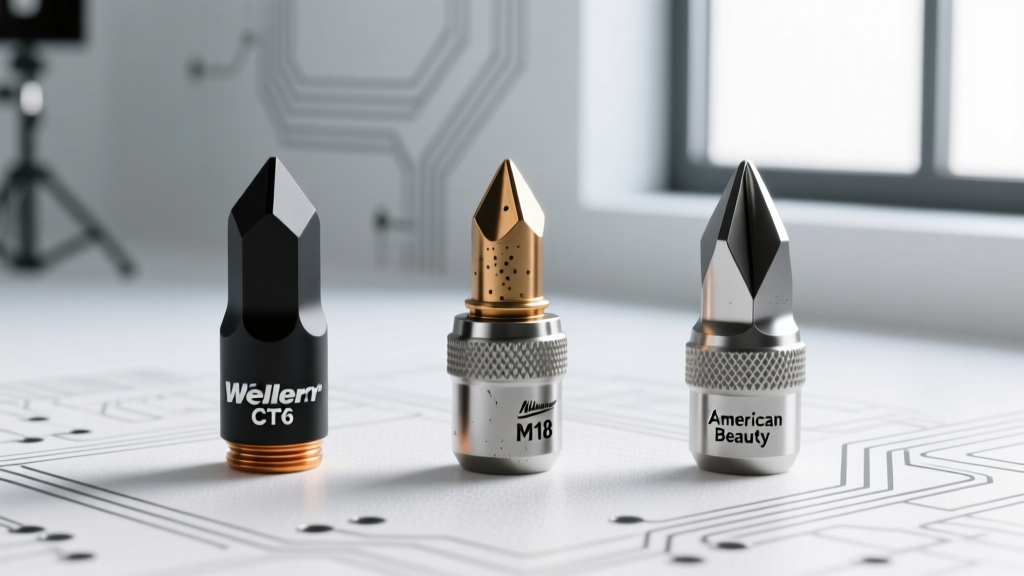
In this comprehensive comparison, we evaluate the top replacement tips across the three dominant soldering gun ecosystems: the classic Weller CT6 series, the modern Milwaukee M18 cordless platform, and the heavy-duty American Beauty plumbing guns.
Comparison Matrix: Top Soldering Gun Replacement Tips
The following table breaks down the exact specifications, current 2026 market pricing, and ideal use cases for the most popular replacement tips on the market.
| Brand / Model | SKU / Part Number | Material & Geometry | Avg. Price (2026) | Best Application | Pitting Resistance |
|---|---|---|---|---|---|
| Weller | CT6F7 (1/16-inch Loop) | Pure Copper Loop | $9.99 (2-pack) | Stained glass, heavy wire | Low (with Lead-Free) |
| Weller | CT6C7 (3/32-inch Loop) | Pure Copper Loop | $9.99 (2-pack) | Automotive harnesses | Low (with Lead-Free) |
| Milwaukee | 48-40-0010 (Chisel) | Iron-Clad / Ceramic | $24.99 (1-pack) | Field electrical, M18 Gun | High |
| American Beauty | 1188 (1/4-inch Chisel) | Solid Copper Screw-In | $38.50 (1-pack) | Plumbing, roofing, heavy ground planes | Medium |
| Wahl Iso-Tip | 4270 (Screw-In Chisel) | Copper / Iron Plated | $12.50 (1-pack) | Rechargeable cordless guns | Medium-High |
Deep Dive: Weller CT6 Series (The Copper Standard)
The Weller D550 and 9600 series soldering guns have been industry staples for over half a century. These guns use a step-down transformer where the secondary winding is a single turn of heavy copper tubing, terminating in the CT6-series loop tips.
The Metallurgy of the Loop Tip
The CT6F7 (1/16-inch) and CT6C7 (3/32-inch) are manufactured from high-purity, oxygen-free copper. Copper offers unparalleled thermal conductivity (approximately 398 W/m·K), allowing the tip to transfer the gun's massive 260W surge directly into the workpiece. However, pure copper is highly susceptible to tin dissolution (leaching). When exposed to molten tin-based solder, the copper literally dissolves into the alloy, causing the loop to thin, pit, and eventually snap.
According to the IPC J-STD-001 standards for soldered electrical assemblies, maintaining proper tip wetting is critical to prevent dry joints. For pure copper gun tips, this requires aggressive and immediate re-tinning after every cycle to create a protective barrier against oxidation and leaching.
Pro Tip for 2026: If you are still using Sn63/Pb37 (leaded solder) for non-RoHS applications like vintage amplifier repair or classic car restoration, a single Weller CT6F7 loop can last for hundreds of joints. If you have transitioned to SAC305 lead-free solder, expect to replace your CT6 loops 3x to 4x more frequently due to the higher melting point (217°C vs 183°C) and the aggressive tin content.
Deep Dive: Milwaukee M18 Cordless Soldering Gun
The Milwaukee M18 Soldering Gun (Model 2867-20) disrupted the market by eliminating the heavy transformer and wall-tether, utilizing a high-efficiency ceramic heating element powered by a lithium-ion battery. Because it does not use a transformer loop, it requires proprietary chisel-style replacement tips, most notably the 48-40-0010.
Iron-Clad Durability vs. Thermal Mass
Unlike the bare copper Weller loops, the Milwaukee 48-40-0010 features an iron-clad plating over a copper core. This iron layer acts as a sacrificial shield against tin leaching, drastically extending the tip's lifespan even when using aggressive, no-clean, lead-free fluxes. The trade-off is a slight reduction in instantaneous thermal transfer compared to bare copper, though Milwaukee's active temperature profiling compensates for this by driving the ceramic heater harder during thermal drops.
- Compatibility: Strictly limited to Milwaukee 2867-20 and newer M18 revisions.
- Failure Mode: The primary failure mode is not pitting, but rather flux carbonization. Because the M18 gun maintains high heat continuously until triggered off, rosin-based fluxes will bake onto the iron cladding, creating a thermal insulator that mimics a 'cold tip'.
- Maintenance: Requires regular wiping on a damp cellulose sponge or brass wire cleaner to remove carbon buildup without scratching the iron plating.
Deep Dive: American Beauty Heavy-Duty Plumbing Tips
When electrical work transitions into plumbing, roofing, or heavy-duty ground plane soldering, the American Beauty line of 100W to 500W soldering guns takes over. These tools use massive, solid-copper screw-in tips. The Model 1188 (1/4-inch chisel) is the gold standard for sweating copper pipes and bonding heavy braided grounding straps.
The Screw-In Connection: Torque and Threading
The most common point of failure for American Beauty guns is not the tip itself, but the internal brass threading of the gun's secondary winding. Technicians frequently use pliers to tighten the screw-in replacement tips, leading to stripped threads and catastrophic tool failure.
Installation Rule: Screw-in soldering gun replacement tips must be tightened by hand, followed by exactly a 1/8th to 1/4th turn with a wrench. The electrical contact relies on surface area mating and thermal expansion during heating, not extreme mechanical torque. Over-tightening will gall the brass threads, making future tip removal impossible without destroying the gun's transformer output.
Failure Modes: Why Your Gun Tips Pit, Oxidize, and Fail
Understanding why soldering gun replacement tips fail is the first step in optimizing your consumable budget. Based on metallurgical guidelines outlined in NASA-STD-8739.3 (Requirements for Soldered Electrical and Electronic Assemblies), tip degradation generally falls into three categories:
- Oxidation (CuO Formation): When a bare copper tip is heated to 400°C+ in the presence of atmospheric oxygen, a layer of black copper oxide forms instantly. Solder will not wet to copper oxide. If a technician leaves a soldering gun triggered 'on' while resting on a stand, the tip will oxidize and become useless within minutes.
- Tin Leaching (Dissolution): As mentioned, the tin in the solder alloy dissolves the copper tip. This creates microscopic craters (pitting) on the working face of the tip, leading to uneven heat distribution and jagged solder joints.
- Flux Corrosion: Water-soluble (OA) fluxes are highly acidic at soldering temperatures. If left on the tip or allowed to vaporize and condense on the tip's shank, they will chemically etch the copper, weakening the structural integrity of thin loop tips.
Step-by-Step Replacement & Tinning Protocol
To maximize the lifespan of your soldering gun replacement tips, follow this strict operational protocol. This methodology is standard practice for high-reliability aerospace and automotive electrical assembly.
Step 1: Cold Installation
Never attempt to remove or install a soldering gun tip while the tool is warm. Thermal expansion alters the thread pitch and loop tension. Ensure the gun is unplugged and at ambient room temperature. For loop tips (Weller CT6), ensure the copper legs are fully seated into the terminal blocks before tightening the set screws. For screw-in tips (American Beauty), apply a microscopic dab of high-temperature anti-seize to the threads to prevent galvanic corrosion and seizing.
Step 2: The Pre-Tin Sequence
The moment the tip begins to heat (within the first 3 to 5 seconds of pulling the trigger), apply rosin-core solder directly to the working face. Do not wait for the gun to reach full operating temperature. The goal is to melt the solder and coat the copper before the copper reaches the temperature required to react with atmospheric oxygen.
Step 3: Operational Maintenance
Keep a pool of molten solder on the tip's working face while soldering. This 'solder blob' acts as a thermal bridge to the workpiece and a physical shield against oxygen. When moving between joints, do not wipe the tip completely clean; leave a protective coat of solder that you will wipe off only immediately before making the next connection.
Step 4: Proper Shutdown
When finishing your work, apply a heavy, generous layer of fresh solder to the tip before releasing the trigger and allowing the gun to cool. This sacrificial layer of solder will oxidize instead of the copper tip. The next time you power on the gun, simply wipe away the oxidized sacrificial solder and apply fresh solder for a perfectly wetted, highly conductive working surface.
Frequently Asked Questions (FAQ)
Can I bend a Weller CT6 loop tip to fit a tight space?
While pure copper is malleable, bending a CT6 loop tip alters its electrical resistance and creates stress fractures at the bend radius. When the high-amperage secondary current passes through the stressed metal, it will create a localized hot spot, causing the tip to melt or snap at the bend. It is always recommended to purchase the correct geometry (such as the angled CT6A7) rather than modifying a straight loop.
Are third-party 'compatible' copper loops worth the cost savings?
Generic, unbranded replacement loops often use lower-purity copper with higher oxygen content. This results in faster oxidation rates and increased brittleness. For professional applications where joint reliability is critical (such as automotive or aviation wiring), the $4 savings per pair is not worth the risk of a cold solder joint or a snapped tip inside a wire harness. Stick to OEM Weller or verified American Beauty replacements.
Why does my Milwaukee M18 tip turn black even when I tin it?
If an iron-clad tip turns black and refuses to wet, it is likely suffering from carbonized flux buildup or microscopic abrasion to the iron plating. Never use a file, sandpaper, or a steel wire brush on an iron-clad tip. Use only a damp cellulose sponge or a soft brass wool cleaner, and re-tin immediately with a flux-cored solder to draw out the carbon impurities.
For more detailed specifications on tool maintenance and electrical assembly standards, technicians should regularly consult the Milwaukee Tool official product documentation and manufacturer technical bulletins.