
The Enduring Legacy of the Ungar Soldering Iron
While the modern electronics workbench in 2026 is dominated by lightweight, switch-mode power supply (SMPS) soldering stations, the legendary Ungar 9400 series remains a highly sought-after workhorse for heavy-duty thermal applications. Originally an independent powerhouse before being acquired and absorbed into the Weller brand (now under Apex Tool Group), Ungar engineered soldering tools with a focus on raw thermal inertia and analog reliability. For technicians working with massive ground planes, RF shielding, and thick-gauge wiring, the Ungar 9400A and its associated 9080/9090 handpieces offer a thermal mass profile that many modern ceramic-core stations struggle to replicate without active preheating.
This deep dive explores the engineering physics, common failure modes, and restoration techniques for the Ungar soldering iron ecosystem, proving why vintage analog gear still holds a permanent spot on high-reliability repair benches.
The Physics of the Ungar 9400 Series Transformer
Modern stations like the Hakko FX-951 or JBC CD-2BQE rely on high-frequency SMPS circuits to rapidly pulse power to low-mass ceramic heaters. The Ungar 9400 series takes the exact opposite approach. The base station houses a massive, iron-core laminated transformer that weighs nearly 8 pounds. This transformer steps down the mains AC voltage to a safer, isolated low-voltage AC output (typically around 24V AC) to feed the heating element.
The advantage of this heavy iron-core design is the complete absence of high-frequency switching noise, which can sometimes interfere with highly sensitive, unshielded RF prototypes. Furthermore, the analog dial control utilizes a robust wire-wound or heavy carbon-track potentiometer paired with a TRIAC phase-angle controller. This allows for infinite, stepless voltage adjustment to the heater, giving the operator a tactile, immediate response when dialing in temperatures between 350°F and 850°F.
Handpiece Anatomy: The 9080 and 9090 Ecosystem
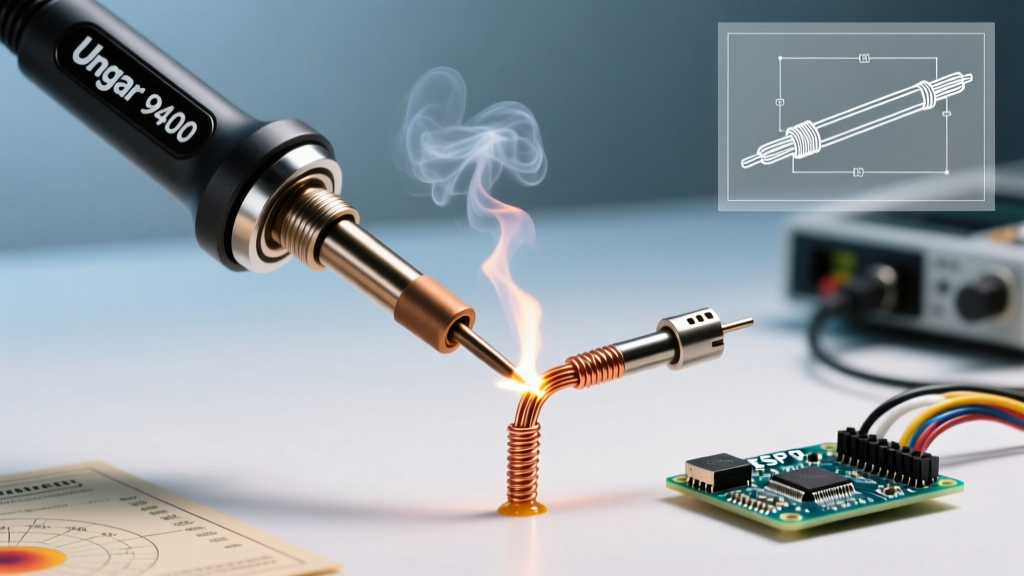
The Ungar 9080 (standard) and 9090 (heavy-duty) handpieces are marvels of mid-century industrial design. Unlike modern composite grips, these irons feature a grounded stainless steel barrel, a high-temperature silicone sleeve, and a massive nichrome-wound heating element.
Critical Failure Mode: Mica Degradation and Ground Faults
The most common failure point in a vintage Ungar handpiece is the degradation of the mica insulation. The nichrome heater coil is wound around a ceramic bobbin and wrapped in layers of natural mica to electrically isolate it from the grounded steel barrel. Over decades of thermal cycling, the mica can become brittle, flake, or absorb conductive flux residues.
If the heater coil shifts and makes contact with the steel barrel, it creates a ground fault. While the 24V AC output is isolated and rarely poses a lethal shock hazard, this short will immediately trip the GFCI breaker on your workbench or blow the internal station fuse. To diagnose this, disconnect the handpiece and use a multimeter (such as a Fluke 87V) set to the Megohm range. Measure between the heater pins and the grounded barrel; any reading below 10 Megohms indicates compromised mica insulation requiring a complete heater core replacement.
Thermal Mass Matrix: Ungar vs. Modern Ceramic Cores
When soldering heavy copper pours, the thermal recovery rate of the tip is paramount. The Ungar 9000-series tips are machined from solid copper and electroplated with thick iron, giving them vastly superior thermal mass compared to modern equivalents.
| Tip Model / Series | Thermal Mass (J/°C) | Recovery Time (to 700°F) | Best Application |
|---|---|---|---|
| Ungar 9218 (1/8' Chisel) | High (approx 4.5) | < 3 Seconds | AWG 12-14 wire, heavy ground planes |
| Hakko T18-D24 | Medium (approx 2.1) | ~ 6 Seconds | General purpose through-hole |
| Weller ET Series | Medium-Low (approx 1.8) | ~ 8 Seconds | Standard PCB through-hole |
| JBC C245-945 | Low (approx 0.9) | < 2 Seconds (Active) | SMD, precision micro-soldering |
Note: Recovery times assume a 10mm draw on a 2oz copper pour at a 700°F set point. Ungar's sheer thermal mass acts as a mechanical battery, dumping stored heat into the joint faster than the sensor can even register the temperature drop.
Restoring the 9400A Base Station in 2026
Finding a New Old Stock (NOS) Ungar 9400A is rare and commands a premium (often $200-$300 on secondary markets). However, restoring a used 'scratchy' unit is straightforward and highly rewarding. The most common complaint is a dial that causes the iron to stutter or arc internally.
Expert Warning: Never use standard contact cleaner on the Ungar dial potentiometer. The carbon track requires specialized lubrication to prevent physical wear from the wiper pin.
Step-by-Step Dial Restoration
- Discharge and Disassemble: Unplug the station and wait 5 minutes. Remove the four rear panel screws and slide off the heavy steel chassis.
- Access the Potentiometer: Locate the dial potentiometer mounted to the front panel. Disconnect the spade terminals (take a photo first for wiring reference).
- Apply DeoxIT D5: Spray a small amount of DeoxIT D5 into the access port of the potentiometer. Rotate the dial from minimum to maximum 50 times to break up carbon oxidation.
- Lubricate with Faderlube: Once the electrical contact is clean, apply DeoxIT F5 Faderlube. This restores the viscous damping required to protect the carbon track from the physical wear of the wiper.
- Tighten Transformer Bolts: The 60Hz laminated core transformer will 'hum' loudly over time as the mounting bolts vibrate loose. Torque the four mounting bolts to 15 in-lbs and apply a drop of blue Loctite to eliminate acoustic resonance.
High-Reliability and Heavy-Gauge Applications
Why keep an Ungar on the bench when digital stations offer precise PID temperature control? The answer lies in high-reliability aerospace and military soldering standards. According to the workmanship requirements outlined in NASA-STD-8739.3 for soldered electrical connections, maintaining adequate thermal dwell without cold-welding or burning the flux requires precise thermal mass management. When terminating AWG 10 wire to a massive brass lug, a low-mass digital iron will drop below the solder's liquidus temperature (typically 183°C for Sn63/Pb37 or 217°C for SAC305), resulting in a dull, disturbed, or cold solder joint.
The Ungar 9218 tip, driven by the 9400A's raw transformer power, acts as a thermal bulldozer. It does not rely on a fast-reacting thermocouple to tell the CPU to turn on the heater; instead, the physical mass of the copper tip simply absorbs the heat sink effect of the heavy wire, keeping the joint above liquidus long enough for the flux to activate and the solder to wet the metallization perfectly.
While Apex Tool Group and the Weller brand have rightfully shifted their commercial focus to digital, ESD-safe, and SMPS-driven stations for modern micro-SMD assembly, the DNA of the Ungar line remains the benchmark for heavy thermal transfer.
Frequently Asked Questions
Are Ungar 9000 series tips still manufactured?
Original Ungar-branded tips are largely discontinued. However, because the Ungar 9000 series shares physical dimensions with the classic Weller SP series and certain Thermaltronics heavy-duty lines, you can source compatible high-mass copper/iron-plated tips from third-party manufacturers specializing in legacy industrial tooling. Always verify the thread pitch of the set screw (typically 4-40) to ensure a secure fit without stripping the handpiece barrel.
Can I use a modern digital station for AWG 12 wire?
You can, but it requires active preheating. If you attempt to solder AWG 12 to a ground plane using a standard 60W digital iron without a bottom-side preheater, the copper will wick the heat away faster than the ceramic element can replenish it. The Ungar 9400 series bypasses this issue entirely through sheer tip mass, making it superior for unheated, heavy-gauge bench work.
How do I prevent the tip set screw from seizing?
The copper oxidation and high temperatures (up to 850°F) cause the mild steel set screw to gall and seize inside the stainless steel barrel. When installing a new tip, apply a microscopic amount of high-temperature nickel-based anti-seize compound to the threads of the set screw. Do not use standard copper anti-seize, as it can interfere with the thermal transfer and electrical grounding path between the tip and the barrel.