
The Thermal Reality: Hobbyist vs. Professional Soldering
Transitioning from a standard ceramic heater iron to a true pro soldering station is the single most impactful hardware upgrade an electronics engineer, repair technician, or contract manufacturer can make. In 2026, the industry-wide shift toward dense multi-layer PCBs, heavy ground planes, and demanding lead-free SAC305 alloys means that thermal mass and sub-second recovery times are no longer optional—they are mandatory. A hobbyist iron will stall and drop temperature when touching a large copper pour, leading to cold joints and lifted pads. A professional station, however, utilizes active tip sensing, high-wattage transformers, and advanced heater cartridges to maintain exact thermal profiles.
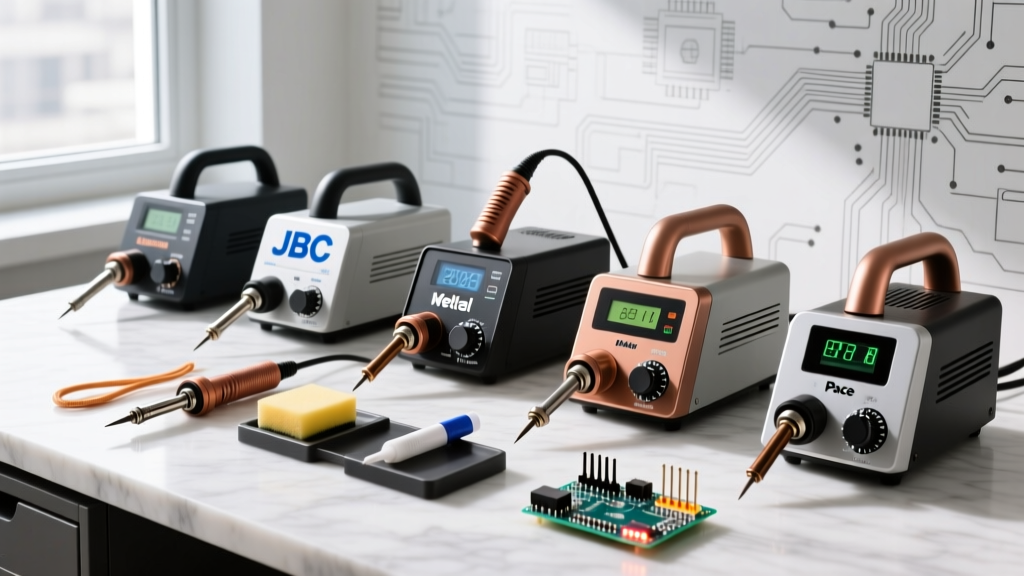
Whether you are building aerospace avionics that must comply with NASA NEPP Workmanship Standards or running a high-volume repair depot, selecting the right equipment dictates your throughput and joint reliability. Below, we break down the top five professional soldering stations dominating the market this year, analyzing their heater technology, tip ecosystems, and real-world failure modes.
The 2026 Pro Soldering Station Comparison Matrix
| Station Model | Heater Technology | Wattage | Heat-Up (to 350°C) | Tip Ecosystem | Approx. Price (2026) |
|---|---|---|---|---|---|
| JBC CD-2BE | Active Cartridge | 130W | ~2 Seconds | C245 / C210 / C115 | $585 |
| Hakko FX-951 | Active Cartridge | 70W | ~8 Seconds | T12 Series | $275 |
| Metcal MX-5200 | RF Induction | 80W | ~6 Seconds | STTC / SMTC | $650 |
| Weller WX1012 | Active Cartridge | 200W | ~5 Seconds | RT / WXP | $520 |
| Pace ADS200 | ThermoJet / Cartridge | 120W | ~4 Seconds | TD-200 | $360 |
In-Depth Reviews: The Top 5 Pro Soldering Stations
1. JBC CD-2BE: The Undisputed Champion of Thermal Recovery
The JBC CD-2BE remains the gold standard for precision rework and micro-soldering in 2026. Its genius lies in the C245 cartridge tip system, where the heating element and thermocouple are integrated directly into the very front of the tip. This eliminates the thermal lag caused by air gaps or screw-on sleeves found in older designs.
- Performance: Reaches 350°C in under two seconds. When you touch a massive ground plane, the station detects the heat sink effect and instantly dumps 130 watts into the tip to compensate.
- Edge Case / Failure Mode: The primary drawback is the consumable cost. Genuine JBC C245 tips cost between $35 and $50 each. If your technicians leave the iron at 400°C without utilizing the station's intelligent sleep/stand modes, tip oxidation will destroy the iron plating in weeks.
- Best For: Micro-soldering (using C210/C115 adapters), high-mix low-volume contract manufacturing, and complex BGA rework prep.
2. Hakko FX-951: The High-Volume Manufacturing Workhorse
While JBC wins on raw speed, the Hakko FX-951 wins on total cost of ownership. This 70W station utilizes the legendary T12 cartridge tips. Like JBC, the heater is embedded in the tip, but Hakko's ecosystem is vastly more affordable, with genuine T12 tips hovering around $8 to $12.
- Performance: Excellent for standard through-hole and SMD components up to 0402 sizes. The split-handpiece design makes it incredibly lightweight, reducing carpal tunnel fatigue during 8-hour shifts.
- Edge Case / Failure Mode: The 70W limit becomes a bottleneck when soldering thick RF shielding cans or multi-layer motherboard ground planes. The station will struggle to maintain 350°C, forcing the operator to dwell too long and risk delaminating the PCB.
- Best For: High-volume production lines, IT repair depots, and educational labs where tip replacement costs must be minimized.
3. Metcal MX-5200: The Calibration-Free Induction Marvel
Metcal approaches soldering from a completely different physics perspective. The MX-5200 uses RF induction heating via Metcal's SmartHeat Technology. There is no thermocouple and no user temperature dial. Instead, the tip is coated with a ferromagnetic alloy that loses its magnetic properties exactly at its Curie temperature, automatically regulating the heat.
- Performance: Because it reacts directly to the thermal load of the joint rather than a sensor reading, it provides incredibly consistent joints without the risk of operator error or dial tampering.
- Edge Case / Failure Mode: You cannot simply turn a dial to increase the temperature for a stubborn joint. If you need to switch from standard Sn63/Pb37 solder to SAC305 lead-free paste, you must physically swap to a 700-series tip (e.g., STTC-117) designed for higher Curie points.
- Best For: Aerospace, medical device manufacturing, and ISO-certified facilities where process validation and the elimination of operator temperature tampering are critical.
4. Weller WX1012: The Smart-Connected Powerhouse
The Weller WX1012 represents the modern, IoT-connected era of the workbench. Boasting a massive 200W power base, it is designed to drive not just standard irons, but also heavy-duty desoldering tweezers and hot-air modules simultaneously.
- Performance: The capacitive glass touch interface and high-resolution TFT display allow for complex profile programming. The RT micro-tips offer incredible precision for tight-pitch QFN chips.
- Edge Case / Failure Mode: The menu-diving required to set up custom sleep profiles or lockouts can be frustrating for fast-paced environments. Additionally, the glass front panel is susceptible to cracking if a heavy metal chassis or rogue screwdriver is dropped on it.
- Best For: Advanced R&D labs and technicians who require a single base station to manage multiple interchangeable handpieces.
5. Pace ADS200: The Ergonomic Precision Specialist
Pace has long been a staple in military and telecommunications repair. The ADS200 features the TD-200 handpiece, which is widely regarded as one of the most ergonomically balanced pens in the industry, heavily reducing grip strain.
- Performance: The SensaTemp technology provides rapid load response. The digital interface is straightforward, avoiding the overly complex menus of its German competitors.
- Edge Case / Failure Mode: The TD-200 tip ecosystem, while robust, doesn't offer the sheer micro-precision variety of JBC's C210 line. For ultra-fine 01005 component placement, Pace falls slightly behind.
- Best For: Telecommunications repair, heavy-duty through-hole work, and technicians prioritizing handpiece ergonomics over micro-SMD capabilities.
Critical Buying Factors for Professional Environments
1. IPC Compliance and Joint Reliability
If your facility produces commercial or military electronics, your soldering process must align with the IPC J-STD-001 standard. This standard mandates strict thermal profiles to prevent intermetallic compound (IMC) overgrowth or component damage. Stations like Metcal and JBC, which offer verifiable thermal lockouts and data logging, make passing IPC audits significantly easier.
2. ESD Safety and Grounding
A true pro soldering station must be Electrostatic Discharge (ESD) safe. This means the handpiece grip, the cord, and the base station must provide a continuous path to ground, typically through a 1-megaohm safety resistor to protect the operator from shock while safely bleeding off static charges from sensitive CMOS and MOSFET components. All five stations listed above meet strict IEC 61340-5-1 ESD standards.
3. The Tip Geometry Reality
Expert Tip: Amateurs reach for the largest chisel tip to transfer heat faster. Professionals know that maximizing the contact area with a bevel or hoof tip (concave chisel) yields better thermal transfer than brute force. Always match the tip width exactly to the pad size to avoid bridging adjacent 0.5mm pitch leads.
Expert Verdict: Which Pro Soldering Station Should You Buy?
Your choice of a pro soldering station in 2026 ultimately depends on your specific production environment and budget constraints:
- Choose the JBC CD-2BE if budget is secondary to absolute performance, micro-precision, and lightning-fast thermal recovery on dense PCBs.
- Choose the Hakko FX-951 if you are outfitting a large team or production line and need a reliable, active-tip station with an ultra-cheap consumable ecosystem.
- Choose the Metcal MX-5200 if you work in a highly regulated industry (medical/aerospace) where process validation and the physical inability to alter temperatures are required by QA.
- Choose the Weller WX1012 if you need a high-wattage, multi-tool hub for an advanced R&D bench that handles everything from micro-SMD to heavy desoldering.
- Choose the Pace ADS200 if ergonomics and mid-tier pricing are your primary concerns for general-purpose repair and telecommunications work.
Investing in any of these professional-grade systems will immediately reduce your defect rate, eliminate cold joints on ground planes, and drastically improve your daily workflow efficiency.