
The Big-Box Store Dilemma: Why Search for a Soldering Iron at Walmart?
When a DIY project, a broken toy, or a frayed appliance cord demands immediate attention, the urge to find a local, same-day solution is overwhelming. Typing soldering iron walmart into your phone's search bar promises a quick trip down the aisle and a fast fix. Big-box retailers stock a variety of entry-level soldering tools, from ultra-budget blister packs to mid-tier hobbyist stations. But as any seasoned electronics technician or plumbing expert knows, the gap between a $12 big-box store iron and a $120 closed-loop soldering station is not just about price. It is a matter of fundamental physics, metallurgy, and long-term joint reliability.
In this 2026 analysis, we deconstruct the actual inventory you will find at major retail chains, compare them against premium benchtop stations, and explore the modern "smart iron" alternatives that have completely disrupted the budget soldering market. Whether you are splicing 14 AWG silicone wire for an RC car or attempting to solder 0805 SMD resistors onto a custom PCB, understanding thermal recovery is the key to avoiding catastrophic pad delamination and cold joints.
Anatomy of a Budget Iron: What You Actually Get for $15 to $45
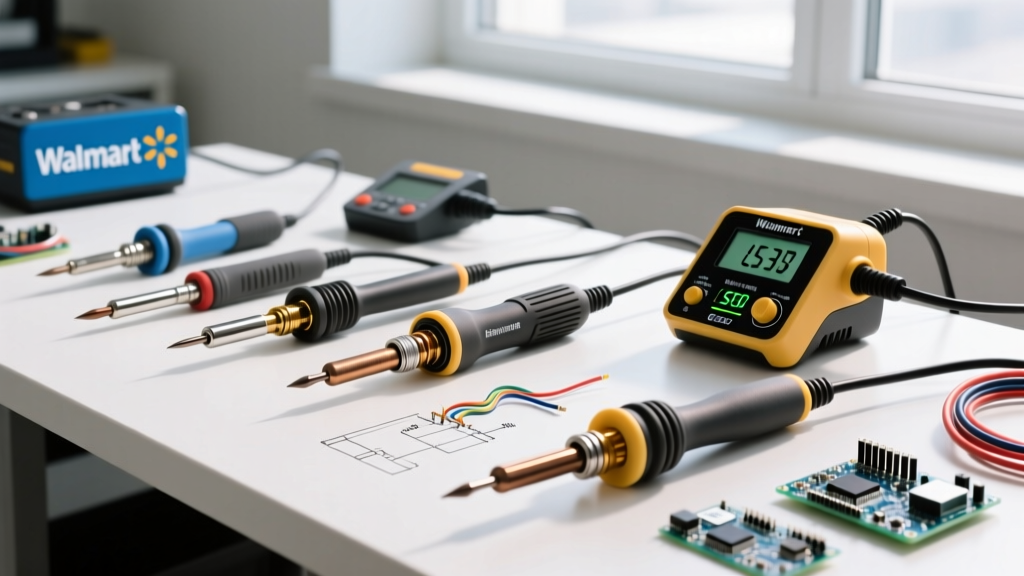
Walk into a typical supercenter, and you will generally find two categories of soldering tools: the ultra-cheap "craft" irons and the entry-level hobbyist stations.
The Ultra-Budget Tier: Hyper Tough and Generic 40W Irons
Priced between $10 and $18, these irons are essentially a resistive Nichrome wire heating element wrapped around a hollow steel tube, with a bare copper tip inserted and secured by a tiny set-screw. They lack any form of temperature regulation. You plug them in, and they heat up until they reach a crude thermal equilibrium based on ambient room temperature and the wattage limit.
- The Thermal Bottleneck: The set-screw mechanism creates a massive air gap between the heater and the tip. Air is an insulator, meaning heat transfer is incredibly inefficient.
- Tip Metallurgy: Budget tips are rarely iron-plated. When exposed to flux and molten solder, the bare copper core rapidly dissolves into the solder pool, pitting the tip and rendering it useless within a few hours of heavy use.
- Use Case: Strictly limited to heavy-gauge wire tinning, basic plumbing (with appropriate lead-free plumbing solder), or melting heat-shrink tubing. They are entirely unsuited for printed circuit board (PCB) work.
The Mid-Tier Hobbyist: Weller WLC100
Often found in the hardware or electronics aisle for around $45, the Weller WLC100 is a 40W station with a variable power dial. While it bears a respected brand name, it operates on a closed-loop system that controls power, not temperature. It uses a heavy-duty screw-on tip design that offers better thermal mass than the blister-pack irons, but it still suffers from severe thermal droop when applied to large ground planes or thick connectors like XT60 battery plugs.
Thermal Recovery and the IPC Standard
To understand why premium stations dominate professional environments, we must look at industry benchmarks. The IPC-A-610 standard for electronic assembly acceptability demands proper wetting, specific fillet angles, and complete rosin activation. Rosin-based fluxes typically activate between 180°C and 220°C. If your iron's tip temperature drops below this threshold upon contact with a component lead, the flux fails to clean the oxidation, resulting in a cold, grainy, and highly resistive solder joint.
Expert Insight: A 40W budget iron might read 400°C on an infrared thermometer while resting in the stand. However, the moment it touches a 14 AWG wire, the thermal mass of the copper absorbs the heat faster than the rudimentary Nichrome heater can replenish it. The tip temperature can plummet below 180°C in under two seconds, guaranteeing a substandard joint.
Head-to-Head Comparison Matrix
Below is a structural and performance breakdown comparing typical big-box store finds against modern premium and smart alternatives available in 2026.
| Feature | Budget (Hyper Tough 40W) | Mid-Tier (Weller WLC100) | Premium (Hakko FX888D) | Smart Iron (Pinecil V2) |
|---|---|---|---|---|
| Price Range | $12 - $18 | $40 - $50 | $110 - $125 | $26 - $35 |
| Heater Type | Nichrome Wire (Open Loop) | Nichrome (Power Control) | Ceramic (Closed-Loop PID) | Ceramic (PID via RISC-V) |
| Tip Mount | Set-Screw (High Thermal Resistance) | Screw-On Collar | Slide-On (T18 Series) | Slide-On (TS100/Pine64) |
| Thermal Recovery | > 15 Seconds (Severe Droop) | 8 - 12 Seconds | < 2 Seconds | < 2 Seconds |
| Best Application | Heat shrink, thick wire splicing | Through-hole DIY, basic repairs | Heavy SMD, multi-layer PCBs | Portable SMD, drones, field repair |
The Premium Benchmarks: Hakko and Weller
Professional stations like the Hakko FX888D (approx. $115) and the Weller WE1010NA (approx. $129) utilize advanced ceramic heating elements with the thermocouple embedded directly inside the tip. This closed-loop PID (Proportional-Integral-Derivative) controller monitors the tip temperature dozens of times per second. When you touch the iron to a massive ground plane on a motherboard, the controller detects the micro-drop in temperature and instantly floods the heater with maximum current to compensate. Furthermore, these stations use iron-plated copper tips. The iron plating prevents the molten solder from dissolving the copper core, extending the tip's lifespan from mere hours to several months or even years of daily use.
The Smart Iron Disruptor: Bypassing the Big Box Store
In recent years, the market has been upended by USB-C PD (Power Delivery) smart irons. The most prominent example is the Pine64 Pinecil V2. Priced at roughly $26, this open-source soldering iron features a 32-bit RISC-V microcontroller that runs a sophisticated PID algorithm. Powered by a standard 65W USB-C laptop charger, the Pinecil V2 achieves a thermal recovery time that rivals $150 benchtop stations. While you will not find the Pinecil on a physical retail shelf next to the hyper-budget craft irons, it represents the ultimate counter-argument to buying a budget iron locally. For the price of a mid-tier big-box station, you can order a smart iron online that offers digital temperature readouts, sleep modes, and rapid heat-up times (reaching 320°C in under 10 seconds).
Failure Modes and Edge Cases of Budget Irons
If you do opt for a budget iron from a local supercenter, be aware of the common failure modes that plague these tools:
- Handle Melting: Because budget irons lack thermal cutoffs, leaving them plugged in for hours can cause the heat to travel up the steel shaft via conduction, eventually melting the cheap plastic or foam handle.
- Set-Screw Corrosion: The tiny grub screw used to hold the tip in place rapidly oxidizes and fuses to the barrel. Attempting to change a burnt-out tip often results in stripping the screw or snapping it entirely, bracing the iron.
- Lead-Free Solder Incompatibility: Modern environmental regulations have pushed many manufacturers toward SAC305 (lead-free) solder, which melts at a much higher 217°C–227°C. Budget irons simply lack the thermal headroom to melt lead-free solder effectively, leading to massive, sloppy blobs that bridge adjacent pads.
Final Verdict: The 2026 Buying Framework
Should you buy a soldering iron from Walmart? The answer depends entirely on your immediate timeline and your target materials.
When to Buy Local (The Emergency Fix)
If a wire snaps on your lawnmower, you need to solder a heavy-gauge connection on a car stereo harness, or you are doing basic copper pipe plumbing (using a dedicated plumbing iron), a $15 big-box iron will suffice. The thermal mass of thick wires is forgiving, and the crude heat output will eventually get the job done.
When to Order Direct (The Electronics Route)
If your search for a soldering iron walmart is driven by a desire to repair a drone flight controller, build an Arduino project with delicate header pins, or swap capacitors on a TV power supply, do not buy a budget iron. The lack of thermal recovery will lift the copper pads right off your circuit board, turning a $2 component repair into a ruined piece of hardware. Instead, invest in a Hakko FX888D for your workbench, or order a Pinecil V2 online for a fraction of the cost with vastly superior performance.