
The Myth of the Dial: Understanding Soldering Iron Tip Temperature
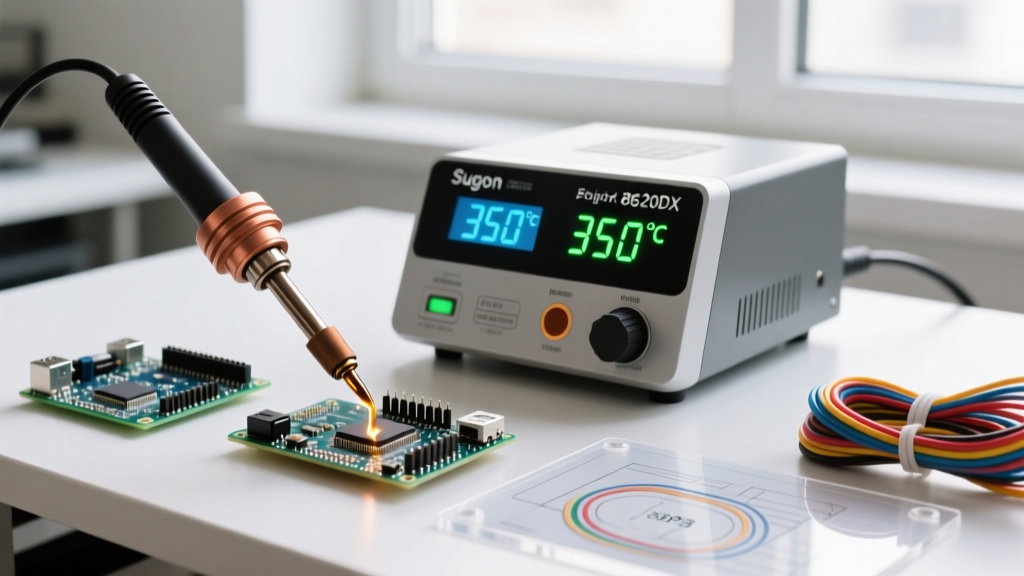
Every electronics hobbyist and assembly technician has experienced the same frustration: you set your station dial to 350°C, wait for the indicator light to turn green, and touch the tip to a large ground plane. Instantly, the solder refuses to flow, the flux burns into a black crust, and you are left with a dull, grainy cold joint. What happened to your 350°C setting?
The reality of soldering iron tip temperature is that the number on your digital display represents the temperature of the internal sensor, not necessarily the working surface of the tip under thermal load. When a tip contacts a high-mass copper pour, heat transfers into the board faster than the station can replenish it. This phenomenon, known as thermal droop, is the primary cause of soldering defects in modern lead-free assemblies.
In this 2026 tool comparison, we dissect how three dominant heating technologies—ceramic resistive, direct-drive cartridge, and RF induction—manage soldering iron tip temperature under real-world thermal loads. By understanding the physics of thermal recovery, you can stop destroying FR4 pads and start producing IPC-compliant joints.
Heating Technologies: A Technical Breakdown
To evaluate how different stations maintain tip temperature, we must look at the physical distance between the heating element, the temperature sensor, and the working surface of the tip.
1. Ceramic Resistive (The Legacy Standard)
Stations like the ubiquitous Hakko FX-888D (retailing around $115 in 2026) use a ceramic heating element with a separate thermocouple sensor embedded near the tip shaft. Because the sensor is physically separated from the tip's working edge by several millimeters of metal and air gaps, there is inherent thermal lag. When the tip surface drops in temperature, it takes 2 to 4 seconds for the sensor to register the change and for the PID controller to pulse the 70W heater. This lag results in severe thermal droop on heavy boards.
2. Direct-Drive Cartridge (The Smart Disruptor)
The Pinecil V2 (approximately $28) represents the modern cartridge revolution. The heater and thermocouple are integrated directly into the base of the tip, eliminating the air gap. Powered via USB-C Power Delivery (up to 65W), the RISC-V microcontroller runs a high-frequency FOC (Field Oriented Control) PID loop. The soldering iron tip temperature responds in milliseconds to thermal drops. However, its absolute wattage ceiling means that while it recovers instantly on 0805 SMDs, it will still stall on massive 10oz copper planes.
3. RF Induction / Curie Point (The Industrial Heavyweight)
The Metcal MX-5200 (priced near $680) abandons traditional sensors entirely. It uses an RF generator to induce eddy currents directly into the ferromagnetic skin of the tip. According to Metcal's SmartHeat documentation, the tip heats itself exactly where the magnetic permeability changes at the Curie temperature. If the tip drops below the Curie point, it draws maximum wattage (up to 80W) precisely at the point of contact. There is zero sensor lag because the tip's metallurgical properties act as the thermostat.
Comparison Matrix: Thermal Recovery Under Load
| Station Model | Heating Tech | Max Wattage | Temp Control Method | Recovery on 4oz Cu (350°C Target) | 2026 Est. Price |
|---|---|---|---|---|---|
| Hakko FX-888D | Ceramic Resistive | 70W | PID + Remote Thermocouple | ~4.5 seconds (High droop) | $115 |
| Pinecil V2 | Cartridge (Integrated) | 65W (PD) | High-Freq FOC PID | ~1.2 seconds (Moderate droop) | $28 |
| Metcal MX-5200 | RF Induction | 80W+ | Curie Point Metallurgy | <0.5 seconds (Near-zero droop) | $680 |
The Hidden Costs of Compensating for Thermal Droop
When technicians encounter thermal droop with ceramic stations, the most common reaction is to turn the dial up to 400°C or 420°C. This is a catastrophic mistake that leads to two specific failure modes:
Failure Mode 1: Accelerated Tip Oxidation
The working surface of a soldering tip is plated with a thin layer of iron to prevent the underlying copper from dissolving into the molten solder. At 350°C, this iron plating oxidizes at a manageable rate. However, oxidation rates increase exponentially above 400°C. Running a Hakko FX-888D at 420°C to compensate for poor thermal recovery will destroy the iron plating in a matter of days, leading to 'dead spots' where solder refuses to wet the tip.
Failure Mode 2: Pad Delamination and Flux Starvation
Modern lead-free solder pastes (like SAC305) have a liquidus temperature of 217°C, but require a working tip temperature of 320°C to 360°C to form a proper Intermetallic Compound (IMC) layer. If you use a 420°C tip, the no-clean flux volatilizes and burns off before the solder can wet the pad. Furthermore, the extreme localized heat can exceed the glass transition temperature (Tg) of standard FR4 laminate, causing the copper pad to lift from the board.
Expert Insight: Never increase your station's baseline temperature to overcome a thermal mass problem. Instead, increase the tip's surface area contact. Switching from a conical tip to a wide chisel or bevel tip will transfer heat vastly more efficiently than adding 50°C to the dial.
Calibration, Drift, and IPC Compliance
For professionals building assemblies that must pass IPC J-STD-001 standards, maintaining an accurate soldering iron tip temperature is a documented requirement. The IPC standard mandates that soldering equipment must be capable of maintaining the set temperature within a specific tolerance (typically ±5°C for Class 3 aerospace/medical products).
- Ceramic Stations: Require manual offset calibration. Over time, the thermocouple degrades, leading to silent temperature drift where the display reads 350°C but the actual tip surface is 335°C.
- Cartridge Stations: The Pinecil V2 wiki details how to perform a boiling water calibration to align the internal ADC readings with the real-world thermistor resistance, ensuring tight PID control.
- Induction Stations: Because Metcal tips are governed by their Curie temperature (e.g., a 700-series tip physically cannot exceed 380°C), they are inherently self-calibrating and immune to sensor drift, making them the default choice for high-reliability manufacturing floors.
Real-World Scenario: Soldering a 10oz Copper Ground Plane
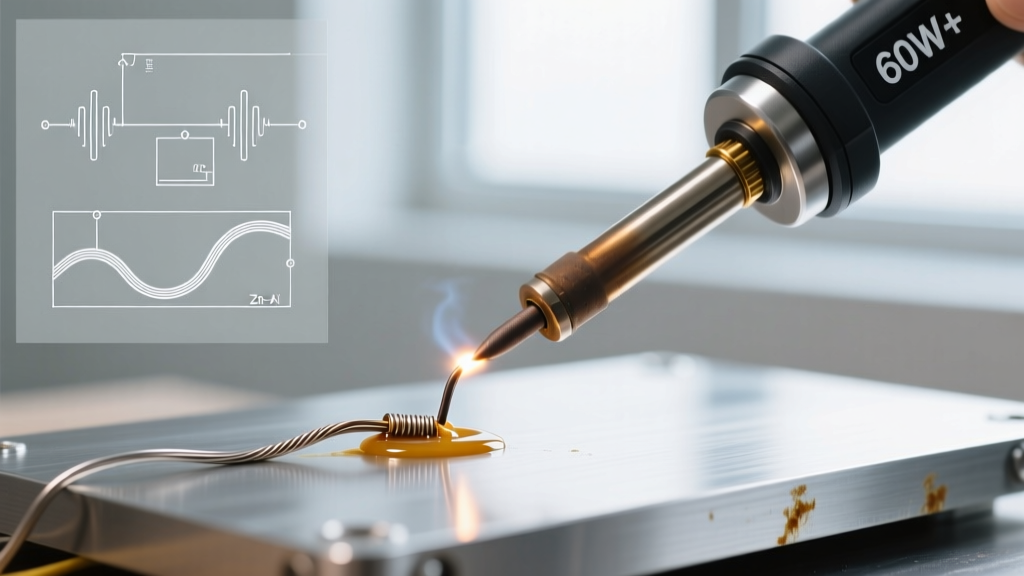
Let us look at a practical edge case: attaching a heavy 12 AWG wire to a 10oz copper ground plane on a motor controller board.
- The Ceramic Approach (Hakko FX-888D): Even with a massive C6 bevel tip set to 380°C, the thermal mass of the copper will pull the tip temperature down to 210°C (below liquidus) upon contact. The operator will likely hold the iron for 8+ seconds, boiling the flux and creating a starved, crystalline cold joint.
- The Cartridge Approach (Pinecil V2): Using an extended heavy-duty chisel tip, the PID loop maxes out the 65W USB-C supply immediately. It will successfully solder the joint in about 4 seconds, but the station's display will flash a thermal droop warning as it hits its absolute power ceiling.
- The Induction Approach (Metcal MX-5200): Using an STTC-137 chisel tip, the RF generator dumps continuous, localized wattage directly into the exact millimeter of the tip touching the wire. The joint reaches reflow in 2.5 seconds with zero risk of exceeding the Curie limit and burning the flux.
Verdict: Matching the Station to Your Thermal Profile
There is no single 'best' station; there is only the right tool for your specific thermal profile.
If your daily work consists of 0402 SMDs, delicate QFNs, and low-mass hobbyist PCBs, the Pinecil V2 offers unmatched value. Its rapid PID loop maintains perfect soldering iron tip temperature on small pads, and the $28 entry price is unbeatable for 2026.
If you are a generalist repair technician working on a mix of consumer electronics, through-hole connectors, and occasional mid-sized ground planes, the Hakko FX-888D remains a reliable workhorse. Just remember to respect its thermal limits and utilize large-geometry tips rather than cranking the temperature dial.
However, if your workflow involves high-power RF boards, thick multilayer motor controllers, or IPC Class 3 aerospace assemblies, the Metcal MX-5200 is a mandatory investment. The ability to maintain a strict, physics-governed soldering iron tip temperature without sensor lag eliminates cold joints and operator error, paying for itself in reduced rework and scrapped PCBs.