
The Linguistic Setup: Brand Pronunciation and Model Identification
Setting up a professional electronics lab in 2026 requires more than just unboxing hardware; it demands precise technical communication. Whether you are configuring voice-directed inventory picking systems, ordering replacement consumables, or troubleshooting with manufacturer support, correct soldering iron pronunciation and terminology are critical soft skills. Mispronouncing brand names or tip geometries frequently leads to supply chain friction, incompatible part orders, and failed IPC certification audits.
Furthermore, the word "solder" itself is a classic engineering shibboleth. In North America, it is pronounced /ˈsɒd.ər/ (sod-er), while in the UK, Australia, and much of the international engineering community, it is pronounced /ˈsoʊl.dər/ (sole-der). Understanding these regional variations is essential when collaborating with global PCB fabrication houses or international technical support teams.
Major Station Brands: Phonetic Guide and Calibration Features
| Brand | Phonetic Pronunciation | Flagship 2026 Model | Calibration Method |
|---|---|---|---|
| Hakko | /ˈhɑːkoʊ/ (Hah-ko) | FX-951 / FX-971 | Card-based digital offset (±5°C) |
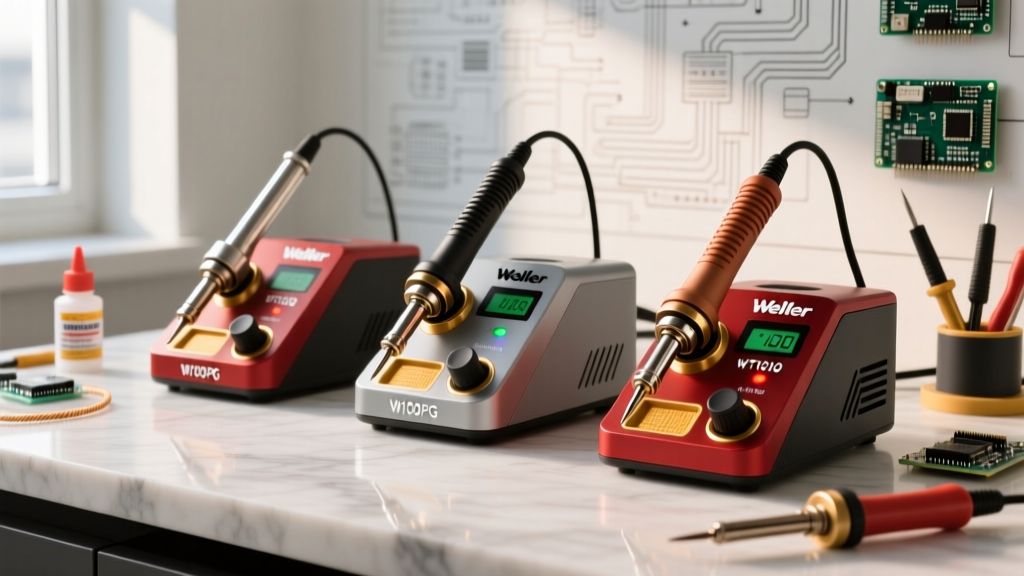
| Weller | /ˈwɛlər/ (Well-er) | WE1010 / WT1012 | Menu-driven digital offset |
| JBC | /ˌdʒeɪ biː ˈsiː/ (Jay-Bee-See) or Spanish /ˈxota be ˈθe/ | CD-2BQF / JTSE | Auto-calibrating sleep sensors |
| Pace | /peɪs/ (Pace) | ADS200 | IntelliHeat sensor mapping |
| Metcal | /ˈmɛtkæl/ (Met-cal) | MX-5200 | SmartHeat (Curie point physics) |
Tip Geometry Terminology for Inventory Setup
When setting up your lab's Computerized Maintenance Management System (CMMS) or calling suppliers, using the exact terminology for tip geometries prevents costly errors. According to Hakko USA's official terminology guides, mixing up bevel and chisel tips will severely impact thermal transfer on high-mass ground planes.
- Chisel (D-Series): Pronounced /ˈtʃɪz.əl/. The flat, wedge-shaped tip used for general through-hole and 0805 SMD work. (e.g., Hakko T18-D24).
- Bevel (C-Series): Pronounced /ˈbɛv.əl/. Features a concave scoop at the end, ideal for drag soldering SOIC chips and holding small amounts of solder.
- Conical (B-Series): Pronounced /kəˈnɪk.əl/. A fine point for precision 0402 components. Often misidentified by beginners as a "needle" tip.
- Knife (K-Series): Pronounced /naɪf/. An angled blade used for cutting solder bridges and cleaning tight pitch QFP pins.
Physical Setup: Step-by-Step Station Calibration
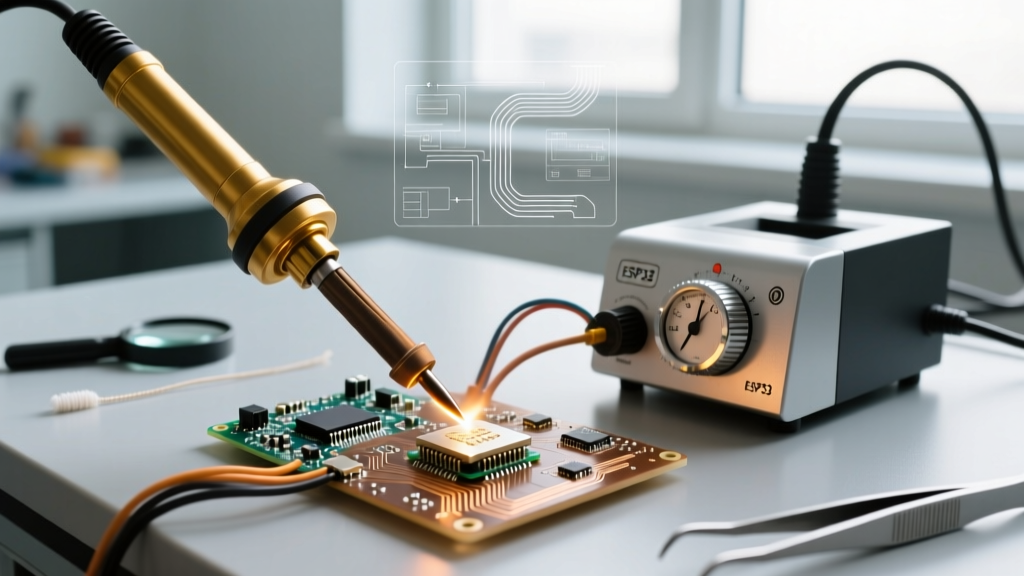
Proper communication gets you the right tools; proper calibration ensures they perform to IPC-J-STD-001 requirements. As of 2026, IPC standards mandate that soldering stations maintain a temperature tolerance of ±5°C (±9°F) from the set point at the tip interface. Here is how to physically set up and calibrate a standard digital station like the Weller WE1010 or Hakko FX-951.
Required Calibration Equipment
- Thermocouple Probe: Fluke 80PK-1 K-type Bead Probe (do not use standard HVAC probes; they lack the thermal mass responsiveness required for micro-soldering tips).
- Calibration Putty: Hakko 191-1 Thermal Paste or high-temperature silicone calibration compound.
- Digital Multimeter: True-RMS meter with K-type input and ±0.1% DC accuracy.
Calibration Procedure
- Prep the Tip: Tin the soldering iron tip with fresh 63/37 SnPb or SAC305 lead-free solder. A dry tip will yield false low-temperature readings due to poor thermal coupling.
- Apply Thermal Compound: Place a small bead of calibration putty directly onto the center of the tip's working surface.
- Seat the Probe: Bury the Fluke 80PK-1 bead into the putty. Ensure the bead is fully encapsulated to prevent ambient air cooling from skewing the data.
- Stabilize: Set the station to 350°C (662°F). Allow the system to reach thermal equilibrium. Wait exactly 45 seconds after the station's "ready" indicator lights up.
- Record and Offset: Read the temperature on your multimeter. If the station reads 350°C but the probe reads 342°C, you have an 8°C deficit. Access the station's hidden calibration menu (on the WE1010, hold the 'Enter' button for 5 seconds; on the FX-951, use the offset card or menu sequence) and apply a +8°C offset.
- Verify Traceability: Log the calibration data, including the serial number of your Fluke probe, to maintain NIST traceability standards for ISO 9001 or IPC audits.
Expert Troubleshooting Callout: If your Weller station displays "Error 4" during setup, it indicates a sensor open circuit—usually caused by a bent pin in the handpiece connector, not a software calibration failure. If a Hakko station flashes the temperature display, the heating element's ceramic sensor has fractured and the tip/handle must be replaced before calibration can even be attempted.
IPC Standards and Verbal Lab Communication
During an IPC-A-610 or IPC-J-STD-001 practical exam, inspectors will verbally quiz operators on tool states and solder joint characteristics. Using precise terminology demonstrates E-E-A-T (Experience, Expertise, Authoritativeness, and Trustworthiness) on the manufacturing floor.
- Wetting: Pronounced /ˈwɛt.ɪŋ/. The chemical metallurgical bond between the solder and the base metal. Never call it "sticking" or "gluing" in an audit.
- Fillet: Pronounced /ˈfɪl.ɪt/ (rhymes with 'millet', not 'fillet' like the steak). The concave profile of a proper through-hole solder joint.
- Intermetallic Compound (IMC): The Cu6Sn5 layer that forms at the boundary. Overheating a station during setup causes excessive IMC growth, leading to brittle, fractured joints.
Frequently Asked Questions
Why do some engineers pronounce "solder" with an "L"?
The pronunciation /ˈsoʊl.dər/ (with the "L") is the standard British English and Commonwealth pronunciation, derived directly from the Old French soldeure. The American /ˈsɒd.ər/ evolved from a 19th-century phonetic spelling simplification. Both are technically correct, but international labs should establish a standard operating procedure (SOP) for voice-picking software to recognize both variants.
Do Metcal SmartHeat stations require manual calibration?
No. Metcal systems utilize Curie point physics. The tip is coated with a ferromagnetic alloy that loses its magnetic properties at a specific temperature (e.g., 350°C), causing the RF generator to stop heating. Because this is a fundamental law of thermodynamics rather than a software sensor reading, Metcal tips do not require traditional offset calibration, though annual RF power verification is recommended.
How often should I calibrate my Hakko FX-951?
For high-reliability aerospace or medical PCB assembly, calibrate every 30 days. For general consumer electronics repair or DIY prototyping, a 6-month calibration interval is sufficient, provided the station has not suffered physical trauma to the handpiece cord.