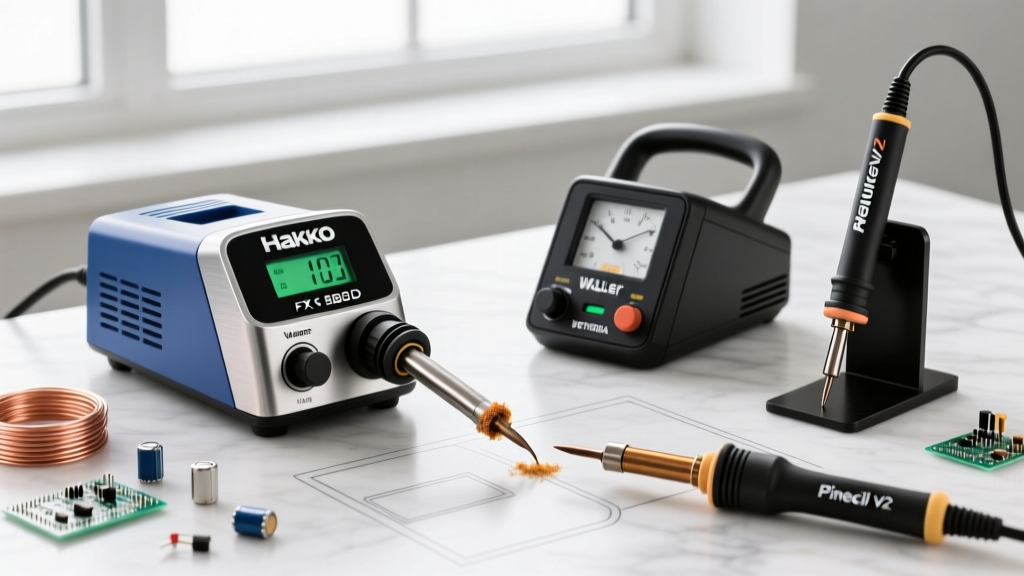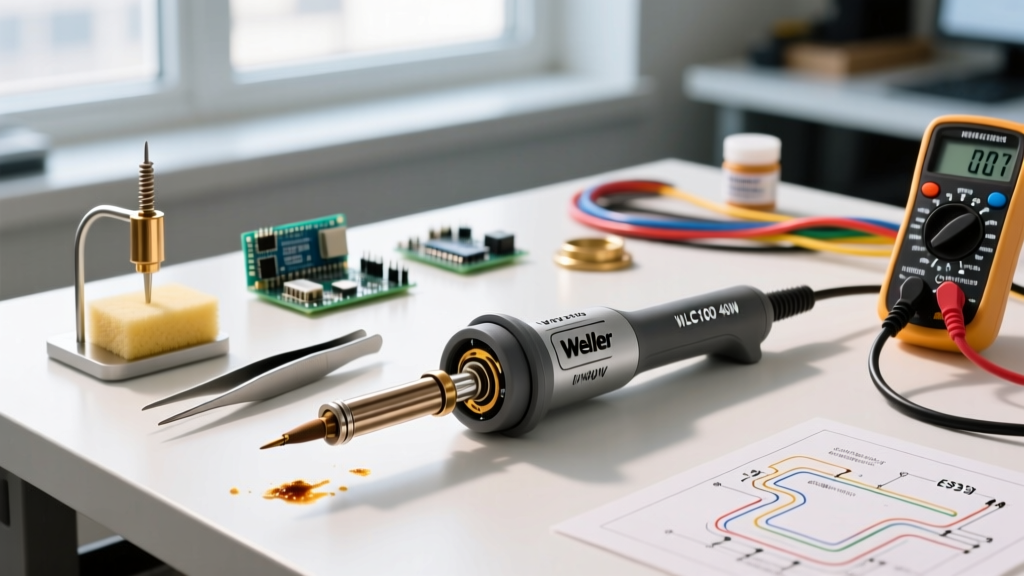

When professionals and advanced hobbyists evaluate soldering gun uses, they are rarely thinking about delicate printed circuit boards (PCBs) or surface-mount devices. Soldering guns—characterized by their trigger-activated operation, bulky form factors, and massive thermal output—exist in a completely different ecosystem than standard pencil irons. They are designed for high thermal mass applications where rapid heat transfer is mandatory.
In 2026, the market is split between traditional, budget-friendly transformer-based guns and premium, smart-thermal or cordless alternatives. Understanding which tier fits your specific workflow requires a deep dive into thermal recovery rates, tip metallurgy, and real-world failure modes. Below, we break down the most critical soldering gun uses and analyze how budget and premium tools perform under heavy loads.
The True Domain of Soldering Gun Uses
A soldering gun operates by passing a high current through a low-voltage, high-amperage secondary loop (the tip itself), generating rapid resistive heating. This makes them uniquely suited for specific, demanding applications.
1. High-Amperage Automotive and Marine Wiring
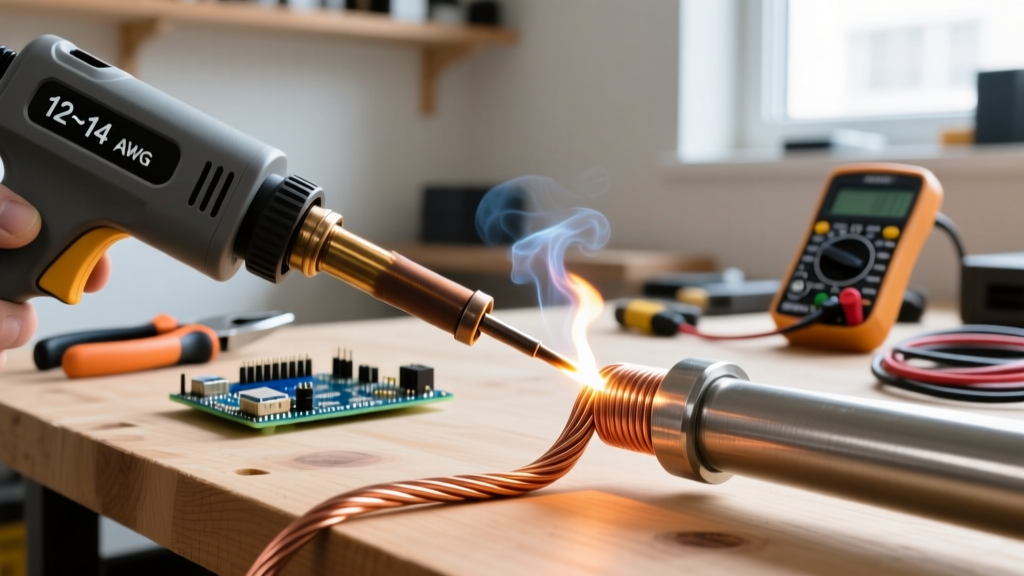
Soldering 8 AWG to 4 AWG battery cables to heavy-duty ring terminals requires overcoming the massive heat-sink effect of thick copper strands. A standard 40W iron will instantly drop below the melting point of 63/37 Sn/Pb or SAC305 lead-free solder, resulting in a cold, crystallized joint. Soldering guns deliver the 150W+ burst needed to flow solder through thick-gauge wire barrels before the wire insulation begins to melt.
2. RC and Drone Battery Connectors
Connectors like the XT90, AS150, and 8mm bullet connectors feature thick brass or copper contact plates. Soldering 10 AWG silicone wire into an XT90 housing requires sustaining a temperature of roughly 700°F (371°C) at the joint for 3 to 5 seconds. If the tool lacks thermal recovery, the prolonged heat exposure will warp the nylon connector housing.
3. Heavy-Gauge Grounding Straps and Busbars
When fabricating custom battery banks or solar arrays, soldering copper braid to solid copper busbars demands extreme thermal mass. This is arguably one of the most punishing soldering gun uses, requiring continuous high-wattage output to prevent the solder from freezing mid-flow.
Budget Tier Analysis: The Transformer Workhorses
The budget tier ($40 to $80) is dominated by classic step-down transformer designs, with the Weller D550PK (approx. $55) serving as the industry baseline.
Performance and Mechanics
The D550 features a dual-trigger mechanism offering 120W (low) and 200W (high) settings. The secondary loop is a thick, replaceable copper wire. When you pull the trigger, the transformer dumps massive current through the loop, heating it to 900°F+ in roughly 4 seconds.
Failure Modes and Limitations
- Thermal Droop: Upon touching an 8 AWG wire, the tip temperature can plummet by 400°F. The transformer takes 5 to 8 seconds to recover, during which time the flux burns off, leading to oxidized, unreliable joints.
- Tip Pitting and Corrosion: Budget copper loop tips are highly susceptible to flux corrosion. If left in the 'on' position for more than 30 seconds without touching a workpiece, the tip will rapidly oxidize and pit, requiring frequent wire cutters to trim the degraded ends.
- Electromagnetic Interference (EMI): The raw transformer design emits a significant electromagnetic spike upon trigger release, which can fry sensitive MOSFETs if used near active automotive ECUs or unshielded drone flight controllers.
Premium Tier Analysis: Smart Thermal and Cordless Heavyweights
The premium tier ($120 to $250+) shifts away from raw, unregulated transformers toward electronically managed thermal delivery and advanced cordless architectures. Key contenders include the Weller 9400PKS (approx. $145) and the Milwaukee M12 Cordless Soldering Iron (2488-20) (approx. $120 bare tool).
Advanced Thermal Management
While the Milwaukee M12 is technically shaped like an iron, its pure copper heating element and 90W-equivalent thermal transfer capability allow it to function in the heavy-duty domain traditionally reserved for guns. It utilizes closed-loop electronic thermal management, meaning it senses the thermal load of an XT90 connector and adjusts power draw to maintain a steady 750°F without overshooting or drooping.
The Weller 9400PKS kit upgrades the traditional transformer gun with advanced metallurgy tips, integrated LED work lights for shadow-free visibility, and improved ergonomic balancing to reduce wrist fatigue during overhead automotive harness work.
Advantages Over Budget Models
- Consistent Thermal Profiles: Premium tools maintain the solder liquidus temperature throughout the entire wetting phase, ensuring proper intermetallic compound (IMC) formation.
- Cordless Freedom: For field mechanics and marine electricians, dragging a 120V transformer gun and an extension cord through a bilge or engine bay is a safety hazard. The M12 eliminates this, offering 45+ minutes of heavy-duty soldering on a single 2.0Ah battery.
- Tip Longevity: Premium iron-clad and specialized alloy tips resist flux corrosion up to 5x longer than bare copper loops.
Head-to-Head Application Matrix
| Application Scenario | Budget (Weller D550) | Premium (Milwaukee M12 / Weller 9400) | Verdict |
|---|---|---|---|
| XT90 / AS150 Connectors | Melts nylon housing due to slow thermal recovery; requires flux re-application. | Flows solder in 3 seconds; preserves connector integrity. | Premium wins easily. |
| 8 AWG Battery Lugs | Effective on high trigger, but tip cools rapidly; heavy cord gets in the way. | M12 maintains heat; cordless design allows easy positioning in tight engine bays. | Premium (Cordless) preferred. |
| Tinning Thick Copper Braid | Excellent raw power; wide copper loop covers broad surface area quickly. | Slower coverage due to smaller tip profile, though joint quality is higher. | Budget is acceptable here. |
| Sensitive Automotive Sensors | High risk of EMI damage and blown traces due to transformer spike. | Safe, regulated DC output; zero EMI risk. | Premium mandatory. |
Thermal Dynamics and IPC Compliance
According to the IPC J-STD-001 standards for soldered electrical and electronic assemblies, a proper solder joint requires the formation of a specific intermetallic layer. This layer only forms correctly when the base metals are heated above the solder's liquidus temperature for a precise duration.
When executing demanding soldering gun uses, budget tools often fail this requirement. The rapid thermal droop means the solder melts via the tip's residual heat, but the base copper wire never reaches the necessary temperature. The result is a "cold joint"—a mechanical connection that looks dull and grainy, offering high electrical resistance. In high-amperage automotive applications, a cold joint will generate localized heat under load, eventually melting the insulation and causing a short circuit. Premium tools with active thermal feedback ensure the base metal reaches the correct temperature, guaranteeing IPC-compliant wetting and structural integrity.
Fume Extraction and Safety Protocols
High-wattage soldering guns vaporize rosin-based fluxes at an aggressive rate. The resulting colophony fumes are a known respiratory sensitizer and can lead to occupational asthma if inhaled repeatedly. As noted by Cornell University Environmental Health and Safety, local exhaust ventilation (LEV) is mandatory when soldering with high-heat tools that generate dense plumes.
Budget guns rarely feature integrated fume extraction. Users must rely on external desktop extractors or open-air environments. Premium stations and advanced cordless setups are increasingly being paired with localized, flexible-arm HEPA/carbon extraction systems to mitigate this hazard, especially when working in enclosed spaces like vehicle interiors or boat cabins.
Expert Verdict: Which Tier Matches Your Workflow?
The Bottom Line: If your primary soldering gun uses involve occasional tinning of heavy ground straps in a well-ventilated garage, a $55 budget transformer gun like the Weller D550 provides the raw thermal mass you need. However, if you are fabricating RC battery harnesses, working on modern automotive CAN-bus systems, or require field portability, the premium investment in a closed-loop or cordless tool is non-negotiable to prevent component damage and ensure joint reliability.
Ultimately, matching the tool to the thermal mass of the workpiece is the hallmark of professional electrical work. By understanding the limitations of transformer droop and the advantages of smart thermal regulation, you can select the right tier for your specific heavy-duty soldering demands.