
The Evolution of the Small Soldering Gun
When field technicians, automotive electricians, and hobbyists search for a 'small soldering gun,' they are typically chasing a very specific utility profile: the rapid, high-wattage thermal delivery of a traditional pistol-grip transformer gun, but without the severe wrist fatigue caused by 3-pound benchtop models. Historically, soldering guns were massive, 200W+ transformer beasts like the Weller D550. The 'small' category emerged to bridge the gap between slow-heating 40W pencil irons and heavy-duty industrial guns.
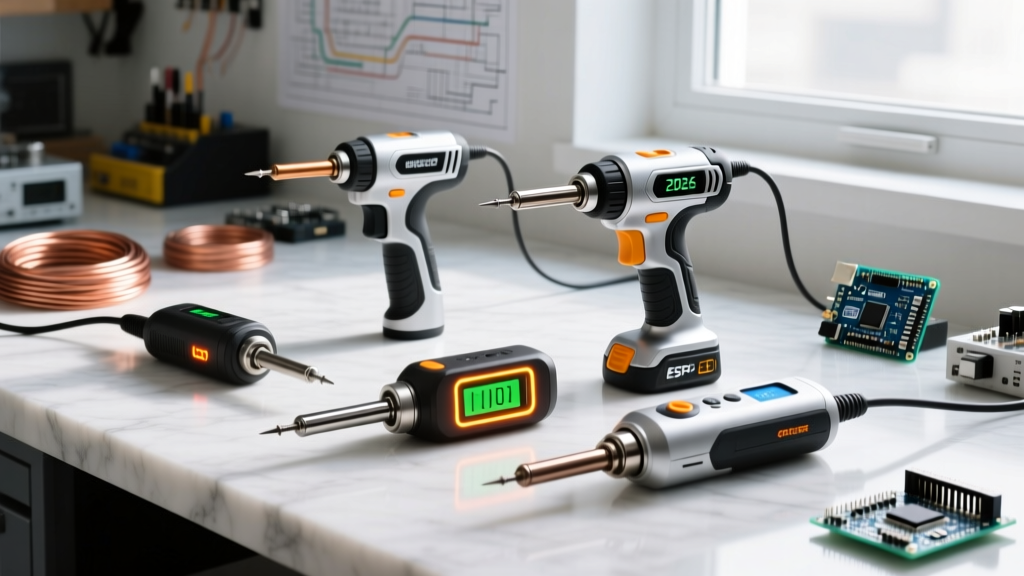
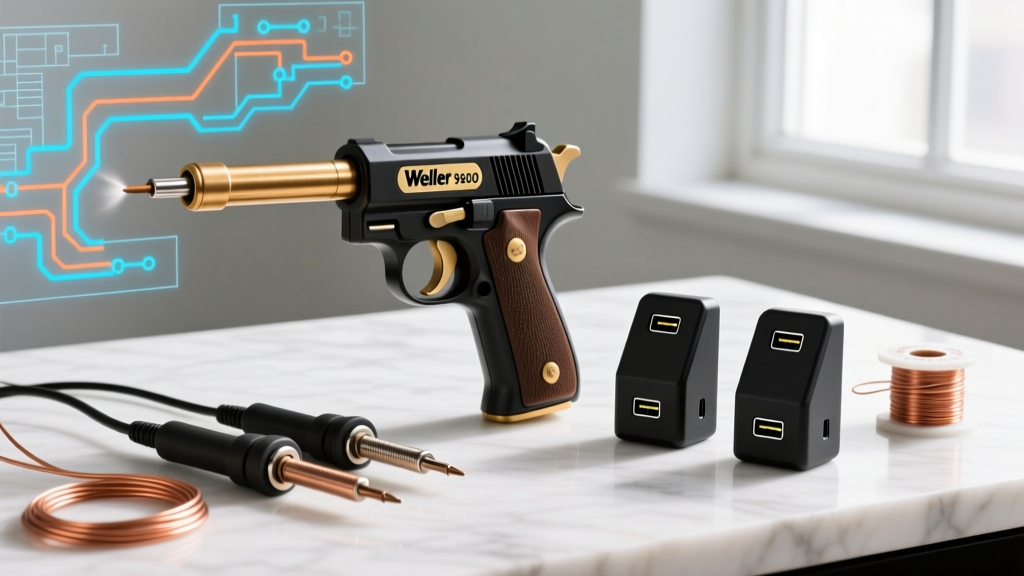
In 2026, the landscape of compact, high-power soldering tools has fractured into two distinct camps. On one side, we have the legacy transformer-based small soldering gun, epitomized by the Weller 9600 Dual-Trigger Pistol Gun. On the other, we have the modern USB-C Power Delivery (PD) compact pens—tools like the FNIRSI HS-02 and Sequre SI-01—that lack the pistol grip but perfectly mimic the rapid-heat, high-power utility of a gun in a fraction of the footprint. This feature deep dive dissects the engineering, failure modes, and practical applications of both paradigms.
Anatomy of a Transformer-Based Small Soldering Gun
To understand why a small soldering gun behaves the way it does, you have to look inside the handle. Unlike a standard soldering iron that uses a high-resistance ceramic or nichrome heating element, a soldering gun uses a step-down transformer. The primary winding takes 120V AC from your wall, and the secondary winding outputs a very low voltage (typically around 24V AC) at a massive current (5 to 10 Amps).
The Copper Loop Heater
In this design, the soldering tip itself is the heating element. The heavy-gauge copper wire loop creates a short circuit across the secondary winding. Because copper has low resistance, the massive amperage causes the tip to heat up via I²R (current squared times resistance) heating in roughly 3 to 5 seconds. This is why transformer guns offer near-instant heat compared to the 45-second warm-up time of traditional ceramic irons.
Feature Deep Dive: Weller 9600 Dual-Trigger Pistol Gun
The Weller 9600 remains the undisputed king of the small soldering gun category. Weighing in at just 1.4 lbs (0.63 kg), it features a unique dual-trigger mechanism: pulling the trigger halfway engages the 80W low setting, while pulling it fully back engages the 120W high setting.
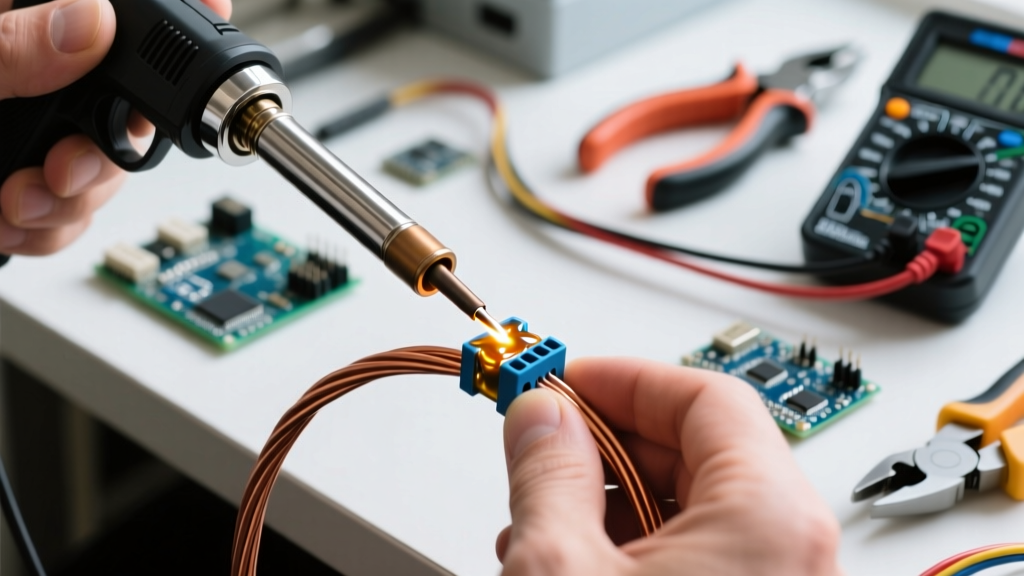
- Thermal Mass: The heavy copper loop tip holds immense thermal energy, making it exceptional for soldering 10 AWG to 14 AWG automotive wires or heavy brass spade connectors that would instantly sink the heat away from a standard 60W pencil iron.
- Maintenance: Tip replacement requires a 1/4-inch nut driver to loosen the brass terminal nuts. Unlike T12 or JBC cartridge tips, the copper loop tips (like the Weller CT6D7) degrade over time as the copper dissolves into the molten solder, requiring replacement every 40-50 hours of active use.
- Pricing: Retailing around $65 in 2026, it is an affordable, high-ROI tool for heavy-gauge electrical work.
⚠️ Expert Troubleshooting: The 'Trigger Arcing' Failure ModeThe most common failure point on the Weller 9600 is not the transformer, but the internal microswitch. Because a transformer is a highly inductive load, releasing the trigger causes the collapsing magnetic field to generate a high-voltage inductive kickback. Over 2 to 3 years of heavy use, this voltage spike arcs across the microswitch contacts, pitting the metal and causing the gun to fail to turn on. The fix: Do not throw the gun away. You can open the handle (4 Phillips screws) and replace the microswitch (a standard $8 part) or solder a 0.1µF snubber capacitor across the switch terminals to suppress the arc and extend its life indefinitely.
The 2026 Paradigm Shift: USB-C PD Compact Irons
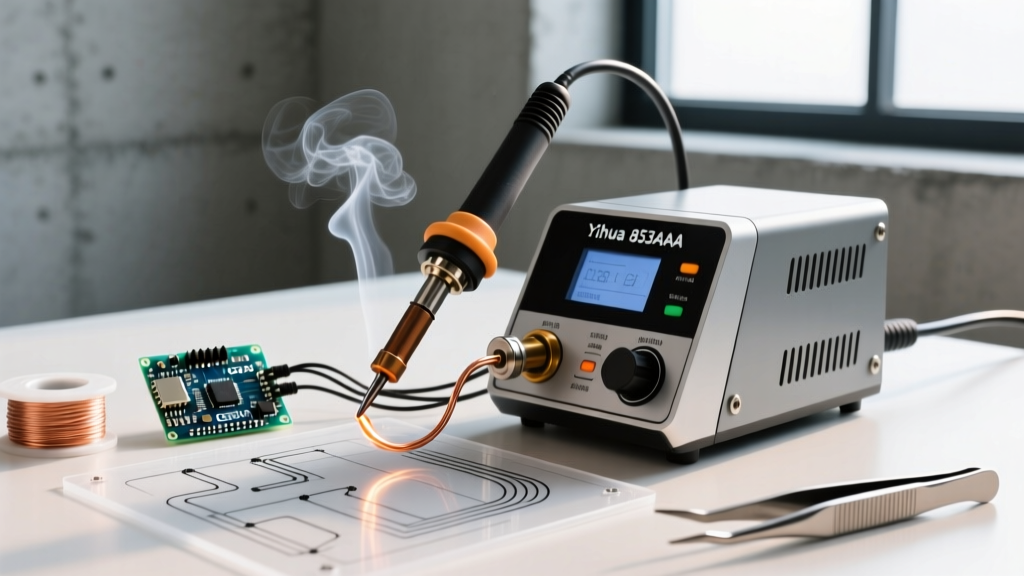
While the Weller 9600 dominates heavy wire soldering, it is entirely unsuited for modern PCB repair or tight-space micro-soldering due to its bulky pistol grip and lack of electrostatic discharge (ESD) safety. Enter the modern 65W USB-C PD soldering irons. These tools have effectively replaced the need for a 'small soldering gun' in electronics workspaces by delivering 65W of rapid-heating power in a package that weighs less than a standard smartphone.
PPS Protocol and Ceramic Heaters
Tools like the FNIRSI HS-02 ($45) and Sequre SI-01 ($55) rely on the USB-C Power Delivery 3.0 protocol, specifically utilizing the PPS (Programmable Power Supply) standard. PPS allows the iron to negotiate exact voltage and current draws (e.g., 20V at 3.25A) dynamically as the tip loses heat to a ground plane. They use composite ceramic heating cores wrapped around a thermocouple, achieving closed-loop temperature recovery in under 2 seconds.
Specification & Performance Matrix
| Feature | Weller 9600 (Transformer Gun) | FNIRSI HS-02 (PD Pen) | Sequre SI-01 (PD Pen) |
|---|---|---|---|
| Max Wattage | 120W (High Trigger) | 65W (PPS Required) | 65W (PPS Required) |
| Weight (Tool Only) | 1.4 lbs (635g) | 150g | 135g |
| Cold-to-350°C Time | ~4 seconds | ~8 seconds | ~7 seconds |
| Tip Style | Copper Loop (Screw-on) | Proprietary Cartridge | JBC C245 Compatible |
| ESD Safe | No (Magnetic Field Risk) | Yes (Grounded via USB-C) | Yes (Grounded via USB-C) |
| Best Application | Automotive, Heavy Wire, RC | Field PCB Repair, Drones | Lab Bench, Micro-Soldering |
Thermal Recovery and IPC Compliance
When choosing between a small soldering gun and a compact PD iron, you must consider the thermal excursion limits defined by industry standards. According to the IPC J-STD-001 requirements for soldered electrical and electronic assemblies, excessive dwell time on a PCB pad can cause pad lifting, barrel cracking in plated through-holes (PTH), and thermal degradation of FR-4 substrates.
A transformer gun like the Weller 9600 possesses massive open-loop thermal mass. When you touch it to a large ground plane, the copper loop dumps its stored energy instantly. However, because it lacks a closed-loop thermocouple feedback system, the transformer takes several seconds to re-energize the tip. If you move to a second pad immediately, the tip temperature may have dropped below the 217°C melting point of SAC305 lead-free solder, resulting in a cold, disturbed joint.
Conversely, modern PD irons sample the tip temperature 20 times per second. When the thermocouple detects a 5°C drop upon contacting a copper pour, the PD negotiation chip instantly requests a surge of current from the power brick, recovering the heat almost imperceptibly. For IPC-compliant PCB work, the closed-loop PD iron is vastly superior.
Ergonomics and NASA Workmanship Standards
Ergonomics play a critical role in tool selection for prolonged use. The NASA-HDBK-8739.3 Workmanship Standard for Soldered Electrical Connections emphasizes the importance of tool balance and operator fatigue. The pistol grip of a small soldering gun forces the operator's wrist into ulnar deviation when working on horizontal bench surfaces. While excellent for vertical applications—such as soldering a wire harness inside a car dashboard or an electrical panel—using a pistol grip for horizontal PCB work for more than two hours significantly increases the risk of carpal tunnel syndrome. For benchtop electronics, the pen-style grip of a PD iron aligns the wrist neutrally, reducing tendon strain.
Actionable Buying Framework: Which Tool Do You Need?
- Choose the Small Soldering Gun (Weller 9600) if: Your primary work involves 10 AWG or thicker wires, XT60/XT90 RC battery connectors, automotive ground straps, or stained glass copper foil. You need raw, unregulated thermal mass to overcome massive heat sinks, and you are working in environments where ESD is not a concern.
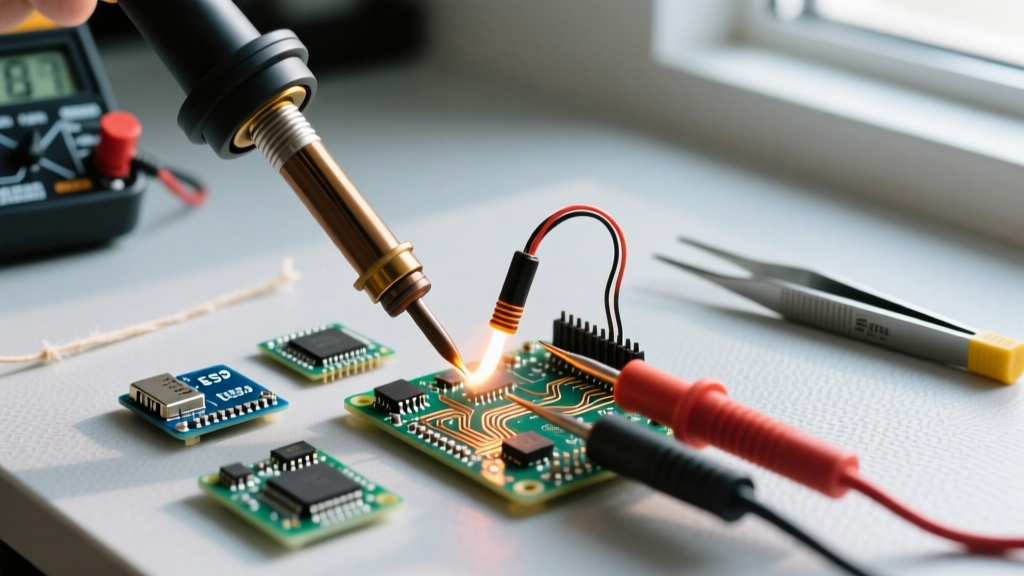
- Choose the Compact PD Iron (FNIRSI/Sequre) if: You are repairing drone flight controllers, soldering 0603 SMD components, building custom mechanical keyboards, or doing any work on multi-layer PCBs. You require ESD safety, precise temperature control (down to 100°C for heat shrink tubing), and JBC-compatible tip geometries for tight-pitch ICs.
Frequently Asked Questions
Can I use a 65W PD iron to solder thick automotive wires?
Technically yes, but practically no. While a 65W PD iron generates enough total energy, the physical mass of the cartridge tip is too small to transfer that energy into a thick copper wire quickly. The wire will act as a massive heat sink, cooling the tip faster than the ceramic heater can replenish it. For wires thicker than 14 AWG, the heavy copper loop of a small soldering gun is mandatory.
Do USB-C PD soldering irons require a specific power brick?
Yes. To achieve the full 65W output, your power brick or power bank must support the PPS (Programmable Power Supply) protocol over USB-C PD 3.0. If you plug a Sequre SI-01 into a standard 65W laptop charger that only supports fixed PDOs (like 20V/3.25A without PPS), the iron will often default to a safe 45W or 30W fallback mode, severely limiting its thermal recovery on large ground planes.
Is the magnetic field from a transformer gun dangerous to electronics?
Yes. The step-down transformer in a pistol-grip soldering gun generates a localized alternating magnetic field when the trigger is pulled. While harmless to copper wire and passive components, bringing an active transformer gun tip too close to unshielded Hall-effect sensors, inductors, or sensitive ICs can induce parasitic voltages or physically shift internal wire bonds. Never use a transformer gun on live or highly sensitive logic boards.