
The Hidden Cost of Poor PCB Fixturing
When assembling surface-mount or dense through-hole electronics, the soldering iron gets all the glory, but the fixturing dictates the outcome. A soldering iron helping hand is not just a convenience; it is a critical thermal and mechanical interface. In 2026, with the widespread adoption of high-thermal-mass lead-free alloys like SAC305 (melting at 217°C) and SAC405, board warpage, lifted pads, and cold joints are rampant if the PCB is not rigidly supported and properly heat-sunk.
According to the SparkFun through-hole soldering guide, board movement during the liquidus phase of solder cooling is a primary cause of micro-fractures in the intermetallic compound (IMC) layer. Yet, most hobbyists and even mid-level repair shops rely on $12 spring-loaded gooseneck alligator clips that fail catastrophically under thermal load. This comparison evaluates the top third-hand workholding solutions on the market, breaking down their mechanical rigidity, thermal dissipation, and ESD safety.
2026 Helping Hand Comparison Matrix
| Tool / Setup | Type | Base Material & Mass | Max Temp Tolerance | Est. Price (2026) | Best Application |
|---|---|---|---|---|---|
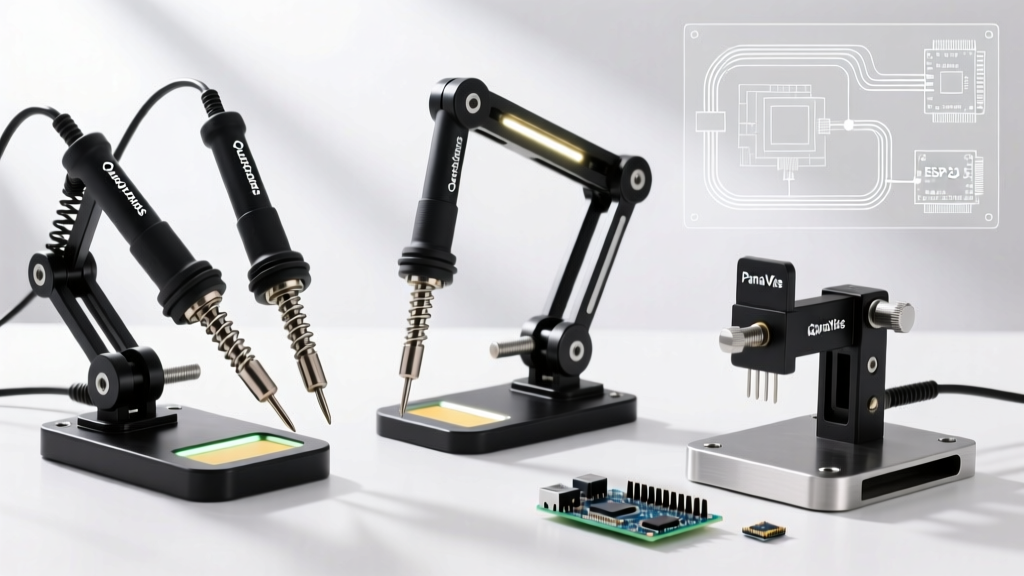
| Quadhands Multi-Arm | Articulating Friction Arms | Aluminum / 2.4 lbs | 260°C (Silicone sleeves) | $75 - $85 | Multi-wire harnesses, 3D prints |
| PanaVise Model 350 | Rigid PCB Vise | Zinc Die-Cast / 3.1 lbs | 150°C (ABS jaws w/ silicone pads) | $65 - $75 | Dense SMD rework, through-hole |
| Sensepeek PCBite2 | Magnetic Probe System | Steel Magnetic Base / 1.8 lbs | N/A (Probes are isolated) | $145 - $160 | Logic debugging, micro-SMD |
| Generic Gooseneck | Spring Steel Flex-Arm | Plastic / 0.4 lbs | 105°C (PVC sleeves melt) | $10 - $18 | Low-temp wire tinning only |
The Thermal Reality: PVC vs. Silicone and Heat Sinking
Before dissecting specific models, we must address the most common failure mode in budget soldering iron helping hand setups: thermal degradation of the grippers. Standard economy helping hands use alligator clips coated in polyvinyl chloride (PVC). PVC begins to soften at 80°C and melts into a toxic, corrosive sludge around 105°C. When you apply a 350°C soldering iron tip to a component held by a PVC-coated clip, the heat conducts down the copper lead, melts the clip, and fuses it to your component.
Premium setups utilize high-durometer silicone tubing, which withstands continuous temperatures up to 260°C without off-gassing or melting. Furthermore, the NASA Electronic Parts and Packaging (NEPP) Program workmanship standards emphasize that fixturing must act as a localized heat sink to protect adjacent temperature-sensitive components. A heavy, metal-based vise draws ambient heat away from the board edge, whereas a lightweight plastic base offers zero thermal mass, causing the entire PCB to act as a heat trap.
Contender 1: Quadhands Multi-Arm (The Articulated King)
The Quadhands system revolutionized the DIY soldering space by abandoning cheap goosenecks in favor of anodized aluminum friction-hinge arms with standard 1/4-20 camera threads.
Strengths and Edge Cases
- Infinite Modularity: Because it uses standard 1/4-20 threading, you can mount DSLR ball heads, smartphone clamps, or custom 3D-printed PCB trays to the arms.
- Zero Spring-Back: Unlike goosenecks that sag when you apply downward pressure with a soldering iron, the friction joints lock in place. What you see is what you get.
- Thermal Sleeves: The included alligator clips are pre-wrapped in high-temp silicone, preventing the PVC melting disaster.
Where It Falls Short
Quadhands excel at holding wires, connectors, and irregular 3D-printed enclosures. However, for holding a flat, rigid 100mm x 100mm PCB for SMD drag-soldering, the localized clamping force of alligator clips can cause board bowing. It is not a dedicated PCB vise.
Contender 2: PanaVise Model 350 (The Rigid Workhorse)
If you are doing high-density SMD rework or precision through-hole soldering, you need absolute rigidity. The PanaVise Model 350 (an upgrade from the plastic-based Model 201) features a heavy zinc die-cast base and a self-centering vise head.
'Board support during soldering is critical to prevent mechanical shock and thermal warping, which can compromise the intermetallic bond.' — Adafruit Guide to Excellent Soldering
The ESD and Thermal Profile
The standard ABS plastic jaws of the PanaVise are inherently insulating, which is dangerous in ESD-sensitive environments (where surface resistance must be between $10^6$ and $10^9$ ohms). For 2026 workflows, you must upgrade to the optional conductive rubber jaw pads. These pads not only dissipate static but also grip the bare FR4 fiberglass securely without crushing delicate edge-mounted components like USB-C connectors or castellated vias.
Contender 3: Sensepeek PCBite2 (The Pro Debugging Standard)
For electrical engineers and advanced repair technicians, the traditional soldering iron helping hand evolves into a magnetic fixturing system. The Sensepeek PCBite2 uses a heavy steel baseplate and magnetic, spring-loaded pogo-pin probes to hold the board from below or above.
- Unobstructed Access: Because the board is held by tiny magnetic probes, the top and bottom edges are completely free for soldering iron access, hot air rework, or oscilloscope grounding clips.
- Integrated Logic Probes: The kit includes specialized SMD grabbers that magnetically snap to the base, acting as a true 'third hand' for multimeter and logic analyzer leads.
- Cost Barrier: At roughly $155, it is an investment strictly for those debugging complex multi-layer boards where traditional clamps would obstruct test points.
The Generic Gooseneck Trap: A Failure Analysis
We must explicitly warn against the ubiquitous $15 'octopus' gooseneck holders found on Amazon and AliExpress. These tools suffer from three fatal engineering flaws:
- Spring Fatigue: The internal steel spring loses tension after repeated bending, leading to 'droop' exactly when you apply the weight of a soldering iron to the wire.
- Resonance Vibration: The long, unsupported flexible arms act as tuning forks. If you bump the desk, or if a nearby cooling fan vibrates, the alligator clips oscillate, ruining the solder joint during the critical cooling phase.
- Base Tipping: The bases are typically hollow plastic filled with a thin layer of sand or a small steel washer. When you extend the arms horizontally to hold a heavy wire harness, the center of gravity shifts past the base footprint, causing the entire rig to crash onto your workspace.
Step-by-Step: Configuring the Perfect Fixturing Envelope
To maximize the effectiveness of your soldering iron helping hand, follow this ergonomic and thermal setup protocol:
- Establish the Thermal Mass: Place your heavy vise or magnetic base directly on an ESD-safe silicone mat. Never place it directly on a hollow wooden desk, which absorbs heat unevenly and can warp.
- Set the Optical Axis: Position your articulated arms so the PCB is angled at 15 to 20 degrees toward you. This allows solder flux fumes to rise away from your face and aligns the board with standard stereo boom microscopes.
- Implement Auxiliary Heat Sinking: If using alligator clips on delicate IC legs, wrap the clip teeth in copper foil tape before clamping. The copper will aggressively wick heat away from the IC junction, preventing thermal shutdown or silicon damage.
- Verify ESD Continuity: Use a multimeter to verify continuity from the alligator clip teeth, through the arm, down to the base, and finally to your bench's common ESD ground point.
Frequently Asked Questions
Can I use a 3D printed helping hand for soldering?
Yes, but material selection is critical. Standard PLA softens at 60°C and will deform if a stray soldering iron touches it or if heat conducts down a wire. You must print custom fixturing jaws or arms in PETG (softens ~80°C) or, ideally, ABS/Polycarbonate (softens >105°C) to survive the ambient thermal radiation of a 350°C iron.
Do I need a magnifying glass attached to my helping hand?
In 2026, integrated glass magnifiers with built-in LED rings are largely considered obsolete and optically inferior. Most professionals prefer to use a separate, high-CRI LED desk lamp paired with a digital microscope or a dedicated stereo boom microscope. The integrated lenses on cheap helping hands often introduce chromatic aberration and restrict the physical clearance needed for your soldering iron and fume extractor.
How do I clean melted flux off silicone helping hand sleeves?
Do not use harsh solvents like acetone or MEK, which will degrade the silicone matrix. Instead, use a stiff nylon brush dipped in 99% Isopropyl Alcohol (IPA) or a dedicated electronics flux remover like MG Chemicals 824. Scrub gently while the flux is still slightly warm for the best results.