
The Anatomy of Soldering Gun Types
When tackling heavy-gauge wiring, stained glass, or plumbing, standard pencil irons lack the thermal mass required to prevent cold joints. This is where soldering guns excel. However, the market is flooded with options, and understanding the underlying engineering of different soldering gun types is critical for making a sound investment in 2026. Unlike continuous-heat irons, soldering guns utilize a pistol-grip form factor and a trigger mechanism, delivering high-wattage thermal bursts on demand.
Broadly, modern soldering guns fall into three architectural categories:
- Step-Down Transformer Guns: The traditional workhorse. These use a heavy toroidal or laminated transformer to step down 120V/240V AC mains to a fraction of a volt (typically 0.2V to 1.0V) while pushing massive current (150A to 300A) through a low-resistance copper tip.
- Ceramic PTC (Positive Temperature Coefficient) Guns: A premium evolution. These utilize advanced ceramic heating elements with integrated thermistors. As the element heats, its electrical resistance increases, providing a natural, self-regulating thermal ceiling without the need for heavy transformers.
- Butane/Cordless Thermal Guns: Powered by catalytic gas reactions. While highly portable for field plumbing, they lack the precise thermal regulation required for electronics and are generally excluded from precision PCB workflows.
The Budget Tier: High Amperage, Low Precision
The budget segment (typically $25 to $55) is dominated by entry-level transformer guns like the Wahl Universal 5050 (~$28) and the Weller 9405 Dual Heat (~$48). These tools are designed for occasional household repairs, automotive wire splicing, and basic stained-glass foiling.
Engineering Trade-offs and Failure Modes
Budget transformer guns operate on a simple binary circuit: pulling the trigger closes the primary AC circuit, inducing a magnetic field that drives current through the secondary winding (the tip). Because there is no closed-loop PID temperature controller, the tip's temperature is entirely dependent on the thermal mass of the joint and the duration of the trigger pull.
Expert Insight: The distinct 'hum' of a budget soldering gun is the 60Hz (or 50Hz) AC magnetic field vibrating the transformer laminations. This AC cycle creates a thermal ripple, meaning the tip temperature fluctuates slightly with every zero-crossing of the AC wave, leading to inconsistent solder flow on large thermal planes.
Common Failure Modes:
- Secondary Winding Shorts: If the user bends the raw copper tip too close to the gun's chassis or drops the tool, the secondary winding can short against the metal housing, instantly blowing the internal thermal fuse or destroying the transformer.
- Unregulated Oxidation: Holding the trigger down for more than 15 seconds causes the tip to exceed 450°C. At this threshold, the iron plating on cheap tips rapidly oxidizes and pits, rendering the tip unwettable and requiring immediate replacement.
- ESD Vulnerability: Budget transformer guns are rarely ESD (Electrostatic Discharge) safe. The alternating magnetic field can induce parasitic voltages in nearby sensitive MOSFET gates, potentially destroying microcontrollers or logic boards if used for desoldering heavy power components.
The Premium Tier: ESD-Safe and Thermally Stable
Stepping into the premium tier ($80 to $200+) introduces tools engineered for professional electricians, avionics technicians, and serious hobbyists. The Weller D550N Professional (260W/200W) (~$85) represents the pinnacle of heavy-duty transformer design, featuring a die-cast aluminum housing, integrated LED work lights, and a replaceable heavy-duty secondary winding. However, the true technological leap is found in ceramic models like the Hakko 980 ESD-Safe Soldering Gun (~$165).
The Ceramic Advantage
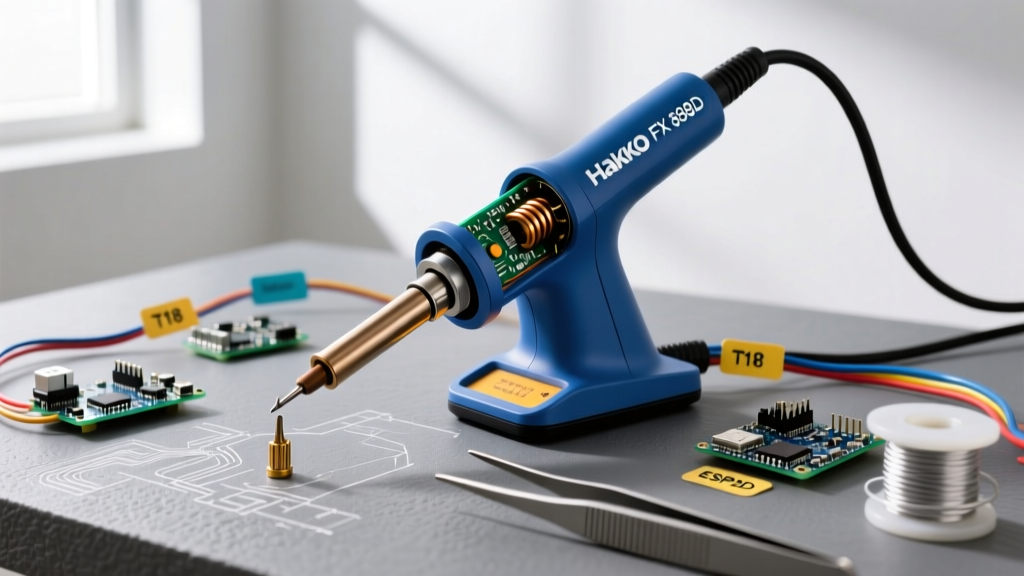
The Hakko 980 abandons the heavy, humming transformer for a lightweight, high-efficiency ceramic heater. It delivers 200W of rapid heat but utilizes a PTC thermistor to clamp the maximum temperature, preventing the catastrophic overheating seen in budget models. Crucially, the Hakko 980 is fully ESD-safe; the tip is grounded directly to the earth pin of the power cord through a dedicated low-impedance pathway, safely dissipating static charges and preventing inductive spikes from damaging sensitive silicon.
Furthermore, premium guns utilize interchangeable, iron-plated copper tips rather than raw copper wire loops. This allows technicians to swap between chisel, conical, and heavy spade tips depending on the thermal mass of the joint, significantly extending tip lifespan and reducing long-term consumable costs.
Head-to-Head Comparison Matrix (2026 Market Data)
| Feature | Wahl 5050 (Budget) | Weller 9405 (Budget) | Weller D550N (Premium) | Hakko 980 (Premium) |
|---|---|---|---|---|
| Heating Technology | Transformer | Transformer | Transformer | Ceramic PTC |
| Wattage Output | 100W / 150W | 120W / 240W | 200W / 260W | 200W (Regulated) |
| Heat-Up Time | ~4.5 seconds | ~3.8 seconds | ~3.0 seconds | ~6.0 seconds |
| ESD Safe | No | No | No | Yes (Grounded) |
| Tip Type | Raw Copper Wire | Raw Copper Wire | Heavy Copper Loop | Interchangeable Iron-Plated |
| 2026 Avg. Price | $28 | $48 | $85 | $165 |
| Best Application | Occasional DIY wire splicing | Stained glass, basic plumbing | Heavy gauge automotive/marine | PCB power planes, ESD-sensitive |
The Hidden Cost: Tip Degradation and Pad Lift
When evaluating soldering gun types, the initial purchase price is only a fraction of the total cost of ownership. Budget guns suffer from a metallurgical phenomenon known as copper dissolution. When raw or poorly plated copper tips are exposed to molten SAC305 (lead-free) solder at unregulated temperatures exceeding 400°C, the tin in the solder aggressively leaches the copper from the tip. A budget gun tip can dissolve and require reshaping with a file after just 20 to 30 heavy joints.
Compliance with Industry Standards
For professionals working in aerospace, automotive, or high-reliability electronics, thermal regulation is not optional. The NASA Workmanship Standards (NASA-STD-8739.3) strictly dictate the visual and metallurgical requirements for soldered connections. Unregulated thermal spikes from budget transformer guns frequently cause 'pad lift'—where the excessive heat delaminates the copper pad from the FR-4 fiberglass substrate of a printed circuit board.
Similarly, the IPC J-STD-001 standard for soldered electrical and electronic assemblies requires proper wetting and the formation of a smooth, continuous intermetallic compound (IMC) layer. Budget guns, lacking thermal feedback, often burn off the rosin flux before the solder can properly flow, resulting in dull, grainy, and mechanically weak 'cold' joints that fail IPC visual inspection criteria. Premium ceramic guns maintain the precise 240°C to 260°C window required for optimal flux activation and IMC formation without scorching the board.
The 2026 Buying Decision Framework
To determine which soldering gun type belongs on your workbench, apply this practical decision matrix based on your primary use case:
- Choose the Budget Transformer (Weller 9405) if: You are primarily working with non-electronic applications. This includes joining copper foil for stained glass, soldering heavy-gauge speaker wire, or repairing sheet metal roofing where ESD safety and precise thermal control are irrelevant, and raw thermal brute-force is required.
- Choose the Premium Transformer (Weller D550N) if: You are an automotive or marine mechanic dealing with 4 AWG to 10 AWG battery cables and grounding lugs. The massive 260W transformer output provides the thermal inertia needed to heat thick copper lugs without stalling, while the rugged die-cast housing survives shop environments.
- Choose the Premium Ceramic (Hakko 980) if: You are working on PCBs, repairing drone flight controllers, or soldering power electronics (like MOSFETs and large capacitors) where ESD safety is mandatory. The ceramic element ensures you will not accidentally fry a $50 microcontroller with an inductive voltage spike, and the interchangeable tips allow for precision work that transformer loops simply cannot achieve.
Final Verdict
The divide between budget and premium soldering gun types in 2026 is defined by control, safety, and metallurgy. While a $30 transformer gun will successfully melt solder onto a wire, it does so with the finesse of a sledgehammer. For any application involving printed circuit boards, sensitive semiconductors, or IPC-compliant commercial work, the premium investment in an ESD-safe ceramic gun is not just a luxury—it is a fundamental requirement for reliable, long-lasting electrical connections.