
The Induction vs. Ceramic Heating Paradigm
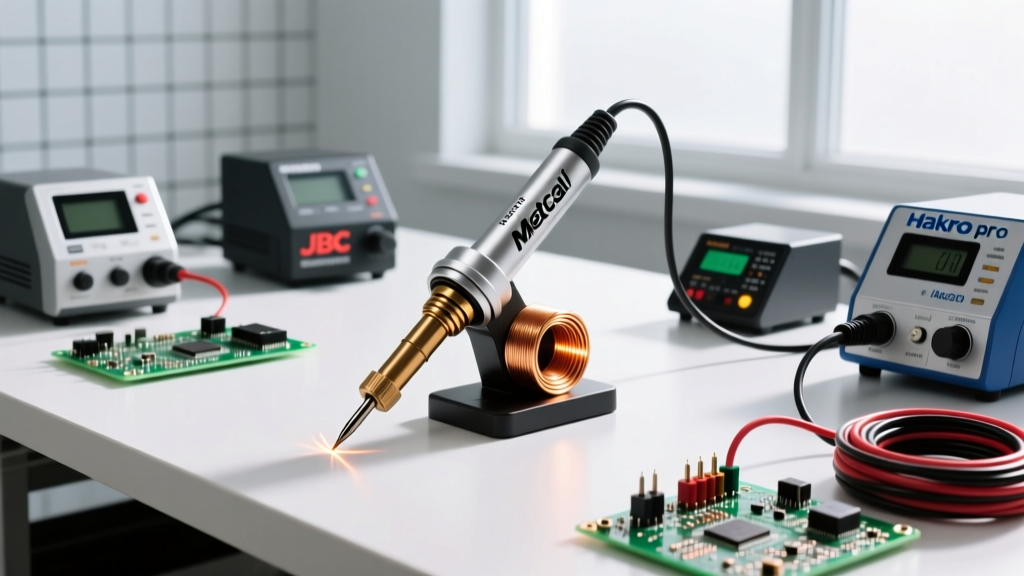
When outfitting a professional electronics lab or aerospace rework station in 2026, the debate inevitably narrows down to three flagship ecosystems: the Metcal soldering iron ecosystem (specifically the MX-5200), JBC’s CD-2BQE, and Hakko’s FX-951. While Hakko and JBC rely on advanced PID-controlled ceramic heating elements with thermocouple feedback, Metcal utilizes a fundamentally different physics-based approach: RF induction heating governed by the Curie point. Understanding this distinction is critical for engineering managers and senior technicians aiming to optimize throughput, minimize component thermal damage, and manage long-term consumable costs.
Head-to-Head Matrix: Metcal MX-5200 vs. JBC CD-2BQE vs. Hakko FX-951
| Specification | Metcal MX-5200 | JBC CD-2BQE | Hakko FX-951 |
|---|---|---|---|
| Heating Technology | RF Induction (SmartHeat) | Ceramic Heater + PID | Ceramic Heater + PID |
| Base Unit Price (2026) | ~$650 | ~$580 | ~$320 |
| Avg. Cartridge/Tip Cost | $38 - $45 | $45 - $55 | $8 - $12 |
| Heat-Up Time (to 350°C) | ~8 seconds | ~2 seconds | ~20 seconds |
| Thermal Overshoot | Zero (Physics-limited) | Minimal (Software-limited) | Moderate (Sensor lag) |
| Heavy Ground Plane Recovery | Exceptional | Excellent | Poor to Fair |
| Calibration Required | Never | Annually | Bi-Annually |
Deep Dive: Metcal SmartHeat Technology
The core of any Metcal soldering iron is its proprietary SmartHeat cartridge. Unlike traditional stations that measure temperature via a thermocouple and adjust power via a PID controller, Metcal uses an RF generator (operating at 13.56 MHz in older models and auto-adjusting frequencies in the MX-5200) to induce eddy currents in a ferromagnetic core inside the tip.
The Curie Point Advantage
The ferromagnetic alloy is engineered to have a specific Curie temperature (typically 350°C, 380°C, or 410°C). When the tip reaches this exact temperature, the core loses its magnetic properties. The RF field can no longer induce eddy currents, and heating stops instantly. As soon as the tip transfers heat to a PCB pad and drops below the Curie point, magnetism returns, and full RF power is reapplied. This results in a self-regulating system with zero thermal overshoot and instantaneous thermal recovery, completely eliminating the need for digital calibration.
Expert Insight: In high-reliability manufacturing, thermal overshoot is a primary cause of micro-cracking in MLCCs (Multi-Layer Ceramic Capacitors). Metcal’s physics-limited heating inherently prevents the tip from exceeding its rated Curie temperature, offering a hardware-level safeguard that software-limited PID stations cannot guarantee during sensor lag events.
Competitor Analysis: When to Choose JBC or Hakko
JBC CD-2BQE: The Micro-SMD King
While Metcal dominates heavy thermal mass applications, JBC’s CD-2BQE station excels in ultra-fine pitch micro-SMD rework. JBC’s C210 and C245 cartridges integrate the heater and thermocouple at the very tip of the cartridge, resulting in a blistering 2-second heat-up time and unmatched precision for 0201 and 01005 components. However, JBC tips are the most expensive on the market, often exceeding $50 per cartridge, and the station requires annual calibration to maintain compliance with strict aerospace standards.
Hakko FX-951: The Budget Workhorse
The Hakko FX-951 remains the undisputed champion of cost-effective lab deployment. At roughly $320 for the base unit and under $10 for T18 replacement tips, it is the default choice for educational labs, hobbyists, and high-volume consumer electronics repair where absolute thermal precision is secondary to operational expenditure. Its primary failure mode is the degradation of the ceramic heating element due to thermal shock, and its PID controller can struggle to maintain temperature when soldering to multi-layer boards with heavy copper pours.
Total Cost of Ownership (TCO) and Edge Cases
When evaluating the Metcal soldering iron ecosystem, buyers often experience sticker shock regarding consumable costs. A single Metcal STTC cartridge costs between $38 and $45. If a busy lab goes through 100 tips a year, the Metcal consumable budget is roughly $4,000, compared to just $900 for Hakko. However, this raw calculation ignores hidden operational costs:
- Calibration Labor: Hakko and JBC stations require periodic NIST-traceable calibration. Metcal stations never require calibration, saving hundreds of dollars in metrology lab fees and downtime.
- Scrap Rates: Thermal overshoot on cheaper stations leads to damaged PCB pads and sensitive ICs. Metcal’s zero-overshoot profile reduces expensive scrap rates in prototype and aerospace environments.
- Tip Seizure: Hakko tips frequently seize to the ceramic heater if flux creeps down the shaft, requiring the replacement of both the tip and the $40 heater assembly. Metcal cartridges are self-contained; if the tip degrades, you simply swap the single cartridge.
Metcal Failure Modes to Watch
Metcal cartridges do not last forever. The primary failure mode is underheating. Over time, the ferromagnetic coating inside the cartridge can degrade, or the tip can oxidize internally. When this happens, the RF generator will run continuously (indicated by a solid power light and audible hum), but the tip will fail to reach the Curie temperature, resulting in cold solder joints. Technicians must be trained to recognize this acoustic and visual cue and discard the cartridge immediately to avoid compromising IPC compliance.
Compliance and Aerospace Standards
For facilities producing hardware for defense, medical, or aerospace sectors, adherence to IPC J-STD-001 (Requirements for Soldered Electrical and Electronic Assemblies) is mandatory. The standard strictly dictates thermal profiling and limits the time components can be exposed to elevated temperatures. Furthermore, guidelines published by the NASA Electronic Parts and Packaging (NEPP) Program emphasize the necessity of controlled thermal profiles to prevent intermetallic compound (IMC) overgrowth and pad lifting. Because the Metcal MX-5200 does not require software calibration and cannot physically overshoot its designated temperature profile, it is often the preferred tool for audited, high-reliability manufacturing floors where documenting tool calibration is a rigorous administrative burden.
Final Decision Framework for 2026
Choosing between these three titans depends entirely on your specific production environment and budget constraints:
- Choose Metcal (MX-5200) if: You are soldering heavy ground planes, RF shielding cans, or multi-layer aerospace boards where thermal recovery is paramount. It is also the best choice for labs that want to eliminate the administrative burden of annual tool calibration.
- Choose JBC (CD-2BQE) if: Your primary workload consists of ultra-fine pitch SMD rework, BGA salvage, and 01005 micro-components where tip geometry and rapid heat-up times are more critical than raw thermal mass penetration.
- Choose Hakko (FX-951) if: You are outfitting a large team, an educational institution, or a general repair bench where consumable budgets are strict, and the occasional struggle with heavy copper pours is an acceptable trade-off for a low initial capital expenditure.
Ultimately, the Metcal soldering iron remains a specialized, physics-driven marvel that justifies its premium consumable cost through unparalleled thermal stability and zero-maintenance compliance in high-stakes engineering environments.