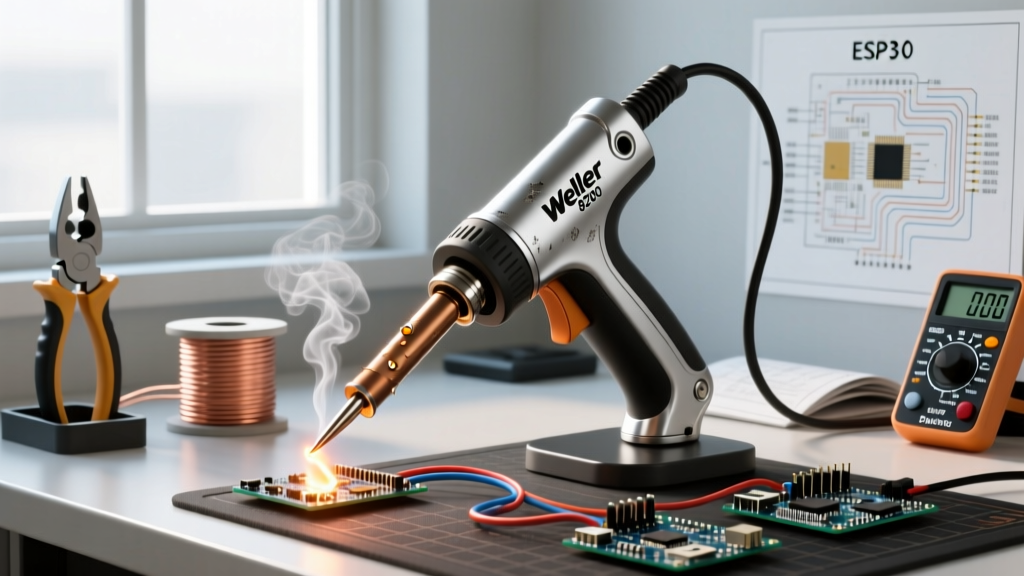

Among heavy-duty electronics technicians, RC hobbyists, marine electricians, and plumbers, the term "welding soldering gun" is frequently used to describe high-wattage, transformer-based soldering tools. While technically a misnomer—true welding fuses base metals at temperatures exceeding 2,500°F, whereas these guns max out around 900°F (482°C) to melt filler solder—the colloquialism perfectly highlights their brute-force thermal capability. Tools like the Weller D550 (260W) or the heavy-duty Hakko FR-300 are designed to sweat 4 AWG battery cables, join thick copper plumbing, and solder heavy ESC tabs where standard 60W ceramic-core irons would instantly fail.
However, pushing 200+ watts through a resistive copper loop takes a massive toll on the tool's internal components. In this 2026 guide, we will dissect the anatomy of heavy-duty transformer guns, diagnose common failure modes, and provide a strict maintenance protocol to extend the life of your equipment.
The Anatomy of a Transformer Soldering Gun
To troubleshoot effectively, you must understand how these tools generate heat. Unlike standard soldering irons that use a continuous resistive heating element, a soldering gun utilizes a step-down transformer. When you pull the trigger, 120V AC mains power energizes the primary winding. This induces a massive, low-voltage (typically 0.5V to 2V) but extremely high-amperage current in the secondary winding. The secondary winding is the thick copper wire that forms the tip itself. The electrical resistance of the tip causes it to heat up almost instantly.
Expert Insight: Because the tip is part of the secondary circuit, it operates at a very low voltage. This makes it inherently safer from a shock hazard perspective than a damaged line-voltage iron, but the high amperage means any loose connection at the tip nuts will generate massive localized arcing and heat, destroying the tool's internal bus bars.
Common Failure Modes & Troubleshooting Matrix
When your heavy-duty gun fails to reach the melting point of SAC305 (lead-free) or 63/37 (leaded) solder, consult this diagnostic matrix before ordering replacement parts.
| Symptom | Probable Cause | Multimeter / Visual Check | Solution |
|---|---|---|---|
| Gun hums loudly but tip stays cold | Loose tip nuts or oxidized contact faces | Visual: Black carbon buildup where tip meets bus bar | Clean faces with sandpaper; torque nuts snug + 1/4 turn |
| Trigger sparks visibly through housing | Internal switch contact arcing/pitting | Visual: Open housing, inspect microswitch contacts | Clean with DeoxIT D5 or replace switch (e.g., Weller SW-1) |
| Gun trips GFCI breaker immediately | Primary winding short to chassis/ground | Multimeter: Check resistance between prongs and chassis | Transformer is fatally shorted; replace entire unit |
| Tip heats unevenly (one side red hot) | Galvanic corrosion or bent tip loop | Visual: Asymmetrical oxidation or physical deformation | Reshape loop gently; replace tip if pitted (e.g., CT6F8) |
| Slow heat-up time (15+ seconds) | Failing primary winding or low mains voltage | Multimeter: Check primary winding resistance (should be 5-15Ω) | Verify outlet voltage; replace transformer if out of spec |
Deep Dive: Fixing the Arcing Trigger Switch
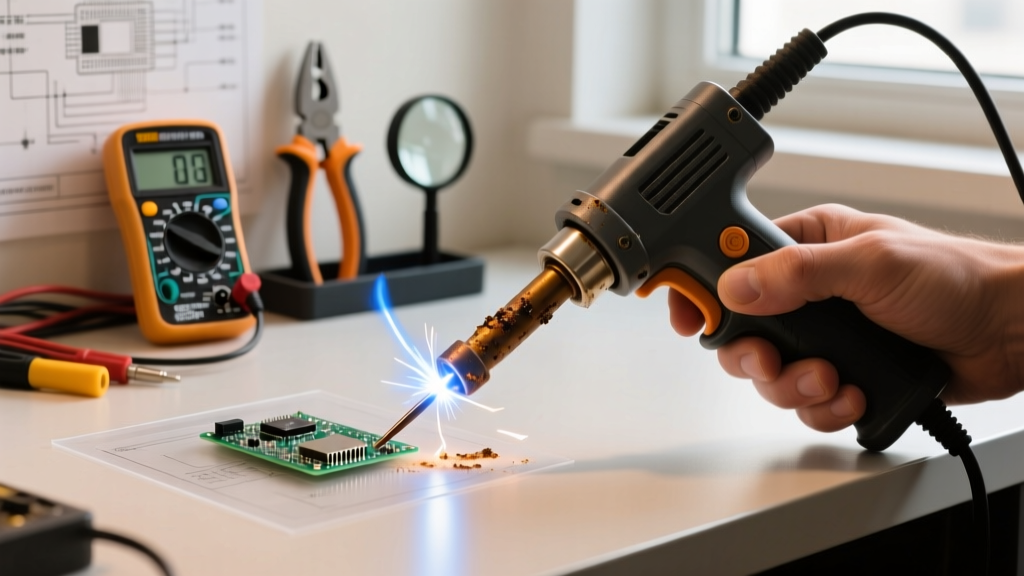
The most frequent point of failure on a heavy-duty welding soldering gun is the trigger switch. Transformers are highly inductive loads. When you release the trigger, the collapsing magnetic field generates a voltage spike (inductive kickback) that arcs across the switch contacts. Over time, this arcing pits the metal, increasing resistance and causing the switch to melt or fail to engage the high-heat secondary tap.
Step-by-Step Switch Restoration
- Disconnect Power: Never work on the primary side of a soldering gun while it is plugged in. There are no large capacitors to discharge, but the 120V line connection is exposed.
- Access the Cavity: Remove the perimeter screws on the gun's thermoplastic housing. Carefully separate the halves, noting the wire routing for the high/low heat taps.
- Inspect the Contacts: Look for black soot or pitted craters on the copper or silver-alloy contacts.
- Chemical Cleaning: Apply a specialized contact cleaner like DeoxIT D5 to dissolve carbon deposits. Avoid standard brake cleaners, which leave insulating residues.
- Mechanical Burnishing: If pitting is present, gently drag a fine diamond file across the contacts to restore a flat mating surface. Do not use sandpaper; the embedded silica will cause future arcing.
- Replacement: If the plastic actuator is melted, you must replace the switch assembly. For the ubiquitous Weller D550, replacement switches cost roughly $12 to $18 in 2026 and require basic crimping or soldering to install.
Tip Degradation: Pitting, Oxidation, and Cold Joints
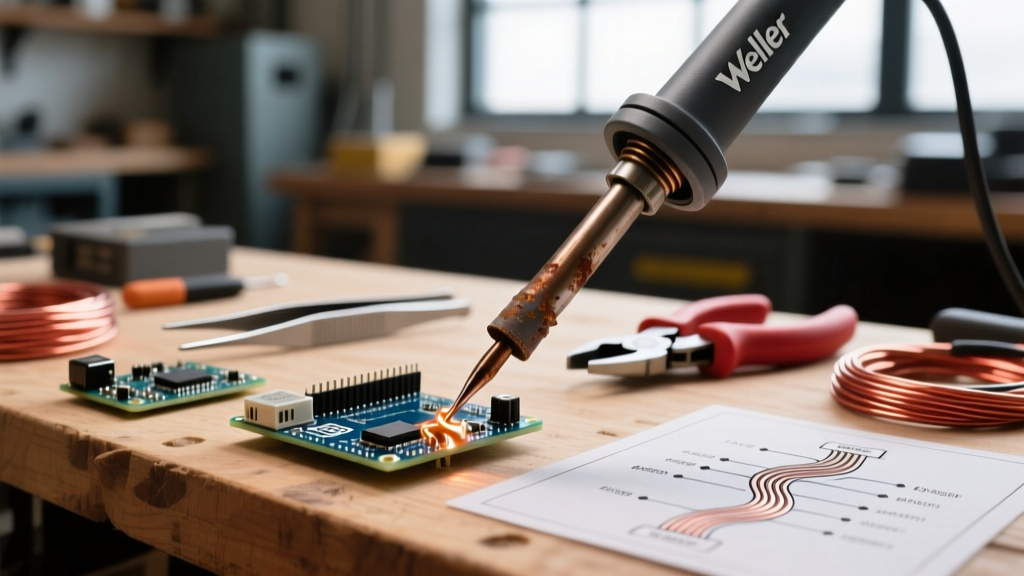
The tip of a transformer gun is not an iron-plated sleeve like a standard station; it is a raw, heavy-gauge copper wire. Copper dissolves into molten tin/lead alloys—a process known as solder leaching or pitting. Once the tip becomes heavily pitted, it loses surface area, resulting in poor thermal transfer and cold solder joints that violate IPC J-STD-001 standards for heavy thermal mass connections.
The Torque Specification Rule
A common mistake DIYers make is overtightening the brass or copper tip nuts to stop a buzzing sound. Never use pliers to tighten tip nuts. The correct installation method is to seat the tip firmly against the bus bars, tighten the nuts finger-tight, and then use the included wrench to turn exactly one-quarter (1/4) turn past snug. Overtightening will snap the copper loop or strip the soft brass threads, leading to a $15 repair bill and downtime.
Transformer Hum and Overheating Diagnostics
It is entirely normal for a heavy-duty soldering gun to emit a loud, 60Hz magnetic hum when the trigger is depressed. This is caused by magnetostriction—the magnetic laminations in the transformer core physically expanding and contracting at twice the AC line frequency. However, if the hum is accompanied by a burning ozone smell or excessive heat radiating from the rear of the gun (near the primary windings), you are likely experiencing an inter-winding short.
To test the primary winding, set your multimeter to the lowest Ohms range. Place the probes on the two main power prongs of the plug (with the trigger taped down in the 'ON' position). A healthy 260W Weller gun primary should read between 5.0 and 8.0 ohms. If you read less than 2.0 ohms, the enamel insulation inside the primary winding has melted and shorted, turning the transformer into a dead short. The unit must be discarded.
Preventative Maintenance Schedule
To keep your heavy-duty gun operating at peak thermal efficiency, adhere to this maintenance cadence:
- After Every Use (Daily): Always tin the tip with a generous blob of 63/37 rosin-core solder before turning off the gun. This sacrificial layer prevents ambient oxygen from oxidizing the raw copper while the tool cools.
- Monthly: Inspect the tip contact faces. Remove the tip and lightly scuff the mating surfaces with 400-grit wet/dry sandpaper to remove micro-arcing carbon deposits. Wipe with isopropyl alcohol before reassembly.
- Annually: Open the housing and blow out metallic dust and flux residue using compressed air. Flux vapors are highly corrosive and will eat through the bare copper windings over time. Ensure adequate ventilation during use, as outlined by NIOSH guidelines on soldering fumes and lead exposure.
Frequently Asked Questions
Can I use a welding soldering gun for delicate PCB work?
No. The massive thermal mass and high wattage will instantly delaminate FR4 fiberglass PCBs and blow the pads off surface-mount components. Restrict these guns to heavy-gauge wire, large lugs, and thick copper plumbing.
Why does my tip melt into the solder puddle?
You are experiencing severe solder leaching. This happens when you hold the trigger continuously for more than 30 seconds while using high-tin lead-free solders (like SAC405). Use the high-heat trigger only to achieve initial flow, then switch to the low-heat trigger (if equipped) to maintain the joint without dissolving the copper tip.