
Introduction to the Hakko FX-888D Workhorse
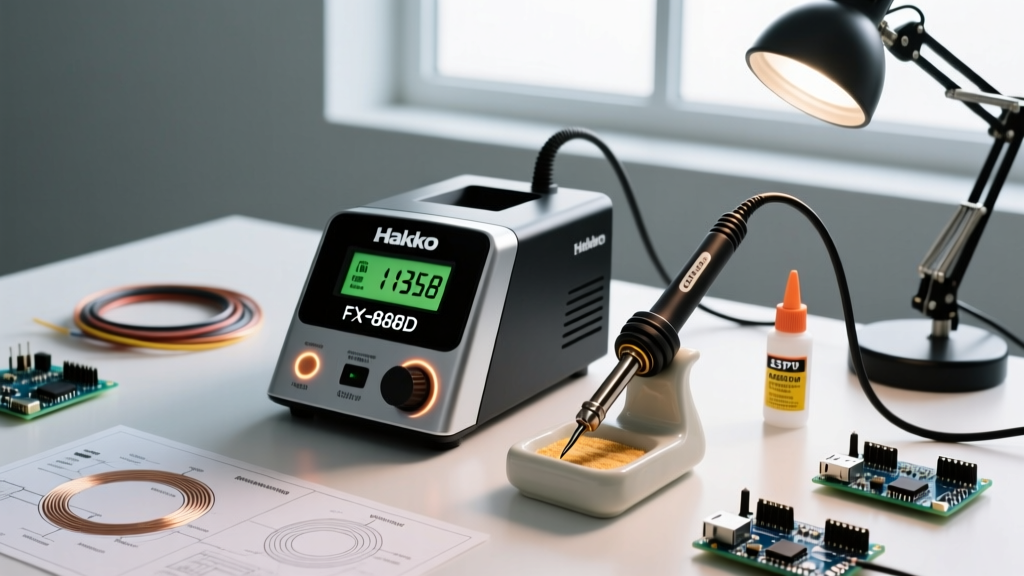
The Hakko soldering station FX-888D remains an industry standard in 2026 for both high-volume electronics manufacturing and precision DIY prototyping. Delivering 70 watts of digital PID-controlled power, it drives the ubiquitous T18 tip series with remarkable thermal recovery. However, even the most robust soldering equipment degrades under daily thermal cycling, flux exposure, and mechanical stress. When the FX-888D fails to maintain temperature or throws digital error codes, blind part-swapping is a waste of time and money. This guide provides deep, actionable troubleshooting and maintenance protocols to keep your station operating within the tight tolerances required by modern IPC J-STD-001 soldering standards.
Decoding FX-888D Digital Error Codes
The digital display on the FX-888D is not just a temperature readout; it is a primary diagnostic interface. When the internal microcontroller detects an anomaly in the heating circuit, it halts power to prevent thermal runaway and displays a specific error code.
| Error Code | Meaning | Root Cause | Diagnostic Action |
|---|---|---|---|
| H-E | Heater Error | Open circuit in the heater element or broken cord wire. | Test heater resistance at the 5-pin DIN connector (Pins 1 & 5). |
| S-E | Sensor Error | Short or open circuit in the thermocouple sensor. | Test sensor resistance (Pins 2 & 3). Check for tip seating issues. |
| C-E | Calibration Error | Calibration offset value exceeds the ±50°C safety threshold. | Reset to factory defaults. If error persists, replace the heater/sensor assembly. |
Expert Insight: If your station displays a flashing temperature readout accompanied by a continuous beep, the microcontroller has detected an open circuit. This usually means the handpiece is not fully inserted into the receptacle, the tip is missing, or the B1358 heater element has physically fractured.
Troubleshooting the Heating Element & Sensor Circuit
The FX-888D handpiece connects to the base via a 5-pin DIN connector. To accurately diagnose heating failures, you must isolate the fault to either the handpiece cord, the ceramic heater (Hakko part #B1358 or B3158), or the base station's internal TRIAC switching circuit.
Step-by-Step Multimeter Testing Protocol
Set your digital multimeter (DMM) to the lowest Ohms (Ω) range. Ensure the station is powered off and unplugged before testing.
- Locate the Pins: Examine the 5-pin DIN plug on the handpiece. Pin 1 is Heater (+), Pin 2 is Sensor (+), Pin 3 is Sensor (-), Pin 4 is Ground/Shield, and Pin 5 is Heater (-).
- Test the Heater Element: Place your DMM probes on Pins 1 and 5. A healthy B1358 ceramic heater will read between 2.0Ω and 3.0Ω at room temperature. A reading of OL (Open Loop) confirms a dead heater or a broken internal cord wire.
- Test the Thermocouple Sensor: Place your probes on Pins 2 and 3. The sensor should read between 1.0Ω and 2.0Ω. An OL reading indicates a severed sensor wire, often caused by dropping the handpiece or aggressive pulling of the cord.
- Check for Ground Faults: Test continuity between Pin 4 (Ground) and the metal shaft of the handpiece. You should have continuity. Then, test between Pin 1 (Heater) and Pin 4. There must be NO continuity. If there is, the heater has shorted to the chassis, posing a severe shock hazard.
Solving Temperature Calibration Drift
Over time, the thermocouple inside the T18 tip sleeve can degrade, causing the displayed temperature to drift from the actual tip temperature. While the CDC and NIOSH guidelines on soldering safety focus heavily on fume extraction, maintaining accurate thermal profiles is equally critical to prevent cold joints or pad delamination. If your external tip thermometer shows a variance greater than ±10°C, you must recalibrate the station.
Entering Calibration Mode
- Power off the FX-888D using the rear rocker switch.
- Press and hold the UP button on the front panel.
- While holding UP, turn the power switch ON. The display will show '1', indicating you are in the calibration offset menu.
- Release the UP button. Use the UP and DOWN arrows to input the offset value. For example, if your tip thermometer reads 340°C but the station is set to 350°C, you need to input -10.
- Press the ENTER button to save the offset. The station will return to normal operation.
Routine Maintenance for Maximum Lifespan
Preventative maintenance drastically reduces the failure rate of the FX-888D. The most common point of failure is not the electronics, but the metallurgical degradation of the T18 soldering tips and the ceramic heater sleeve.
Tip Metallurgy and Thermal Shock
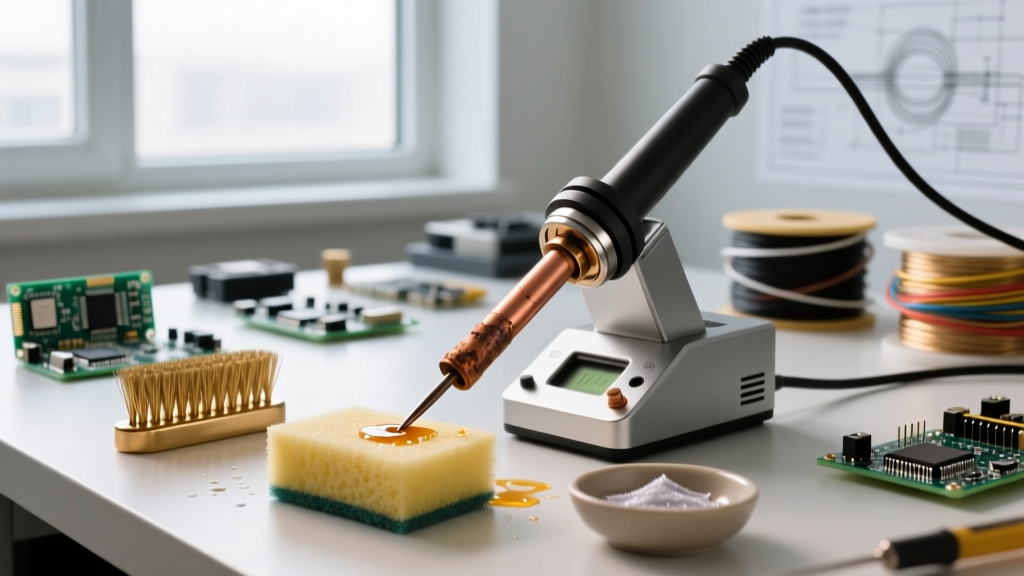
Hakko T18 tips feature a high-conductivity copper core plated with a layer of iron to resist solder erosion, followed by a chromium plating on the non-working areas to prevent solder wetting. Using a wet cellulose sponge to clean the tip causes rapid thermal contraction (thermal shock). Over hundreds of cycles, this micro-fractures the iron plating, allowing molten solder to dissolve the copper core. Always use dry brass wire wool for tip cleaning to maintain thermal stability and preserve the plating.
Heater Sleeve Care
The B1358 ceramic heater slides directly into the T18 tip. If flux residue and oxidized solder build up inside the tip's cavity, it acts as a thermal insulator. This forces the PID controller to drive the heater to higher voltages to maintain temperature, eventually burning out the ceramic element. Every 30 days, remove the tip, let it cool, and use a dry cotton swab to gently clean the inside cavity of the tip and the exterior of the ceramic heater.
Cost Analysis: Repair vs. Replace in 2026
When diagnosing a dead FX-888D, technicians must weigh the cost of OEM replacement parts against purchasing a new unit. Below is a realistic cost breakdown based on 2026 electronics distributor pricing.
| Component | Hakko Part Number | Avg. Cost (USD) | Failure Frequency |
|---|---|---|---|
| Ceramic Heater / Sensor | B1358 / B3158 | $24.00 - $28.00 | Moderate (Every 2-3 years) |
| Handpiece Cord Assembly | B2351 (5-Pin) | $32.00 - $38.00 | Low (Usually mechanical abuse) |
| Standard Chisel Tip | T18-D24 | $11.00 - $14.00 | High (Consumable) |
| Complete FX-888D Station | FX-888D | $115.00 - $135.00 | N/A |
Verdict: Replacing the heater element or cord is highly cost-effective. However, if the base station's internal transformer or main PCB fails (indicated by a completely dead unit with no display and verified AC power at the wall), the labor and part costs often exceed the price of a new unit. In such cases, replacement is the logical choice.
Expert FAQ: Edge Cases and Common Pitfalls
Can I use FX-951 T12 tips on the FX-888D?
No. The T12 tip series integrates the heating element and thermocouple directly into the tip itself and operates on a different pinout and power delivery protocol. The FX-888D is strictly designed for the T18 series tips paired with a separate B1358/B3158 heater. Attempting to modify the handpiece to accept T12 tips will result in immediate PCB damage and void all safety certifications.
Why does the temperature drop drastically when soldering large ground planes?
The FX-888D outputs 70 watts. While sufficient for 90% of PCB work, massive ground planes or heavy-gauge wires act as enormous heat sinks, draining thermal energy faster than the 70W element can replenish it. If you frequently solder heavy thermal masses, you are exceeding the station's design envelope. Upgrade to a higher-wattage station like the Hakko FX-951 (95W) or use a pre-heater board to bring the ambient PCB temperature up to 100°C before applying the iron.
The station works, but the handpiece gets excessively hot near the grip.
This is a classic symptom of a failing heater sleeve or a tip that is not fully seated. If the T18 tip is not pushed all the way down onto the ceramic heater, the heat transfer is inefficient. The PID controller detects the low temperature at the sensor and continuously maxes out the voltage to the heater, causing the upper shaft and grip to overheat. Ensure the locking nut is tightened securely while the tip is fully depressed.
For further technical bulletins, wiring diagrams, and warranty support, always refer directly to the official Hakko USA Support portal. Proper maintenance and precise troubleshooting will ensure your FX-888D delivers flawless, IPC-compliant solder joints for years to come.