
The True Cost of Ownership: Budget vs Premium in 2026
The landscape of electronics assembly has shifted dramatically. While a cheap iron soldering iron might suffice for basic wire splicing or through-hole capacitor replacements, modern surface-mount device (SMD) work and high-density PCB repair demand rigorous thermal management. When evaluating your primary iron, soldering iron thermal mass and heater proximity dictate your success with heavy ground planes and sensitive 0402 components alike.
In this comprehensive 2026 analysis, we dissect the engineering realities separating budget-friendly stations (under $100) from premium, lab-grade systems ($300 to $600+). We will examine PID control loops, intermetallic compound (IMC) layer formation, and the hidden costs of tip degradation to help you make an evidence-based purchasing decision.
Thermal Dynamics and the Intermetallic Compound (IMC) Layer
The most critical metric for any soldering tool is not its maximum temperature, but its thermal recovery time—the speed at which the tip returns to its setpoint after transferring heat to a joint. According to the IPC J-STD-001 standard for soldered electrical and electronic assemblies, excessive dwell time leads to the overgrowth of the Intermetallic Compound (IMC) layer.
An ideal IMC layer between the copper pad and the tin-lead or SAC305 solder should be between 1 and 3 microns thick. If a budget iron lacks the wattage or thermal mass to maintain temperature, the operator compensates by holding the iron on the pad longer. This prolonged heat exposure causes the IMC layer to grow excessively thick, resulting in a brittle, glass-like joint prone to micro-fracturing under thermal cycling or mechanical vibration.
Furthermore, NASA's Workmanship Standards for soldering emphasize strict dwell time limits to prevent delamination of the PCB substrate and pad lifting. Premium stations with active-tip technology eliminate this risk by injecting heat directly into the joint in under two seconds.
2026 Benchmark Comparison Matrix
Below is a data-driven comparison of the most dominant platforms across both tiers, tested on a standard 4-layer FR4 board with 2oz copper ground planes.
| Model / Tier | Nominal Wattage | Thermal Recovery (14 AWG) | Tip Technology | Avg. Tip Cost |
|---|---|---|---|---|
| Pinecil V2 (Budget) | 65W (Peak 90W) | ~4.5 seconds | Passive (T12 clone) | $2.50 - $5.00 |
| Hakko FX-888D (Mid) | 70W | ~8.0 seconds | Passive (T18) | $6.00 - $9.00 |
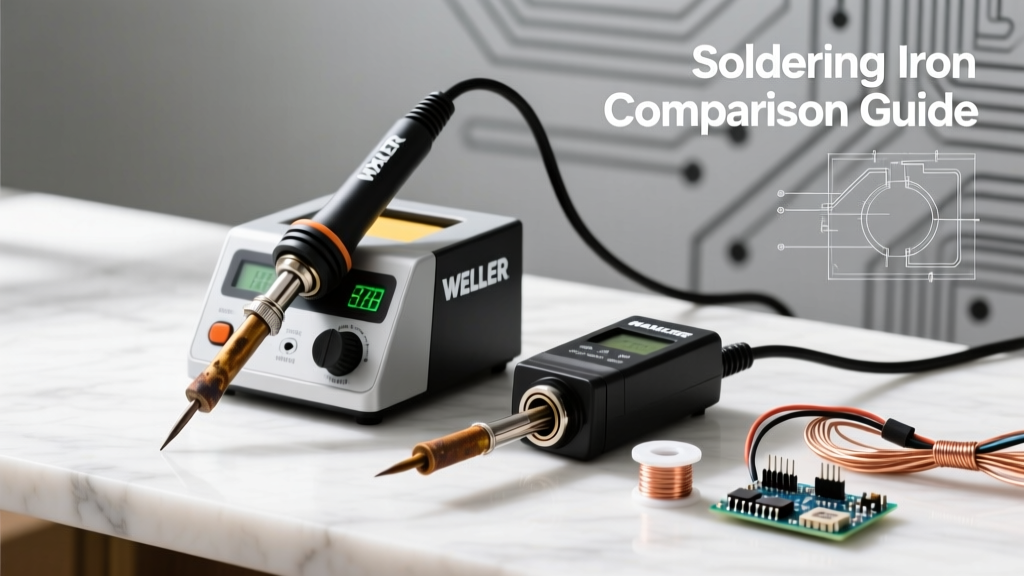
| Weller WE1010NA (Mid) | 70W | ~6.5 seconds | Passive (ET) | $8.00 - $12.00 |
| JBC CD-2BQE (Premium) | 130W (Peak) | ~1.5 seconds | Active (C245) | $35.00 - $45.00 |
Budget Tier Analysis: The $25 to $120 Range
The budget tier has been revolutionized by open-source, microcontroller-driven irons. The traditional transformer-heavy stations of the 2010s have been largely replaced by GaN (Gallium Nitride) USB-C power delivery systems.
The RISC-V Disruption: Pinecil V2
Retailing around $26 (excluding the power supply), the Pinecil V2 utilizes a RISC-V processor running a highly tunable PID (Proportional-Integral-Derivative) algorithm. It samples tip temperature up to 10 times per second. While it uses T12-style cartridges where the thermocouple and heater are in the same ceramic core, it still suffers from thermal lag when hitting massive ground planes because the heater element is physically separated from the very tip of the copper core by a few millimeters of insulating ceramic and air gaps.
- Pros: Unbeatable price-to-performance ratio, open-source firmware (IronOS), portable, accelerometer-based auto-sleep prevents tip oxidation.
- Failure Modes: Relies on third-party USB-C PD chargers; a poorly negotiated PD handshake can cause voltage drops and erratic temperature spikes.
The Legacy Workhorse: Hakko FX-888D
Priced around $115, the Hakko FX-888D remains a staple in educational labs. However, its T18 tip design is fundamentally outdated for modern micro-soldering. The heater sits inside a ceramic sleeve, and the tip slides over it. This mechanical air gap acts as a thermal insulator, severely bottlenecking heat transfer.
- Pros: Extreme durability, widely available genuine and clone tips, simple two-button digital interface.
- Failure Modes: Tip seizure. If the user fails to apply a thin layer of solder to the tip before powering down, flux carbonization will permanently fuse the T18 tip to the ceramic heater, requiring a costly heater replacement.
Premium Tier Analysis: The $300 to $600+ Range
Premium stations abandon the 'heater-plus-sleeve' design in favor of active tip technology. In these systems, the heating element and thermocouple are manufactured directly inside the copper tip cartridge, mere microns from the contact surface.
The Industry Standard: JBC CD-2BQE
At approximately $495, the JBC CD-2BQE station paired with C245 tips represents the pinnacle of thermal engineering. Because the heater is integrated into the tip, the station's microprocessor detects a temperature drop the millisecond the tip touches a cold solder joint, dumping up to 130 watts of instantaneous power directly into the joint. The thermal recovery is virtually imperceptible to the human operator.
- Pros: Flawless SMD and 0201 component work, zero thermal lag on heavy planes, tool-less tip ejection via a mechanical lever, advanced standby modes that drop tip temperature to 180°C when holstered to halt oxidation.
- Cons: The ecosystem is expensive. C245 tips cost roughly $40 each. Furthermore, the high thermal transfer rate can easily melt plastic connectors or lift poorly plated vias if the operator is not accustomed to the rapid dwell times.
The Weller Alternative: WXMP / WXD2
Weller's premium WX series offers similar active-tip performance (using the WXMP handpiece and RT series tips). Weller's competitors in the premium space often focus heavily on ESD (Electrostatic Discharge) safety and strict grounding pathways, making Weller a preferred choice in aerospace and medical device manufacturing where IPC-A-610 Class 3 compliance is mandatory.
Metallurgy and Tip Degradation: The Hidden Cost
When calculating the ROI of your soldering setup, you must factor in tip longevity. All soldering iron tips feature a copper core (for thermal conductivity) plated with iron (for erosion resistance), and finally a layer of chromium or nickel to prevent solder from wetting the non-working areas.
In budget irons, operators frequently crank the temperature to 400°C+ to compensate for poor thermal recovery. At these temperatures, the molten SAC305 (tin-silver-copper) solder aggressively dissolves the iron plating. Once the iron plating is breached, the solder attacks the copper core, hollowing out the tip in a matter of weeks. Premium stations, by contrast, allow operators to solder effectively at 320°C to 340°C because the instantaneous heat delivery eliminates the need for excessive baseline temperatures. Consequently, a $40 JBC tip used correctly on a premium station will often outlast ten $4 budget tips subjected to thermal abuse.
Decision Framework: Which Tier Do You Need?
The 80/20 Rule of Soldering: If 80% of your work involves through-hole components, basic wire splicing, or large-pitch DIP ICs, a $30 USB-C smart iron is all you need. If your work involves 4-layer PCBs, QFN/BGA rework, or high-reliability automotive/aerospace assemblies, the premium tier is not a luxury; it is a mandatory quality-control tool.
Final Recommendations for 2026
- Hobbyists & Makers: Buy the Pinecil V2 and pair it with a high-quality 65W USB-C GaN laptop charger. Allocate the saved capital toward premium 63/37 rosin-core solder (like Kester 44 or Senko) and high-quality brass tip cleaners.
- Repair Technicians & Lab Managers: Invest in the JBC CD-2BQE or Weller WX1. The reduction in rework time, eliminated pad-lifting incidents, and compliance with stringent IPC standards will yield a positive ROI within the first six months of professional use.
Ultimately, the best tool is the one that respects both the delicate metallurgy of the PCB and the time of the technician. By understanding the thermal physics at play, you can confidently select the station that aligns with your specific engineering requirements.