
The Evolution of SMD Rework in 2026
As surface-mount technology continues to shrink, with 01005 passives and high-density BGA (Ball Grid Array) packages becoming the standard in consumer and automotive electronics, traditional soldering irons are no longer sufficient for comprehensive PCB repair. A high-quality soldering hot air station is now a mandatory tool for any serious electronics workbench. Hot air rework stations utilize convective heat transfer to uniformly raise the temperature of component leads and solder paste, allowing for the safe removal and placement of multi-pin ICs without the mechanical stress of a physical iron tip.
In this 2026 best-of comparison, we evaluate the top-performing soldering hot air stations across professional, mid-tier, and budget categories. We will analyze airflow mechanics, thermal recovery rates, and ESD safety compliance based on ESD Association standards to help you select the exact tool for your rework needs.
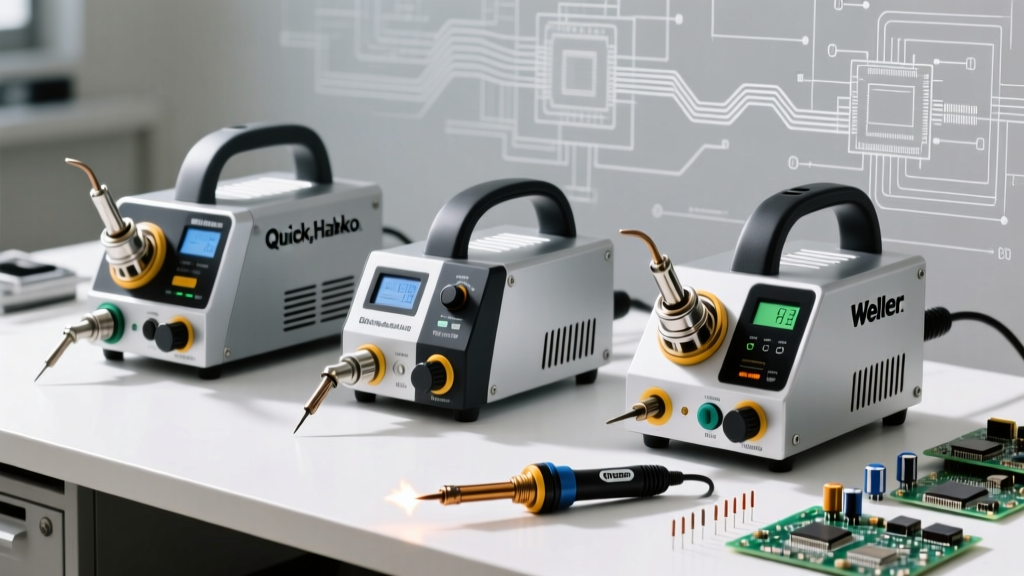
Quick Comparison Matrix: Top Hot Air Stations
| Station Model | Wattage | Airflow Type | Max Airflow | 2026 Est. Price | Best Application |
|---|---|---|---|---|---|
| Quick 861DW | 1000W | Brushless Fan | 120 L/min | $260 | Mid-tier / Prosumer |
| Hakko FR-830 | 1000W | Brushless Fan | 130 L/min | $850 | High-Volume Production |
| Weller WXHAP 200 | 200W | Brushless Fan | 90 L/min | $450 (Tool) | Precision Micro-Rework |
| Aoyue 852D++ | 600W | Diaphragm Pump | 50 L/min | $85 | Hobbyist / Entry-Level |
Deep Dive Reviews: The Best Soldering Hot Air Stations
1. Quick 861DW: The Undisputed Mid-Tier Champion
The Quick 861DW has maintained its dominance in the prosumer and independent repair shop market for years, and in 2026, it remains the gold standard for price-to-performance. Powered by a 1000W ceramic heating element and a highly reliable brushless motor, it delivers up to 120 liters per minute of smooth, laminar airflow.
- Pros: Exceptional thermal stability; quiet operation; digital PID temperature control accurate to within 2°C; widely available aftermarket nozzles (A-series).
- Cons: The handle cord is somewhat stiff and heavy, which can cause fatigue during intricate BGA rework sessions.
- Expert Insight: The brushless fan in the 861DW provides high volume but relatively low static pressure. This is ideal for broad heating, but when working on heavily grounded multi-layer PCBs, you must pair it with a bottom pre-heater to avoid exceeding the FR-4 glass transition temperature (Tg) on the top layer.
2. Hakko FR-830: The Production-Grade Powerhouse
When downtime costs hundreds of dollars a minute, the Hakko FR-830 is the station of choice. Priced at a premium $850, this 1000W unit is built for continuous, high-volume SMD rework. It features advanced digital profiling, allowing technicians to save specific temperature and airflow curves for different component types, ensuring strict adherence to IPC standards for rework thermal profiles.
- Pros: Unmatched build quality; programmable thermal profiles; integrated pre-heat control capabilities; ultra-fast thermal recovery.
- Cons: High initial investment; proprietary B-series nozzles are significantly more expensive than generic alternatives.
- Expert Insight: The FR-830 excels at removing large QFP (Quad Flat Package) ICs. By utilizing its programmable ramp-up feature, you can prevent thermal shock to adjacent sensitive components, a critical requirement in aerospace and medical device repair.
3. Weller WXHAP 200: Precision Meets Innovation
Part of the Weller WX ecosystem, the WXHAP 200 hot air iron is a marvel of modern engineering. While it only boasts 200W, its micro-heating element is positioned millimeters from the nozzle tip, resulting in near-instantaneous thermal response that rivals 1000W traditional stations. The standout feature is the integrated motion sensor: the station automatically enters standby mode when the handle is placed in the security rest, saving energy and extending heater life.
- Pros: Motion-sensing auto-standby; incredibly lightweight handle; superior precision for micro-SMD components; seamless integration with Weller WXD 2 MS base stations.
- Cons: Requires a WX base station (sold separately), pushing the total system cost over $1,200; lower maximum airflow volume compared to 1000W units.
- Expert Insight: Because the heating element is so close to the workpiece, the WXHAP 200 is less affected by ambient drafts from HVAC systems, making it highly reliable in open-bench environments.
4. Aoyue 852D++: The Budget-Friendly Workhorse
For hobbyists, students, and occasional repair technicians, the Aoyue 852D++ offers functional hot air rework at a fraction of the cost of professional units. It utilizes a 600W heating element and a traditional diaphragm pump rather than a brushless fan.
- Pros: Highly affordable; includes a built-in smoke absorber module; simple analog-style digital readouts; excellent for basic SOIC and SOP chip removal.
- Cons: Diaphragm pump causes noticeable desk vibration; pulsing airflow can displace tiny 0402 components if the nozzle is held too close; slow thermal recovery.
- Expert Insight: To mitigate the vibration inherent to diaphragm pumps, place a high-density silicone dampening mat under the main unit. Furthermore, keep the airflow dial below 40% when working with 0402 or smaller passives to prevent them from blowing off the pads before the solder reflows.
The Physics of Airflow: Brushless Fans vs. Diaphragm Pumps
Understanding the mechanics of your soldering hot air station is critical for avoiding catastrophic PCB damage. The market is divided into two primary airflow generation methods:
Brushless Fan Systems (High CFM, Low Static Pressure)
Stations like the Quick 861DW and Hakko FR-830 use brushless fans located in the base unit, pushing air through the hose to the heating element. This creates a smooth, continuous, and high-volume airflow. The laminar flow profile ensures that heat is distributed evenly across the surface of a BGA chip, reducing the risk of localized hot spots that can cause pad cratering.
Diaphragm Pump Systems (Low CFM, High Static Pressure)
Budget stations use an oscillating diaphragm pump. This creates a pulsing airflow (high static pressure but lower overall volume). While the high static pressure is good for pushing air through long, narrow nozzles, the pulsing nature can cause micro-vibrations. According to the NASA Workmanship Training Program, excessive vibration during the critical liquidus phase of solder reflow can lead to disturbed solder joints, resulting in brittle intermetallic layers and long-term reliability failures.
Real-World Troubleshooting: Avoiding Common Hot Air Failures
Tombstoning on Passives
The Failure: A two-terminal passive component (like a capacitor or resistor) stands up on one end during reflow, resembling a tombstone.
The Cause: Asymmetric heating. If the hot air is directed more heavily toward one pad, the solder paste on that pad will reflow first. The surface tension of the liquid solder pulls the component upright.
The Fix: Use a nozzle that is significantly wider than the component. Maintain a distance of 10-15mm from the PCB and use a slow, continuous circular motion to ensure both pads reach the liquidus temperature (typically 217°C for SAC305 lead-free solder) simultaneously.
MLCC Cracking (Thermal Shock)
The Failure: Multi-Layer Ceramic Capacitors (MLCCs) develop microscopic internal fractures that cause short circuits or capacitance loss under voltage.
The Cause: A rapid temperature gradient across the ceramic body. Blasting 400°C air directly onto a cold MLCC causes the outer layers to expand faster than the inner layers.
The Fix: Never start with maximum heat. Begin with an airflow temperature of 150°C to gently pre-heat the component and surrounding board area for 15 seconds, then ramp up to 350°C for the actual reflow. Always apply high-quality tack flux, which acts as a secondary thermal transfer medium, equalizing the heat distribution.
Pad Lifting and Delamination
The Failure: The copper trace separates from the fiberglass substrate.
The Cause: Prolonged exposure to temperatures exceeding the PCB's Tg (Glass Transition Temperature). Standard FR-4 has a Tg of around 130°C-150°C, and the decomposition temperature (Td) is roughly 300°C. Holding a 400°C hot air wand in one spot for more than a few seconds will vaporize the epoxy resin binding the copper to the board.
The Fix: Keep the wand moving. If a large ground plane is acting as a heat sink and preventing reflow, do not simply turn up the hot air station. Instead, use a PCB pre-heater to bring the entire board to 120°C, which drastically reduces the thermal delta required from the top-side hot air.
Final Verdict: Which Station Should You Buy?
Choosing the right soldering hot air station depends entirely on your workflow and budget. For independent repair shops, mobile technicians, and advanced hobbyists, the Quick 861DW remains the undisputed best value in 2026, offering professional-grade brushless airflow and PID control for under $300. If you are outfitting a high-volume production rework line where traceability and thermal profiling are legally required, the Hakko FR-830 is a necessary capital investment. Conversely, if your work primarily involves micro-soldering and precision component swapping under a microscope, the lightweight, motion-sensing Weller WXHAP 200 provides unparalleled ergonomic control. Finally, beginners dipping their toes into SMD rework will find the Aoyue 852D++ perfectly adequate for learning the fundamentals of convective heat transfer without breaking the bank.