
The Core Chemistry: Why Use Flux When Soldering?
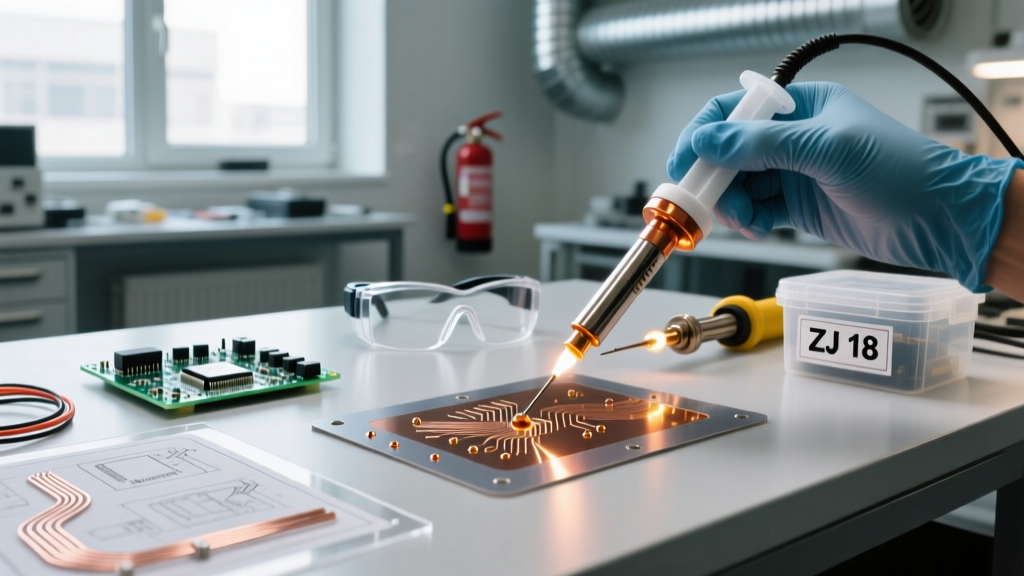
Many electronics hobbyists and junior technicians ask a fundamental question: why use flux when soldering if the solder wire already has a rosin core? The assumption that the internal flux core of a standard 63/37 or SAC305 wire is sufficient for all joints is a primary cause of field failures and rework. While the core flux aids in initial wetting, it vaporizes rapidly upon contact with a 350°C iron tip, leaving the secondary pad and component leads exposed to instantaneous oxidation.
At temperatures exceeding 150°C, copper surfaces rapidly form cuprous oxide (Cu2O) and cupric oxide (CuO). Solder alloys simply will not wet oxidized copper; the surface tension causes the molten alloy to ball up and reject the pad. Flux acts as a chemical reducing agent. The active ingredients in the flux dissolve the metal oxides, exposing the pure copper underneath, while simultaneously lowering the surface tension of the molten solder to promote capillary action. According to the NASA-STD-8739.3 Workmanship Standard for high-reliability soldering, the proper application and activation of flux is a mandatory requirement for achieving acceptable metallurgical bonds and preventing catastrophic joint fractures in mission-critical hardware.
Expert Insight: Flux does not just clean; it protects. The liquid flux creates a temporary thermal barrier that prevents oxygen from reaching the heated metal surface until the solder alloy can flow and permanently seal the joint.
Decoding the IPC J-STD-004C Classification Matrix
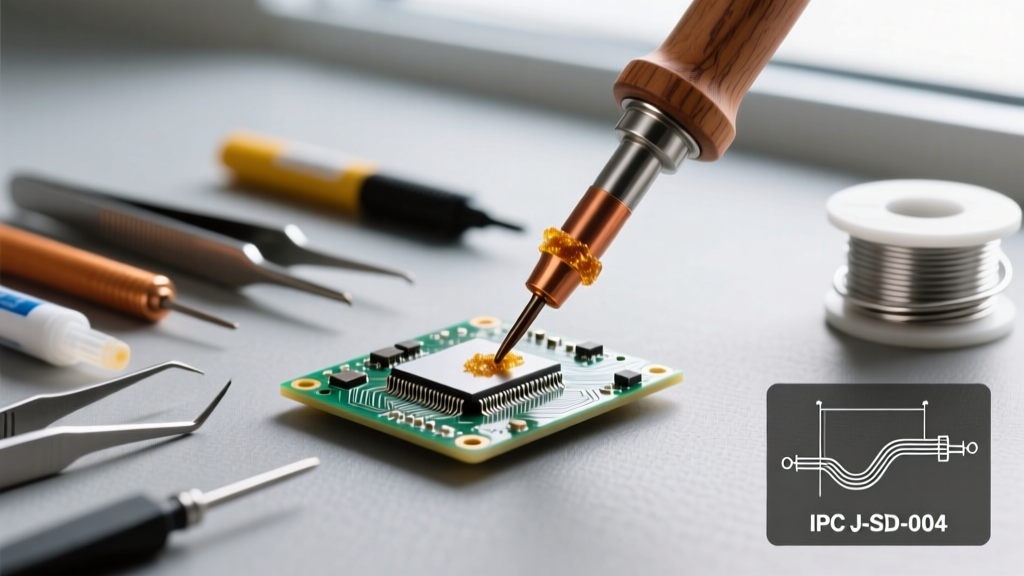
To select the right consumable, you must understand the IPC J-STD-004C standard, which categorizes fluxes by their chemical composition and activity level. This system replaced the outdated R, RMA, and RA designations with a more precise alphanumeric matrix.
| Composition Code | Chemical Base | Activity Level (L, M, H) | Halide Content | Cleaning Required? |
|---|---|---|---|---|
| RO | Rosin (Natural Pine Resin) | L (Low), M (Medium), H (High) | 0% to >2% | Depends on Activity (L=No, M/H=Yes) |
| OR | Organic Acid (Water-Soluble) | L, M, H | 0% to >2% | Yes (Strict DI Water Rinse) |
| IN | Inorganic Acid | L, M, H | High | Yes (Extremely Corrosive) |
| RE | Resin (Synthetic) | L, M, H | 0% to >2% | Depends on Activity |
The activity level (L, M, H) dictates the aggressive nature of the flux. Low (L) activity fluxes are typically no-clean and safe to leave on the board. Medium (M) and High (H) activity fluxes contain halide activators (chlorides or bromides) that aggressively strip heavy oxidation but will cause severe electrochemical migration (dendrite growth) if not cleaned post-soldering.
The Three Primary Flux Types for Electronics
1. Rosin-Based Flux (RO)
Derived from pine tree sap, the primary active ingredient is abietic acid. Rosin is solid at room temperature and only becomes chemically active when heated to its melting point (approx. 170°C).
Top Product Pick: Kester 186 Mildly Activated (RMA) Rosin Flux. Priced around $18 for a 2oz bottle, it is the industry standard for through-hole technology (THT) and heavy-gauge wire tinning. It leaves a hard, amber residue that is slightly tacky but generally non-corrosive in benign environments.
2. Water-Soluble / Organic Acid Flux (OR)
Formulated with organic acids (like lactic or stearic acid) and glycol ethers, these fluxes are highly aggressive. They are designed for automated wave soldering or soldering heavily oxidized legacy components.
Top Product Pick: Kester 245 Water-Washable Flux ($22 for 2oz). Warning: OR fluxes must be cleaned using heated deionized (DI) water (approx. 60°C) within 2 hours of soldering. Leaving OR flux on a PCB will guarantee trace corrosion and short circuits within weeks.
3. No-Clean Synthetic Flux (RE/RO-L)
Modern SMT assembly relies heavily on no-clean fluxes. These use synthetic resins and mild activators that completely consume themselves during the reflow process, leaving behind a clear, hard, and electrically inert residue.
Top Product Pick: Amtech NC-559-V2-TF Tacky Flux ($38 for a 10cc syringe). This is the gold standard for BGA rework and QFN drag-soldering. Its high viscosity holds micro-components in place before reflow, and the residue passes IPC surface insulation resistance (SIR) testing without cleaning.
Selection Framework: Matching Flux to Your Scenario
- Hobbyist / General THT Prototyping: Use a standard 63/37 rosin-core wire paired with a Kester 951 No-Clean liquid flux pen ($14). The pen wicks into tight connector pins where the wire core cannot reach.
- SMT Reflow & BGA Rework: Use a tacky no-clean paste flux (Amtech NC-559). The viscosity prevents 0402 and 0201 passives from floating or tombstoning during the liquidus phase of the reflow profile.
- High-Reliability / Aerospace: Follow strict NASA or IPC-A-610 Class 3 guidelines. Use an ROL0 (Rosin, Low Activity, 0% Halides) flux, followed by an ultrasonic cleaning process to ensure zero ionic residue remains before conformal coating application.
Real-World Failure Modes: What Happens When You Skip Flux?
Ignoring the principles of flux application leads to distinct, diagnosable failure modes on the PCB assembly:
- Cold Joints and High Contact Angles: Without flux to lower surface tension, the solder forms a convex blob with a contact angle greater than 90°. This joint lacks intermetallic compound (IMC) formation and will fracture under minor thermal or mechanical stress.
- Tombstoning (Drawbridging): In SMT reflow, if one pad oxidizes faster than the other due to uneven flux outgassing, the wetting force on the clean pad will pull the component upright, standing it on its end.
- Solder Balling and Splatter: When molten solder hits an oxidized pad, it rejects the surface and splatters into tiny micro-spheres. These spheres can lodge under IC leads, causing latent short circuits when the board is exposed to humidity.
- Dendritic Growth: If you use a high-activity (H) flux and fail to clean it, the halide residues absorb ambient moisture. Under DC voltage bias, metal ions migrate between traces, forming conductive crystalline structures (dendrites) that eventually short the circuit.
Expert Protocols for Flux Cleaning
A common misconception is that 99% Isopropyl Alcohol (IPA) is a universal flux cleaner. While IPA works for some pure rosin (R) fluxes, it merely smears the activators of RA and water-soluble fluxes across the board, trapping them under components. For thorough removal, consult the technical data sheets provided by the Indium Corporation's technical flux resources or use specialized saponifiers.
For localized cleaning of RMA fluxes, use an aerosolized solvent like Techspray Flux-Off V ($19/can) paired with a hog-hair brush to agitate the residue, followed by a lint-free wipe. For batch cleaning of water-soluble OR fluxes, utilize an ultrasonic cleaner operating at 40kHz with a 5% saponifier solution in DI water, heated to 55°C for exactly 4 minutes, followed by a cascading DI water rinse.
Frequently Asked Questions
Can I use plumbing flux for electronic soldering?
Absolutely not. Plumbing fluxes (like Oatey No. 95) are typically zinc chloride-based (Inorganic Acid / IN). They are vastly too aggressive for PCBs. Even after cleaning, the chloride ions penetrate the fiberglass laminate of the PCB, causing irreversible delamination and continuous trace corrosion.
Does flux expire?
Yes. Liquid and paste fluxes contain volatile solvents (like glycol ethers or alcohols). Over 12 to 24 months, these solvents evaporate, altering the flux's viscosity and reducing its thermal transfer properties. Store tacky flux syringes in a cool, dark environment (not necessarily refrigerated, as condensation can introduce water into the paste) and always check the manufacturer's shelf-life specification.