
The Great Confusion: Solder Paste vs. Soldering Paste
When assembling surface-mount devices (SMD) or executing complex BGA rework in 2026, choosing the right consumable is the difference between a reliable PCB and a scrap board. The terms 'solder paste' and 'soldering paste' are frequently conflated by hobbyists and even some entry-level technicians. However, in professional electronics manufacturing, they represent distinct chemical systems with entirely different applications.
Solder Paste is a precise mixture of microscopic powdered solder alloy and flux. It is designed for reflow soldering, applied via stencils or jet-printing, and melts in a reflow oven to form permanent electrical and mechanical joints.
Soldering Paste (often referred to as tacky flux or flux paste) contains little to no metallic solder powder. Instead, it is a highly viscous flux used to hold BGA spheres in place during manual rework, or to aid in hand-soldering with a traditional iron and solder wire. Understanding this distinction is the first step in mastering SMD assembly.
Solder Paste for Reflow: Powder Size Breakdown
The physical size of the solder powder particles dictates which components you can reliably assemble. According to the IPC J-STD-005 standard, solder pastes are categorized by 'Type' based on mesh size and micrometer (µm) particle distribution. As the industry pushes toward miniaturization with 01005 and 008004 metric components in 2026, selecting the correct powder type is critical to avoid bridging and insufficient solder defects.
| IPC Type | Particle Size (µm) | Best Use Case | Minimum Pitch |
|---|---|---|---|
| Type 3 | 25 - 45 µm | Standard through-hole, large SMD (SOIC, QFP) | 0.50 mm (20 mil) |
| Type 4 | 20 - 38 µm | Standard SMT, 0603/0402 passives, BGAs | 0.40 mm (16 mil) |
| Type 5 | 15 - 25 µm | Fine-pitch QFN, 0201 passives, micro-BGA | 0.30 mm (12 mil) |
| Type 6 | 5 - 15 µm | Ultra-fine 01005, 008004, advanced SiP | 0.15 mm (6 mil) |
Expert Insight: While Type 5 and Type 6 pastes are necessary for ultra-fine pitch, they possess a higher surface-area-to-volume ratio. This makes them highly susceptible to oxidation and requires strict nitrogen-inerted reflow atmospheres to prevent excessive solder balling and graping defects.
Alloy Selection: SAC305, SnPb, and Low-Temp BiSn
The metallic composition of your solder paste determines the melting point, mechanical strength, and thermal fatigue resistance of the final joint. Here are the dominant alloys used in modern PCB assembly:
1. SAC305 (Sn96.5 / Ag3.0 / Cu0.5)
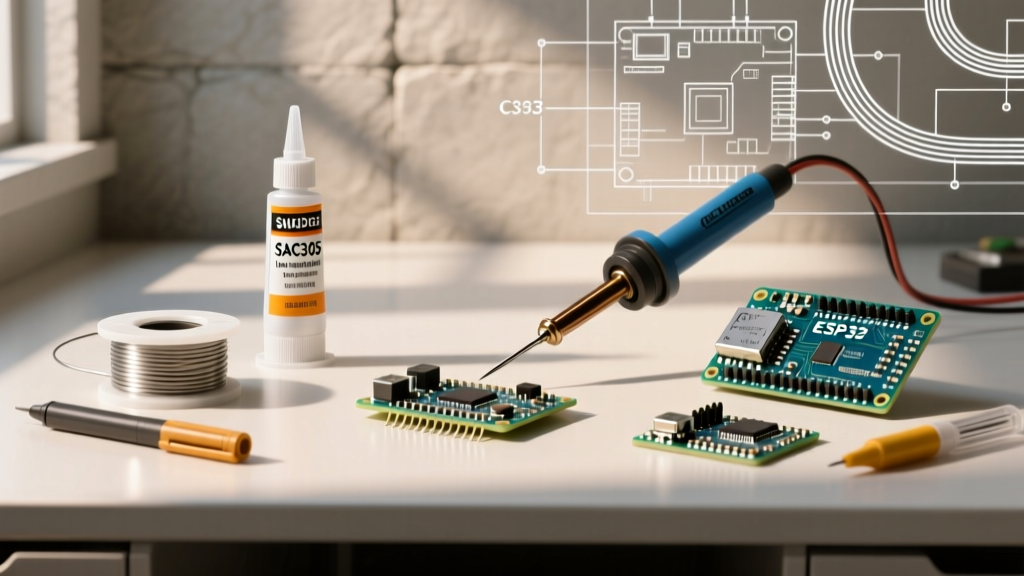
The undisputed king of commercial lead-free assembly. SAC305 melts at 217°C and offers excellent drop-shock resistance. A 50g syringe of Kester EP256 (SAC305 Type 4) typically retails around $55 to $65 in 2026. It requires a peak reflow temperature of 245°C, which can be stressful for sensitive RF modules and electrolytic capacitors.
2. Sn63/Pb37 (Eutectic Tin-Lead)
Despite RoHS restrictions, Sn63/Pb37 remains heavily used in aerospace, military, and hobbyist prototyping due to its forgiving 183°C melting point and superior wetting characteristics. Chip Quik SMD291AX is a favorite among engineers, costing roughly $28 for a 35g syringe. It shines in mixed-technology boards where thermal budgets are tight.
3. Low-Temperature Bismuth-Tin (Sn42/Bi57.6/Ag0.4)
For heat-sensitive flex PCBs, LED arrays, and step-soldering processes, low-temp alloys melting at 138°C are indispensable. The addition of 0.4% silver drastically improves the brittle nature of pure Bismuth-Tin. Chip Quik SMD4300SNL provides excellent shear strength for consumer electronics, though it is not recommended for high-vibration automotive environments without underfill.
Soldering Paste (Tacky Flux) for Rework & BGA
When you are replacing a faulty BGA chip or drag-soldering a 100-pin QFP with a hand iron, you need 'soldering paste'—specifically, a high-tack flux. This paste acts as a temporary adhesive and a powerful oxide remover.
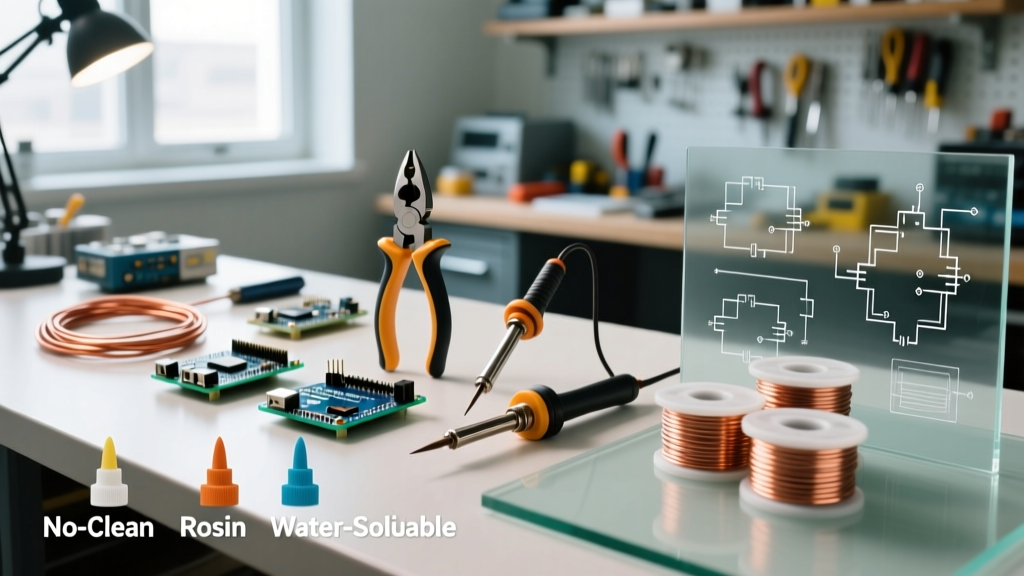
- No-Clean (ROL0 / ROL1): Leaves a benign, clear residue that is safe to leave on the board. Ideal for BGA rework where cleaning under the component is impossible. Indium TACFlux 020B is an industry benchmark.
- Water-Soluble (ORH0 / ORH1): Highly active and aggressive. It will easily cut through heavily oxidized pads, but the residue is highly corrosive and must be washed with heated deionized water immediately after soldering. Never use water-soluble tacky flux under BGAs unless you have an ultrasonic cleaning setup.
Stencil Aperture Design: The Hidden Variable
Even the most expensive solder paste will fail if the stencil aperture is poorly designed. According to guidelines published by the Indium Corporation engineering blog, standard 1:1 aperture reductions often lead to defects on passive components. To prevent tombstoning on 0402 and 0201 capacitors, engineers must employ 'home-plate' or 'reverse home-plate' aperture geometries. This reduces the paste volume on the inner edges of the pads, minimizing the surface tension imbalance that pulls the component upright during the liquidus phase of reflow.
Troubleshooting Common Paste Failures in 2026
When your reflow profile is correct but defects persist, the consumable is usually the culprit. Here is how to diagnose paste-specific failures:
Tombstoning (Drawbridging)
The Symptom: One end of a passive component lifts off the pad, standing upright like a tombstone.
The Paste Fix: Your paste may have an overly aggressive flux activation rate, causing one pad to wet before the other. Switch to a paste with a wider activation window (e.g., a Type 4 with a slower-rosin activator) or reduce the stencil thickness from 5 mil to 4 mil to decrease overall deposit volume.
Head-in-Pillow (HiP) Defects
The Symptom: Common in BGAs, the solder sphere melts but fails to coalesce with the solder paste deposit, resting on top like a head on a pillow.
The Paste Fix: This is almost always a flux exhaustion issue. The paste's flux activates and burns off before the BGA sphere reaches its melting point. Upgrade to a high-activity no-clean paste like Kester NXG1, or switch from Type 4 to Type 5 powder to increase the surface area and accelerate heat transfer into the sphere.
Excessive Solder Balling and Graping
The Symptom: Tiny spheres of solder scatter around the main pad, or the paste looks like a cluster of grapes that never fully merged.
The Paste Fix: This indicates severe powder oxidation. Your paste has likely exceeded its shelf life or was left on the stencil for more than 4 hours without printing. Discard the paste. For future runs, ensure your storage protocols are strictly followed.
Storage and Shelf Life Protocols
Solder paste is a perishable chemical product. To maintain the viscosity and prevent the flux from separating from the metal powder, adhere to these storage rules:
- Temperature: Store unopened jars and syringes between 0°C and 10°C (32°F - 50°F). Never freeze the paste, as ice crystals will destroy the flux chemistry.
- Shelf Life: Most SAC305 and SnPb pastes have a guaranteed shelf life of 6 months from the date of manufacture when refrigerated.
- Acclimatization: Before opening, allow the syringe to sit at room temperature (20°C - 25°C) for at least 2 to 4 hours. Opening a cold syringe causes ambient moisture to condense inside the barrel, leading to violent spattering and solder balling when exposed to reflow temperatures.
- Stencil Life: Once printed on a board, the paste should be reflowed within 2 hours. If production is delayed, scrape the boards clean and run them through an ultrasonic wash before re-stenciling.
By aligning your IPC powder type, alloy chemistry, and stencil geometry with your specific component pitch, you can eliminate the vast majority of SMT assembly defects. For ongoing technical data sheets and reflow profile recommendations, always consult the manufacturer's latest documentation via Kester or your preferred supplier.