
The Shift to Lead-Free: Beyond RoHS Compliance
The transition away from traditional tin-lead (Sn63/Pb37) eutectic solder was initially driven by environmental regulations, most notably the EU RoHS Directive guidelines. However, as of 2026, soldering lead free alloys has evolved from a mere compliance checkbox into a nuanced engineering discipline. Lead-free solders offer superior tensile strength, better creep resistance, and enhanced thermal fatigue life compared to their leaded counterparts. Yet, they introduce significant challenges: higher melting points, increased surface tension, and accelerated oxidation.
For DIY electronics enthusiasts, repair technicians, and prototype engineers, selecting the correct lead-free alloy is no longer optional; it is critical for joint reliability. This guide dissects the metallurgy, flux requirements, and practical selection frameworks for modern lead-free soldering.
Core Metallurgy: Types of Soldering Lead Free Alloys
Unlike the simple binary eutectic of Sn63/Pb37 (which melts and freezes instantly at 183°C), most lead-free alloys are near-eutectic or possess a distinct "pasty range." Understanding these compositions is the first step in mastering lead-free hand soldering.
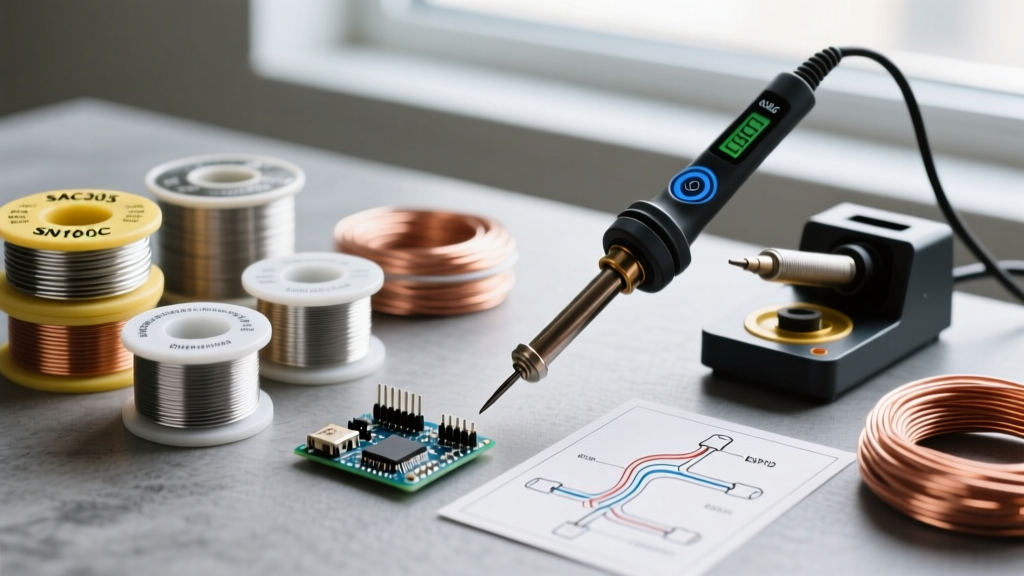
1. SAC305 (Sn96.5 / Ag3.0 / Cu0.5)
SAC305 (Tin-Silver-Copper) remains the undisputed industry standard for commercial electronics manufacturing. The 3% silver content provides excellent mechanical strength and drop-shock resistance, while the 0.5% copper prevents the leaching of copper from the PCB pads.
- Melting Point: 217°C - 220°C (Solidus to Liquidus)
- Pasty Range: ~3°C. This brief plastic state means the joint is vulnerable to micro-movements just as it solidifies.
- Cost (2026): ~$45 - $55 per 500g spool (0.8mm diameter).
- Best For: General DIY, commercial prototyping, and SMD rework.
2. SN100C (Sn99.3 / Cu0.7 / Ni / Ge)
Developed as a cost-effective, silver-free alternative, SN100C relies on 0.7% copper for strength. The secret to its exceptional performance lies in trace additions of Nickel and Germanium. Nickel refines the grain structure and reduces copper leaching, while Germanium acts as an antioxidant, significantly reducing dross formation and improving wetting.
- Melting Point: 227°C (True eutectic)
- Pasty Range: 0°C. It snaps from liquid to solid instantly, reducing the risk of disturbed joints.
- Cost (2026): ~$25 - $35 per 500g spool.
- Best For: Wave soldering, heavy ground-plane through-hole components, and budget-conscious hobbyists.
3. Bismuth-Based Low-Temperature (Sn42 / Bi58)
When working with heat-sensitive components (like certain RF modules or flexible PCBs), standard SAC alloys will cause thermal damage. Bismuth-based alloys offer a drastically lower melting point. However, pure Sn42/Bi58 is notoriously brittle.
- Melting Point: 138°C
- Pasty Range: 0°C (Eutectic)
- Cost (2026): ~$40 per 250g spool.
- Best For: Wearables, step-soldering, and heat-sensitive SMD sensors.
Alloy Comparison Matrix
| Alloy Designation | Composition | Melting Point | Tensile Strength | Wetting Speed | Primary Application |
|---|---|---|---|---|---|
| SAC305 | Sn96.5/Ag3.0/Cu0.5 | 217-220°C | High (45 MPa) | Moderate | Standard SMD/PTH |
| SAC405 | Sn95.5/Ag4.0/Cu0.5 | 217-220°C | Very High (48 MPa) | Moderate | Automotive/Aerospace |
| SN100C | Sn99.3/Cu0.7/Ni/Ge | 227°C | Medium (38 MPa) | Fast | Heavy thermal mass PTH |
| Sn42/Bi58 | Sn42/Bi58 | 138°C | Low (30 MPa) | Fast | Heat-sensitive flex PCBs |
Flux Chemistry: Overcoming High Surface Tension
The most common mistake when soldering lead free alloys is using the same flux intended for Sn63/Pb37. Molten lead-free solder has significantly higher surface tension, causing it to "ball up" rather than flow smoothly into a via or under an SMD pad.
To combat this, you must select a flux with stronger activators (usually halide-based or advanced organic acids) that remain active at 230°C - 250°C.
Expert Insight: For hand soldering SAC305, a No-Clean tacky flux syringe (like Amtech NC-5500-V2-TF) is vastly superior to liquid rosin fluxes. The tacky viscosity holds the SMD component in place while the aggressive activators strip oxides from the pads at elevated temperatures.
If you prefer liquid flux for through-hole work, ensure it is rated for lead-free temperatures. Standard RMA (Rosin Mildly Activated) fluxes will burn and carbonize before the SAC305 alloy even reaches its liquidus state, leaving a non-conductive, crusty residue that prevents wetting.
Hardware Realities: Tip Degradation and Thermal Mass
Lead-free solder is notoriously hostile to soldering iron tips. The high tin content (96%+) actively dissolves the iron plating on standard tips up to four times faster than leaded solder.
Optimizing Your Station for Lead-Free
- Do Not Crank the Heat: A common misconception is that higher temperatures (e.g., 400°C) compensate for lead-free's higher melting point. This accelerates tip oxidation and flux burn-off. Set your station to 340°C - 360°C.
- Maximize Thermal Mass: Instead of using a micro-pencil tip and turning up the heat, switch to a wider bevel or a heavy chisel tip (e.g., Hakko T18-D24 or Weller XT series). The larger surface area transfers heat into the joint faster than a tiny tip at a higher temperature.
- Aggressive Tip Tinning: Never leave a lead-free tip idle without a heavy blob of solder on the end. Use a specialized lead-free tip tinner (like Hakko 599B) every 15 minutes during heavy sessions to replenish the iron plating and strip stubborn oxides.
Troubleshooting Common Lead-Free Failure Modes
Even with the right alloy, visual inspection of lead-free joints can be deceptive. According to the IPC-A-610 workmanship standards, a perfect lead-free joint often looks different from a shiny leaded joint.
- Dull or Grainy Appearance: Unlike the mirror finish of Sn63, SAC305 naturally solidifies with a slightly dull, satin, or grainy finish. This is not a cold joint. Do not reheat it unnecessarily.
- Disturbed Joints (Micro-cracking): Because SAC305 has a 3°C pasty range, any vibration or movement of the component while the solder cools from 220°C to 217°C will cause internal micro-fractures. These appear as severe graininess or concentric rings around the lead. Always secure the board and component before applying heat.
- Pad Lifting: The combination of 350°C+ tip temperatures and aggressive lead-free flux can delaminate FR4 fiberglass and lift copper pads. Always use a pre-heater (set to 100°C) for multi-layer boards to reduce the thermal delta required from the iron.
Step-by-Step Selection Framework
Use this decision tree to select the exact consumable for your next project:
- Is the PCB heat-sensitive or flexible?
Yes: Use Sn42/Bi58. Ensure the board has zero residual lead to prevent the formation of the 96°C ternary eutectic.
No: Proceed to step 2. - Are you soldering heavy ground planes or large through-hole connectors?
Yes: Use SN100C (0.8mm or 1.0mm wire). The 0°C pasty range prevents disturbed joints on massive thermal masses, and the lack of silver keeps costs down.
No: Proceed to step 3. - Is this a high-vibration environment (automotive, drones, robotics)?
Yes: Use SAC405. The extra 1% silver significantly increases drop-shock survivability.
No: Use standard SAC305 with a No-Clean tacky flux for the best balance of cost, availability, and reliability.
Frequently Asked Questions
Can I mix lead-free solder with residual lead on the pads?
It is highly discouraged. If you use a Bismuth-based lead-free alloy (Sn42/Bi58) on a pad that has residual Sn63/Pb37 solder, the three metals (Tin, Lead, Bismuth) will form a ternary eutectic alloy that melts at a mere 96°C. This joint will literally melt if left in a hot car or near a warm power supply, leading to catastrophic field failure.
Why is my lead-free solder balling up and refusing to stick to the iron?
This is caused by rapid oxidation. Lead-free solder oxidizes almost instantly when exposed to air at 230°C. You must introduce flux before or exactly as the solder melts to break the oxide layer. Furthermore, ensure your iron tip is specifically rated for lead-free use; standard tips will pit and develop a black, non-wettable oxide crust within hours when used with SAC alloys.