
The Hidden Hazards of Flux Pyrolysis
When discussing flux soldering electronics, the conversation often centers on wetting action and joint reliability. However, the thermal decomposition of flux—pyrolysis—creates a complex aerosol of hazardous chemical compounds. When a soldering iron tip reaches 350°C to 400°C, the flux core vaporizes. This vapor rapidly cools in the ambient air, condensing into sub-micron particulate matter and volatile organic compounds (VOCs) that are easily inhaled deep into the alveolar tissue of the lungs.
According to the UK Health and Safety Executive (HSE), colophony (pine rosin) is a severe respiratory sensitizer. Repeated exposure to rosin fumes can lead to occupational asthma, a condition that is often irreversible even after exposure ceases. Understanding the chemistry of these fumes and implementing rigorous extraction protocols is non-negotiable for professional and hobbyist workspaces alike.
Chemical Breakdown by Flux Type
- Rosin-Based (RMA/RA): Contains abietic acid. When heated, it degrades into dehydroabietic acid and releases aldehydes, including trace amounts of formaldehyde. This is the primary culprit behind "rosin asthma."
- No-Clean (Synthetic): Formulated with modified resins and glycol ethers. While they leave less visible residue, their fumes contain high levels of VOCs and isopropyl alcohol vapors, which can cause central nervous system depression and mucosal irritation.
- Water-Soluble (OA): Contains aggressive organic acids and amines. The fumes are highly acidic and can cause immediate burning sensations in the eyes and respiratory tract.
Fume Extraction Hardware: Benchtop vs. Ambient Systems
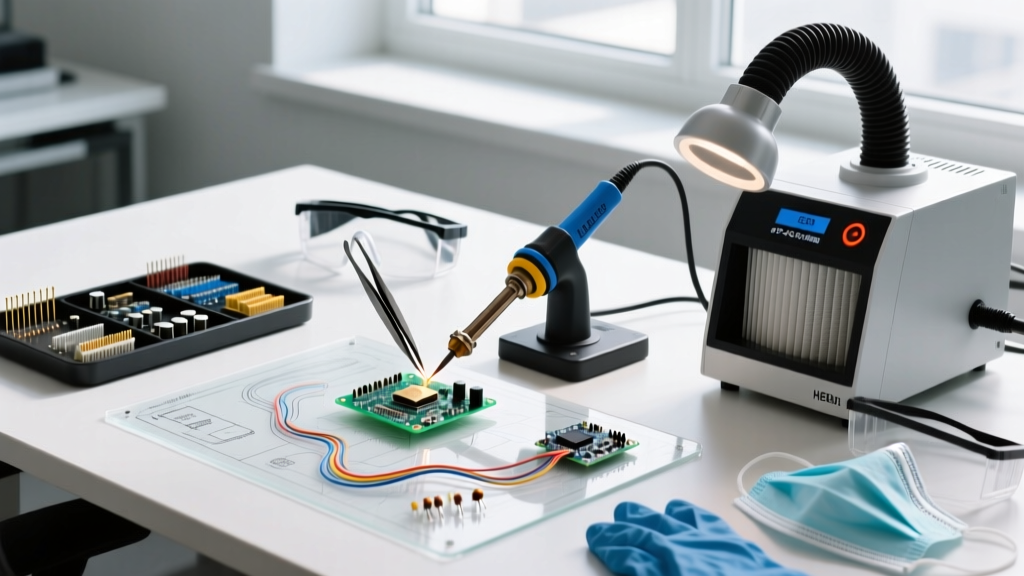
Opening a window or relying on standard HVAC is entirely insufficient for capturing sub-micron soldering fumes. Effective capture requires a localized exhaust ventilation (LEV) system designed specifically for the thermal plume generated by the iron.
Capture Velocity and Positioning
The golden rule of fume extraction is capture velocity. To effectively pull the thermal plume away from the operator's breathing zone, the extraction nozzle must maintain a minimum air velocity of 100 feet per minute (fpm) at the source. For a standard benchtop extractor, this means the nozzle must be positioned exactly 2 to 3 inches (5 to 7.5 cm) from the soldering joint. Moving the nozzle just 6 inches away reduces capture efficiency by over 70%, allowing toxic aerosols to drift into the operator's face.
| System Type | Recommended Model (2026) | Avg. Cost | Filtration Stages | Best Use Case |
|---|---|---|---|---|
| Basic Benchtop | Hakko FA-400 | $220 - $250 | Activated Carbon (Basic) | Occasional hobbyist use (under 2 hrs/week) |
| Advanced Benchtop | Metcal MX-A500 | $550 - $620 | Pre-filter, HEPA, Deep-bed Carbon | Professional labs, daily rework, lead-free |
| Ambient Room | Weller WFE-2X | $1,200 - $1,450 | Multi-stage HEPA/Carbon, High CFM | Multi-operator production lines, classrooms |
Pro Tip: Never use a standard shop-vac or dust collector for soldering fumes. These systems lack the deep-bed activated carbon required to adsorb VOC gases, and they will simply blow unfiltered toxic aldehydes back into the room.
IPC J-STD-004B: Balancing Reliability with Toxicity
Selecting the right flux is a balancing act between solder joint reliability and operator safety. The IPC J-STD-004B standard classifies fluxes based on their chemical composition, activity level, and halide content. Understanding this matrix allows you to choose the safest flux that still meets your electrical reliability requirements.
Decoding the IPC Flux Designators
The designation consists of three parts: Material Type, Activity Level, and Halide Content. For example, ROL0 stands for Rosin (RO), Low activity (L), and Zero halides (0).
| IPC Designator | Material | Activity / Halides | Safety & Reliability Profile |
|---|---|---|---|
| ROL0 | Rosin | Low / No Halides | Gold Standard. High reliability, safe residue. Fumes still require extraction due to rosin sensitization risk. |
| ROL1 | Rosin | Low / Halides Present | Moderate risk. Halides improve wetting but leave conductive residues that can cause electrochemical migration (dendritic growth). |
| ORL0 | Organic Acid | Low / No Halides | High fume toxicity (acidic). Must be cleaned post-soldering to prevent severe PCB corrosion. |
| REL0 | Resin (Synthetic) | Low / No Halides | Common in "No-Clean" wire. Lower respiratory sensitization risk than rosin, but VOCs still require ventilation. |
For 95% of consumer electronics, DIY microcontrollers, and commercial PCB assembly, ROL0 or REL0 (63/37 or lead-free SAC305 alloys) are the optimal choices. They pass the rigorous IPC-TM-650 2.3.32 Copper Mirror Test and the 2.3.33 Silver Chromide Test, ensuring no corrosive breakdown over time, while minimizing the introduction of highly toxic halide gases into your workspace.
PPE and Workspace Ergonomics
Fume extraction is your primary defense, but Personal Protective Equipment (PPE) acts as the critical secondary barrier. Many technicians overlook the dermal absorption risks associated with flux solvents and the ingestion risks of lead/flux cross-contamination.
Glove Selection and Solvent Resistance
Standard latex gloves degrade rapidly when exposed to the glycol ethers and alcohols present in liquid flux and cleaning solvents. Always use nitrile gloves with a minimum thickness of 4 to 5 mil. If you are performing heavy PCB washing with solvents like Techspray Ecoline Flux Remover or MicroCare MCC-1000D, double-gloving or switching to heavy-duty 8-mil chemical-resistant nitrile is mandatory to prevent contact dermatitis and systemic solvent absorption.
The "Clean Hand" Protocol
Ingestion of trace heavy metals (if using Sn63/Pb37) and toxic flux activators is a primary vector for systemic toxicity. Implement a strict workflow:
- Zone Separation: The soldering bench is a "dirty zone." No food, coffee, or smartphones are allowed on the work surface.
- Washing Cadence: Wash hands with cold water first (hot water opens pores, facilitating lead/chemical absorption), followed by warm water and a heavy-duty pumice soap.
- Tool Hygiene: Wipe down soldering iron handles and tweezers with isopropyl alcohol (99% IPA) at the end of every shift to remove invisible flux creep.
Post-Soldering Cleaning: When "No-Clean" Isn't Enough
While ROL0 and REL0 fluxes are designed to remain on the board without causing corrosion, there are specific scenarios where leaving flux residue is a catastrophic failure mode. In high-impedance circuits, RF modules, or environments with high humidity, uncleaned no-clean flux can absorb atmospheric moisture, creating a parasitic leakage path that alters circuit behavior.
Aqueous vs. Solvent Cleaning
If your design dictates cleaning, the solvent must match the flux chemistry. Using the wrong solvent will merely smear the activators across the board rather than lifting them.
- For Rosin (RMA/RA) Residues: Use a specialized saponifier or a high-purity solvent like Techspray Ecoline Flux Remover (approx. $25 per 12oz aerosol). Apply with a hog-bristle brush, and immediately blot with a low-lint wipe before the solvent evaporates and re-deposits the flux.
- For Water-Soluble (OA) Residues: Do not use IPA. Water-soluble fluxes are engineered to dissolve in water. Use a heated (60°C) deionized (DI) water ultrasonic bath or a dedicated aqueous inline washer. Follow with a DI water rinse and an immediate forced-air bake at 80°C for 30 minutes to prevent flash oxidation.
Summary Checklist for Safe Flux Soldering
To maintain a workspace that meets professional EHS (Environment, Health, and Safety) standards, verify the following before every soldering session:
- [ ] LEV System Active: Fume extractor is powered on, nozzle is positioned 2-3 inches from the work area, and airflow is verified (visual smoke test).
- [ ] Filter Maintenance: HEPA and carbon filters are within their service life (typically 6-12 months for daily use; replace if solvent odors are detectable).
- [ ] Flux Verification: Solder wire is confirmed as ROL0 or REL0; aggressive water-soluble or high-halide RA fluxes are segregated and used only when strictly required.
- [ ] PPE Donned: 4-mil nitrile gloves and ANSI Z87.1 safety glasses (to protect against molten solder splatter and UV/IR from high-wattage irons) are in place.
- [ ] Cleaning Solvents Ready: Appropriate solvents and lint-free wipes (e.g., Kimwipes) are staged in sealed dispensers to prevent VOC evaporation into the room.
By treating flux fumes with the same respect as high-voltage electricity, you ensure that your electronics assembly process remains safe, sustainable, and compliant with modern occupational health standards.