
The Botanical Origins of Electronic Grade Colophony
At its core, rosin flux for soldering is a marvel of applied organic chemistry. Unlike synthetic water-soluble fluxes that rely on aggressive halide-based acids, rosin (scientifically known as colophony) is a naturally occurring solid form of resin obtained from pines and some other plants, mostly conifers. In its raw state, pine resin contains volatile terpenes and impurities. To create electronic-grade rosin, manufacturers subject the raw resin to steam distillation, driving off the turpentine and leaving behind a brittle, translucent, amber-colored solid.
This purification process is critical. The resulting colophony is primarily composed of abietic acid (C20H30O2), alongside minor isomers like pimaric acid. According to the National Center for Biotechnology Information (PubChem), abietic acid is a tricyclic diterpenoid that exhibits a unique dual-nature: it is entirely inert and non-conductive at room temperature, but transforms into a highly effective, mild organic acid when subjected to soldering temperatures. This thermal switching behavior is precisely why rosin remains a foundational chemistry in electronics assembly, even as the industry shifts toward advanced lead-free alloys.
Thermal Activation: The Chemistry of Oxide Reduction
To understand why rosin flux for soldering is so effective, we must examine its thermal activation profile. Solder cannot wet a metal surface if a layer of metal oxide is present. Copper, the standard base metal for printed circuit board (PCB) pads, oxidizes rapidly in ambient air, forming Copper(II) oxide (CuO).
The Copper Abietate Reaction
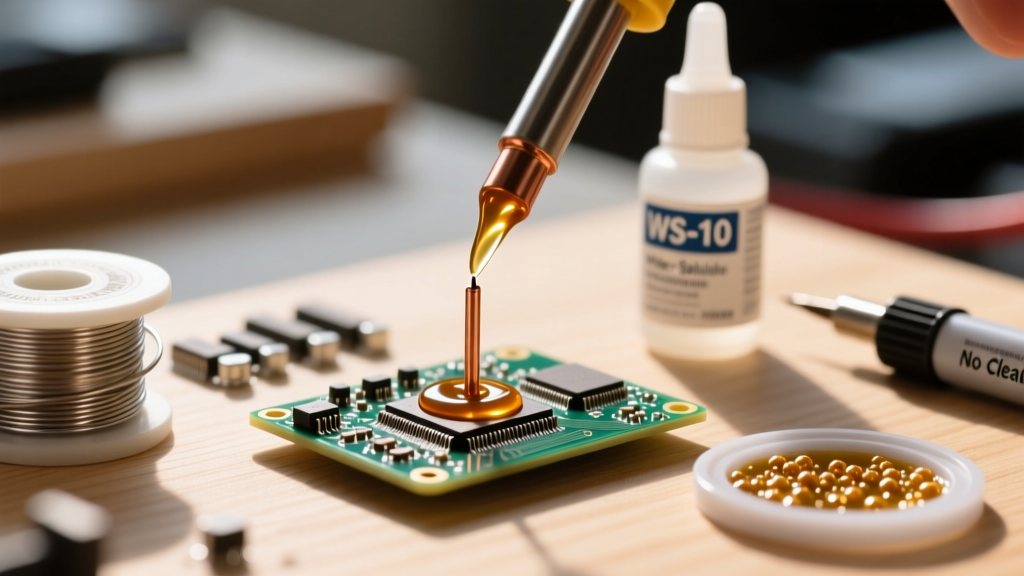
When a soldering iron tip or reflow oven heats the rosin flux past its melting point (approximately 170°C), the abietic acid molecules gain enough kinetic energy to break their stable ring structures. Between 200°C and 250°C, the flux acts as a weak reducing agent. It donates protons to the oxygen in the copper oxide layer, forming water vapor (which boils off) and a metal-organic complex known as copper abietate.
CuO + 2 C20H30O2 → Cu(C20H30O2)2 + H2O
The formation of copper abietate is a textbook example of a metal soap reaction. This complex dissolves into the molten flux matrix, physically lifting the oxide layer away and exposing pristine, highly reactive copper for the molten solder alloy to wet.
Once the heat source is removed and the joint cools below 170°C, any unreacted abietic acid instantly reverts to its inert, solid state, encapsulating the joint in a protective, electrically insulating shell.
IPC J-STD-004B: Decoding Rosin Flux Classifications
Pure rosin (Type R) is often too weak to remove heavy oxidation, especially on older components or nickel-plated leads. To solve this, chemical engineers add activators—typically halides (chlorides or bromides) or organic amines. The IPC J-STD-004B standard classifies these formulations based on their base material, activity level, and halide content. Understanding these codes is mandatory for selecting the right rosin flux for soldering high-reliability assemblies.
| Legacy Term | IPC Code | Activator Level | Halide Content | Cleaning Required? | Primary Application |
|---|---|---|---|---|---|
| R (Pure Rosin) | ROL0 / ROL1 | Low (L) | 0% / <0.5% | No | Bare copper, highly sensitive aerospace PCBs |
| RMA (Mildly Activated) | ROM0 / ROM1 | Medium (M) | 0% / 0.5% - 2.0% | Recommended | General through-hole, consumer electronics |
| RA (Fully Activated) | ROH0 / ROH1 | High (H) | 0% / >2.0% | Mandatory | Heavily oxidized leads, RF shielding cans |
Lead-Free Alloys and the Thermal Limits of Rosin
The transition from eutectic Sn63/Pb37 (melting at 183°C) to lead-free alloys like SAC305 (Sn96.5/Ag3.0/Cu0.5, melting at 217°C) fundamentally altered the material science constraints of rosin flux. Because SAC305 requires a peak reflow temperature of 240°C to 250°C to achieve proper wetting, the rosin flux is pushed dangerously close to its thermal degradation threshold.
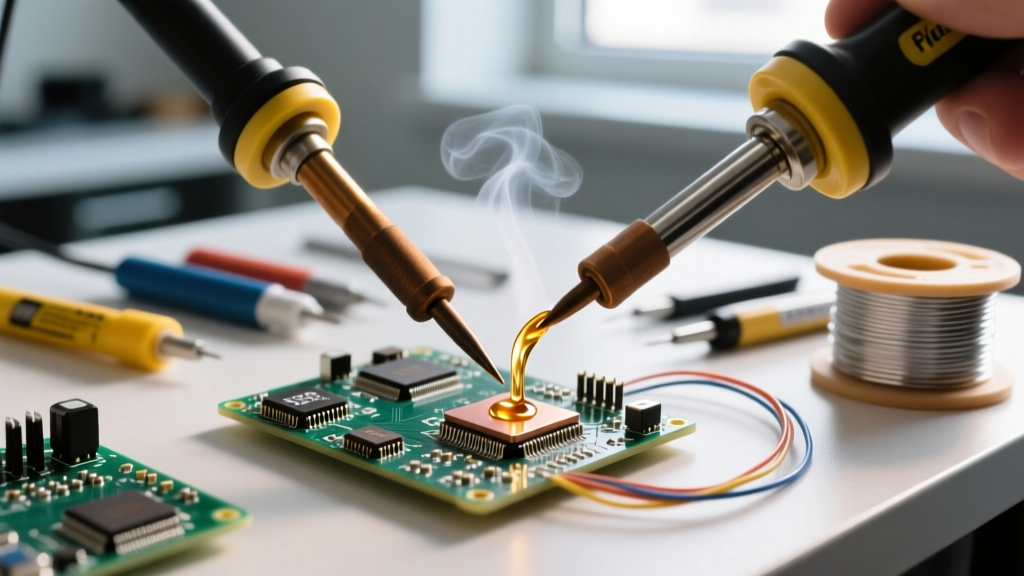
When abietic acid is exposed to temperatures exceeding 280°C for more than a few seconds, it undergoes pyrolysis. The molecular structure breaks down into carbonized, tar-like residues. This charred flux is not only impossible to clean with standard saponifiers, but it can also act as a thermal insulator, masking cold solder joints during automated optical inspection (AOI). For lead-free hand soldering in 2026, technicians must use temperature-controlled stations (like the JBC CD-2BQE or Weller WE1010) set precisely between 350°C and 380°C at the tip, ensuring the localized flux activation zone remains below the pyrolysis threshold.
2026 Market: Real-World Product Selection & Pricing
Selecting the correct rosin flux for soldering requires matching the activator package to your specific metallurgical challenges. Here is a breakdown of current, industry-standard formulations and their market pricing:
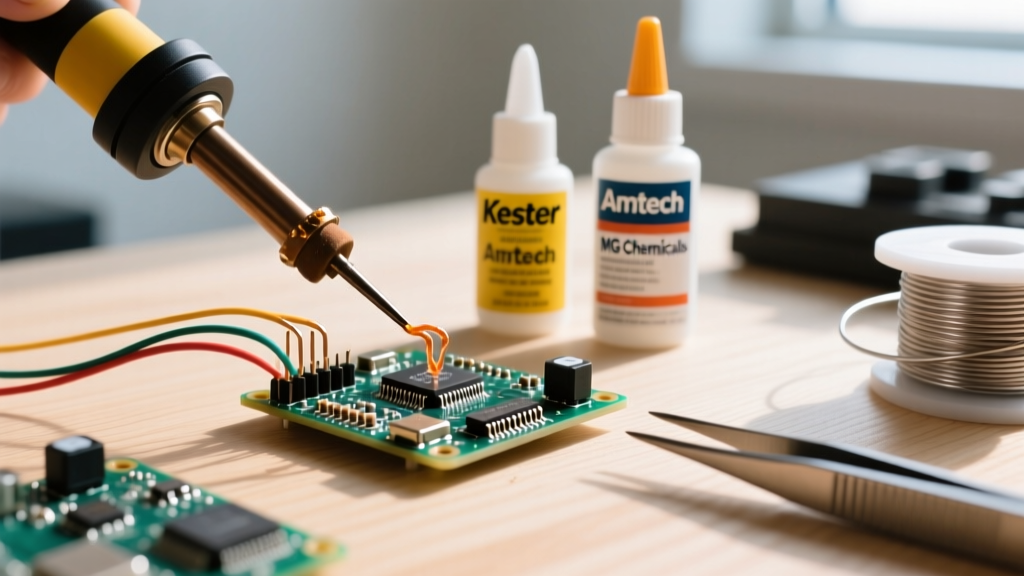
- Kester 44 (RA / ROH0): The legendary fully activated rosin flux. Exceptional wetting on tarnished brass and oxidized copper. Contains roughly 1.1% halide activators. Cost: ~$28.00 for a 2oz (56g) squeeze bottle. Warning: Residues are highly corrosive if left uncleaned; requires an IPA or dedicated flux wash.
- MG Chemicals 8341 (RMA / ROM0): A halide-free, mildly activated rosin paste flux. Ideal for general-purpose rework where cleaning is difficult but some extra wetting power is needed over pure rosin. Cost: ~$18.50 for a 10ml syringe.
- Superior Flux 63-Clear (R / ROL0): Pure, unactivated liquid roin. Used primarily for tinning magnet wire or working on ultra-sensitive medical devices where zero ionic residue is permissible. Cost: ~$22.00 for an 8oz bottle.
Failure Modes: Charring and Dendritic Growth
Even with perfect technique, misunderstanding the material limits of rosin flux for soldering can lead to catastrophic field failures. Below is a troubleshooting matrix for common flux-related defects.
| Visual Symptom | Material Science Root Cause | Corrective Action |
|---|---|---|
| Black, crusty residue around the joint | Thermal pyrolysis of abietic acid due to excessive iron tip temperature or prolonged dwell time (>4 seconds). | Lower tip temp by 20°C; use a larger chisel tip to transfer heat faster, reducing dwell time. |
| Solder balls / de-wetting on adjacent pads | Flux boiled violently, spattering molten solder, or activators exhausted before reaching reflow temp. | Apply flux in two stages: a light pre-coat, followed by the main application immediately before soldering. |
| White, powdery film after IPA cleaning | Reaction of rosin with atmospheric moisture during cleaning, or incomplete dissolution of copper abietate. | Switch to a dedicated saponifier or use an ultrasonic bath with heated (45°C) isopropyl alcohol. |
| Short circuits / high leakage current | Electromigration driven by halide activators (in RA flux) absorbing ambient humidity, forming conductive dendrites. | Mandatory aqueous cleaning post-solder; conformal coat the assembly; or switch to an ROL0 (pure rosin) flux. |
Expert Insight: The 'No-Clean' Misconception
Many modern RMA and RA fluxes are marketed as "no-clean" because the bulk of the rosin encapsulates the activators upon cooling. However, as noted in reliability studies by NASA's Electronic Parts and Packaging (NEPP) Program, in high-humidity or high-impedance analog environments, even trace amounts of unencapsulated halide activators can trigger electrochemical migration (ECM). If your circuit operates above 50% relative humidity or handles microamp-level sensor signals, you must clean RA and RMA rosin residues using a multi-stage saponification process, regardless of the manufacturer's "no-clean" label.
Conclusion
Rosin flux for soldering is far more than a simple cleaning agent; it is a thermally activated, phase-changing chemical solvent that bridges the gap between botanical chemistry and modern electronics manufacturing. By understanding the precise thermal activation of abietic acid, the stoichiometry of the copper abietate reaction, and the strict classifications of the IPC J-STD-004B standard, engineers and technicians can eliminate cold joints, prevent dendritic failures, and achieve metallurgical perfection on every PCB assembly.