
The Role of Rosin Flux in Micro-Soldering and PCB Rework
When tackling delicate printed circuit board (PCB) rework, understanding how to use rosin soldering flux is the dividing line between a reliable, IPC-compliant joint and a catastrophic pad lift. Unlike water-soluble or no-clean fluxes, rosin-based fluxes (derived from pine tree sap, primarily abietic acid) offer a unique combination of high-tack viscosity, excellent thermal stability, and non-corrosive residue. This makes them the undisputed champion for surface mount device (SMD) rework, QFN/BGA reflow, and micro-soldering applications where components are densely packed and thermal mass is minimal.
However, applying rosin flux to a 0402 metric capacitor or a 64-pin QFN microcontroller requires precise technique. Using too much flux can cause solder bridging, while applying too little results in oxidized, grainy cold joints. In this comprehensive 2026 guide, we break down the exact chemistry, thermal activation profiles, and application methodologies required to master rosin flux in professional and advanced DIY electronics environments.
Decoding Rosin Classifications: R, RMA, and RA
Before you pick up a syringe, you must select the correct activation level. The IPC J-STD-004B standard categorizes rosin fluxes by their chemical activity and halide content. Choosing the wrong type for your specific PCB application can lead to long-term electrochemical migration (dendritic growth) or insufficient oxide removal.
| Classification | IPC Code | Activation Level | Corrosivity / Residue | Best Application | Example Product (2026 Pricing) |
|---|---|---|---|---|---|
| Pure Rosin (R) | ROL0 | Very Low | Non-corrosive, hard glass-like residue. Safe to leave on board. | High-reliability aerospace, medical, and bare copper wire tinning. | Kester 186 RMA Liquid (Often grouped here, ~$12/2oz) |
| Rosin Mildly Activated (RMA) | ROM0 / ROM1 | Medium | Slightly tacky. Generally safe to leave, but cleaning recommended for high-impedance circuits. | General SMD rework, drag soldering, and through-hole repair. | Chip Quik SMD291AX10 Gel (~$16.95/10cc syringe) |
| Rosin Activated (RA) | ROH0 / ROH1 | High | Highly active, leaves acidic residue. Must be cleaned to prevent corrosion. | Heavily oxidized pads, legacy PCB restoration, and difficult-to-solder alloys. | MG Chemicals 8341 Paste (~$8.99/1oz jar) |
Step-by-Step: Applying Rosin Flux for QFN and BGA Rework
For advanced SMD rework, the physical application of the flux is just as critical as the thermal profile. Here is the exact protocol for using RMA gel flux when replacing a QFN-32 IC.
- Preparation and Pre-Baking: If the PCB has been stored in a humid environment, bake it at 100°C for 2 hours to prevent delamination and solder splatter. Clean the existing pads with 99% Isopropyl Alcohol (IPA) and a lint-free swab.
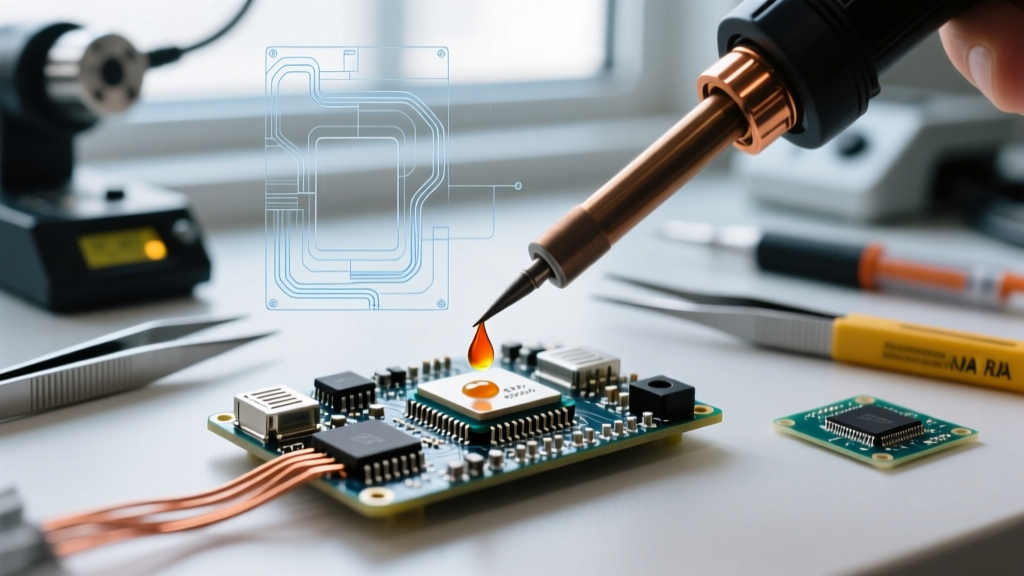
- Micro-Dispensing the Gel: Using a 10cc syringe of RMA gel (like Chip Quik SMD291AX) fitted with a 22-gauge blunt needle, apply a microscopic bead of flux to the center of the QFN footprint. Do not cover the entire pad array. The flux will spread via capillary action when heated.
- Component Placement: Use vacuum tweezers or a fine-point silicone tip to place the QFN chip. The tackiness of the rosin flux will hold the component in place, eliminating the need for adhesive.
- Thermal Profiling: Apply heat using a hot air rework station set to 320°C with an airflow of 30 CFM. Keep the nozzle 15mm above the board. The rosin flux will visually transition: it softens at ~70°C, melts and flows at ~150°C, and chemically activates (boiling off oxides) between 180°C and 220°C.
- Observation of the Reflow Meniscus: Watch for the solder fillets to pull tight against the component pins (the "meniscus" effect). Once the flux stops bubbling and turns slightly amber, remove the heat immediately to prevent carbonization.
Dispensing Methods: Syringe vs. Pen vs. Brush
The delivery mechanism dictates your precision. Below is a comparison matrix to help you choose the right tool for your specific PCB repair scenario.
- Syringe (Gel/Paste): Best for SMD rework, BGA stenciling, and drag soldering. Allows precise volumetric control. Drawback: Requires air pressure or manual thumb force; can trap air bubbles if not stored vertically.
- Flux Pen (Liquid RMA): Ideal for quick touch-ups on through-hole joints and tinning stranded wire. Drawback: Liquid viscosity causes it to wick under components, potentially contaminating ZIF sockets or potentiometers.
- Natural Bristle Brush (Paste/Jar): Excellent for applying a thin, even coat over large ground planes before hot-air reflow. Drawback: Bristles can shed; difficult to control volume on 0402 components.
Thermal Activation and Avoiding Carbonization
A common failure mode when learning how to use rosin soldering flux is thermal degradation. Rosin is an organic compound. If your soldering iron tip exceeds 380°C, or if you dwell on a joint for more than 8-10 seconds, the rosin will carbonize.
Expert Insight: Carbonized flux turns into a hard, black, glassy residue that is virtually insoluble in standard IPA. More importantly, carbonization destroys the flux's ability to reduce oxides, leading directly to cold, grainy solder joints. If you see black crusting on your iron tip or PCB pad, you must stop, clean the tip with brass wool, and reapply fresh flux.
According to workmanship guidelines referenced by NASA's Electronic Parts and Packaging (NEPP) Program, maintaining strict thermal limits during hand soldering is critical to preventing thermal shock to the component and preserving the chemical integrity of the flux medium. Always use a temperature-controlled station (e.g., Hakko FX-951 or Weller WE1010) locked between 320°C and 350°C for standard Sn63/Pb37 or Sn96.5/Sn3.0/Ag0.5 (SAC305) lead-free alloys.
Post-Solder Cleaning Protocols
While R (Pure Rosin) and some RMA formulations are technically "no-clean" in benign environments, best practices for high-impedance, RF, or high-voltage circuits dictate thorough cleaning. Residual flux can absorb ambient moisture, creating a parasitic leakage current path.
The IPA and Brush Method
For standard RMA gel residue, use 99.9% anhydrous Isopropyl Alcohol. Do not use 90% or 70% IPA, as the water content will smear the rosin into a sticky white haze rather than dissolving it. Apply the IPA, agitate with a clean natural bristle brush, and immediately wipe away the dissolved flux with a lint-free Kimwipe before the alcohol evaporates.
Ultrasonic Cleaning for RA Flux
If you used a highly activated RA flux (like MG Chemicals 8341) to rescue heavily oxidized vintage PCB pads, IPA may not be enough. You will need a saponifier or a dedicated flux remover. For batch processing, an ultrasonic cleaner operating at 80kHz (not 40kHz, which can damage delicate MEMS microphones and crystal oscillators) with a heated saponifier bath at 50°C will completely strip RA residue from under tight-pitch QFPs.
Flux Shelf Life and Cold Storage
Rosin gel fluxes in syringes have a strict shelf life, typically 6 to 12 months at room temperature. Over time, the solvents evaporate, and the flux becomes thick, stringy, and prone to splattering when heated. To extend the life of premium fluxes like Amtech or Chip Quik, store the syringes in a refrigerator at 5°C to 10°C. Critical Warning: When removing a cold syringe from the fridge, allow it to acclimate to room temperature for at least 2 hours before opening. Opening a cold syringe immediately will cause atmospheric condensation to form inside the barrel, introducing water into your flux and guaranteeing solder splatter during your next rework session.
Frequently Asked Questions
Can I use plumbing rosin paste for electronics?
No. Plumbing fluxes (even those labeled as rosin-based) often contain aggressive petroleum distillates, zinc chloride, or animal fats designed to strip heavy oxidation from copper pipes. These will instantly destroy PCB traces and cause severe electrochemical corrosion. Always use electronics-grade flux that complies with IPC J-STD-004.
Why is my solder balling up and refusing to wet the pad?
This is a classic symptom of flux exhaustion. The rosin has boiled off or carbonized before the solder reached its liquidus temperature. Remove the iron, clean the pad with IPA, apply a fresh drop of RMA liquid or gel flux, and reattempt the joint with a slightly lower iron temperature to preserve the flux chemistry.
Is rosin flux smoke dangerous?
Yes. The vaporized colophony (rosin) is a known respiratory sensitizer and can trigger occupational asthma. Always use a localized fume extractor with a HEPA and activated carbon filter positioned within 6 inches of the soldering zone, as recommended by modern occupational health standards.