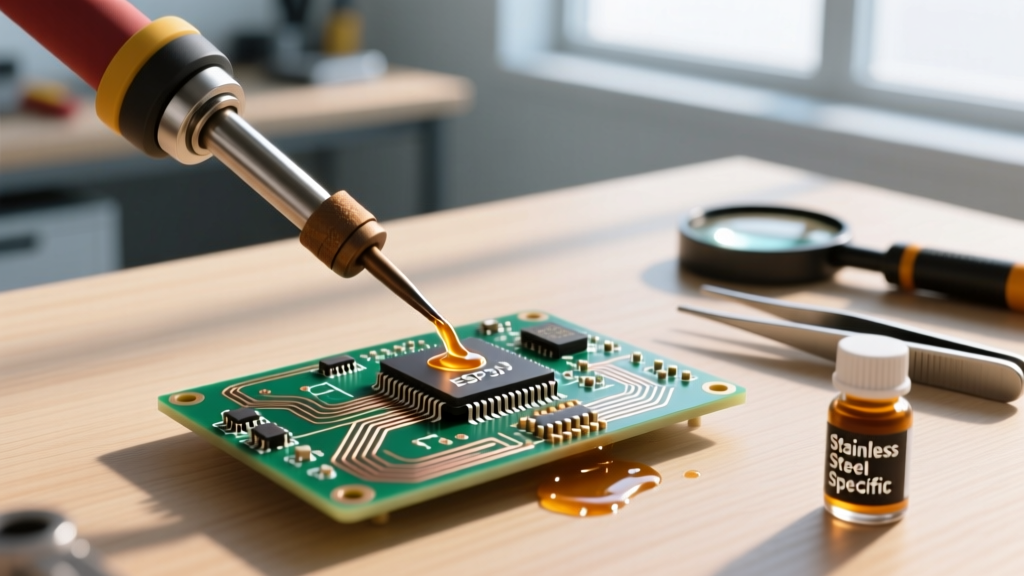

The Chromium Oxide Barrier: Why Standard Fluxes Fail
Soldering stainless steel is a notorious challenge in both structural fabrication and DIY repairs. The root of the problem lies in the metallurgy of the alloy itself. Stainless steel owes its corrosion resistance to a minimum of 10.5% chromium content. When exposed to oxygen, this chromium instantly forms a passive, microscopic layer of chromium oxide (Cr2O3). According to the British Stainless Steel Association, this passive layer is highly stable and chemically inert at standard soldering temperatures.
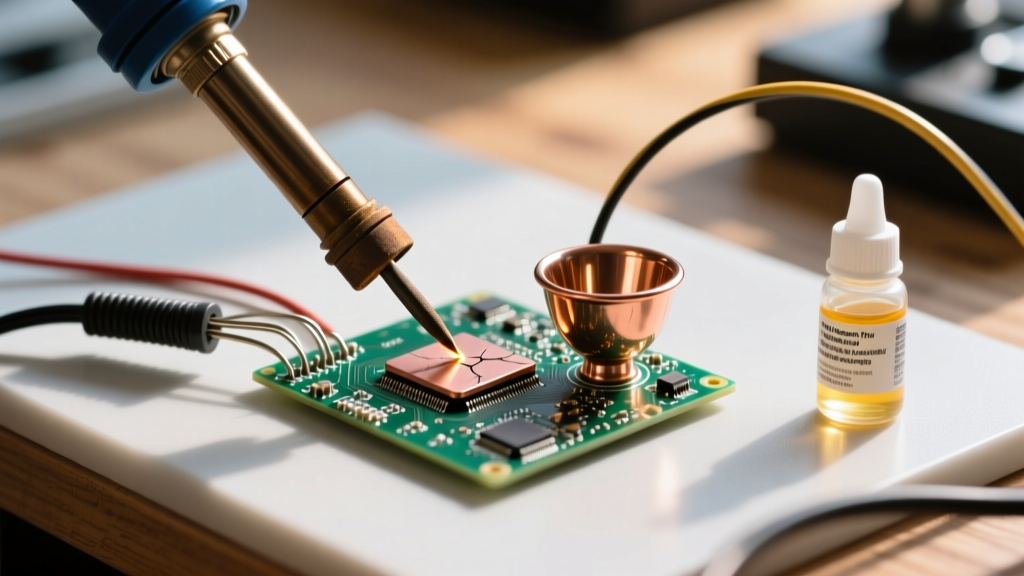
Standard rosin-based (RMA) or mild no-clean fluxes used in electronics are entirely incapable of dissolving this chromium oxide barrier. To achieve metallurgical wetting, you must use an aggressive inorganic acid flux—commonly referred to as "acid flux"—which chemically strips the oxide layer and prevents immediate re-oxidation while the solder flows.
CRITICAL APPLICATION WARNING:Acid flux (zinc chloride or phosphoric acid-based) is strictly for mechanical, plumbing, and structural stainless steel applications. NEVER use acid flux on electronic printed circuit boards (PCBs) or microcontroller wiring. The highly active ionic residues will cause rapid electrochemical migration, dendritic shorting, and catastrophic trace corrosion. For electronics, stick to IPC J-STD-004 compliant rosin or no-clean fluxes.
Top Acid Flux Recommendations for Stainless Steel
When selecting an acid flux, you are generally choosing between zinc chloride and phosphoric acid formulations. Zinc chloride is the industry standard for stainless steel due to its aggressive oxide-removal capabilities at temperatures between 200°C and 350°C.
1. Superior Flux #71 (Zinc Chloride Base)
Superior #71 is a heavy-duty, water-soluble zinc chloride flux specifically engineered for stainless steel, Monel, and high-carbon steels. It leaves a residue that is highly active, requiring thorough post-solder cleaning. Expect to pay around $18 to $24 for a 2 oz (59 ml) bottle. It is widely considered the gold standard for demanding structural joints.
2. Harris Stay-Clean Liquid Flux
A staple in plumbing and HVAC, Stay-Clean utilizes a zinc chloride and ammonium chloride blend. While primarily marketed for copper and brass, it is highly effective on thin-gauge stainless steel sheet metal when paired with adequate heat. It is highly accessible and cost-effective, typically retailing for $7 to $10 for a 4 oz bottle.
3. Rubyfluid (Zinc Chloride / Ammonium Chloride)
Rubyfluid is another aggressive inorganic flux that excels at breaking down stubborn oxides on stainless alloys like 304 and 316. It flows easily into capillary joints and is available in both liquid and paste forms. Paste forms are preferable for vertical or overhead stainless steel soldering to prevent runoff.
Solder Alloy Selection Matrix
According to guidelines from the American Welding Society, the solder alloy must be matched to the mechanical and environmental requirements of the stainless steel joint. Because acid flux allows for excellent wetting, you can utilize high-strength, lead-free alloys that might otherwise struggle on stainless surfaces.
| Alloy Composition | Melting Range | Best Application | Tensile Strength |
|---|---|---|---|
| Sn96.5 / Ag3.5 (Lead-Free) | 221°C (430°F) | High-strength structural, food-safe equipment | ~7,500 psi |
| Sn95 / Sb5 (Lead-Free) | 232-240°C (450-464°F) | High-temperature plumbing, automotive | ~6,200 psi |
| Sn60 / Pb40 (Leaded) | 183-190°C (361-374°F) | Non-potable mechanical joints, prototypes | ~5,600 psi |
| Sn63 / Pb37 (Leaded) | 183°C (361°F) Eutectic | Fast-freezing joints on thin-gauge sheets | ~6,300 psi |
Thermal Management: The Hidden Hurdle
A common failure mode when soldering stainless steel is the "cold joint" caused by inadequate thermal transfer. Stainless steel has a thermal conductivity of approximately 15 W/m·K, which is roughly 26 times lower than copper (400 W/m·K). This means heat does not spread laterally through the metal; it pools exactly where the iron or torch touches.
If you use a standard 40W electronics soldering iron, the stainless steel will act as a massive heat sink, dropping the tip temperature below the flux's activation threshold before the joint reaches solder-melting temperatures. The chromium oxide will rapidly reform, resulting in a solder ball that simply rolls off the surface.
Equipment Requirements
- Thin Gauge (Up to 18 AWG / 1mm sheet): Use a temperature-controlled soldering station with a minimum of 80W to 100W output (e.g., Weller WE1010 or Hakko FX-951). Use a heavy, bevel or wide chisel tip to maximize surface area contact.
- Thick Gauge / Structural: Abandon irons entirely. Use a propane or MAPP gas torch with a swirl-tip to heat the joint broadly. Apply the acid flux via a brush as the metal reaches the activation temperature.
Zinc chloride flux is incredibly corrosive to the iron plating on modern soldering tips. If you must use a soldering station for stainless steel, dedicate an older or inexpensive tip specifically for acid flux work. Clean the tip immediately after use, or expect severe pitting and premature tip death.
Step-by-Step Soldering Protocol
Follow this precise sequence to ensure metallurgical bonding and joint integrity.
- Mechanical Abrasion: The passive oxide layer must be physically disrupted before chemical fluxing. Scour the joint area with 400-grit silicon carbide sandpaper or a coarse Scotch-Brite pad until the surface is uniformly dull. Wipe with isopropyl alcohol to remove oils.
- Pre-Flux Application: Apply a generous coat of your chosen zinc chloride acid flux to the abraded area before applying heat. This prevents the oxide from reforming as the metal heats up.
- Targeted Heating: Apply your 100W+ iron or torch to the stainless steel, not the solder. Watch the flux; it will bubble, then settle into a clear, glassy liquid. This visual cue indicates the metal has reached the optimal activation temperature (typically 220°C+).
- Solder Introduction: Feed the silver-bearing or tin-antimony solder wire into the joint interface. Capillary action will draw the molten solder under the flux layer, displacing it and wetting the bare stainless steel.
- Cooling: Remove the heat source and hold the joint completely still until the solder transitions from a liquid to a solid, dull state. Moving the joint during the plastic phase will cause a disturbed, brittle grain structure.
Post-Solder Neutralization and Cleaning
This is the most frequently skipped step by amateurs, leading to catastrophic joint failure weeks later. Zinc chloride residues are highly hygroscopic (they absorb moisture from the air) and form hydrochloric acid when hydrated. If left on the joint, it will eventually eat through the solder and the surrounding stainless steel.
The Baking Soda Neutralization Process
Water alone is insufficient for cleaning zinc chloride flux. You must chemically neutralize it using a mild alkaline solution.
- Mix a neutralizing solution of 1 tablespoon of sodium bicarbonate (baking soda) per 1 cup of warm distilled water.
- Brush the solution vigorously over the cooled solder joint. You will observe effervescence (bubbling) as the baking soda reacts with the acidic residues, converting the corrosive zinc chloride into harmless, insoluble zinc carbonate and sodium chloride (table salt).
- Once the bubbling ceases, scrub the joint with a stiff nylon brush under running warm water to wash away the neutralized salts.
- Dry thoroughly with compressed air or a lint-free cloth. For maximum corrosion resistance in harsh environments, follow up with a passivation bath (e.g., citric acid-based passivator) to restore the stainless steel's native chromium oxide layer around the soldered zone.
Summary of Best Practices
Successfully utilizing acid flux for stainless steel soldering requires respecting both the metallurgy of the base metal and the chemistry of the consumables. By selecting a dedicated zinc chloride flux like Superior #71, pairing it with a high-strength alloy like Sn96.5/Ag3.5, applying aggressive thermal management, and executing a strict alkaline neutralization protocol, you can create stainless steel solder joints that rival mechanical fasteners in both strength and longevity. For further reading on specialty joining techniques, consult the technical data sheets available directly from Superior Flux & Mfg. Co.