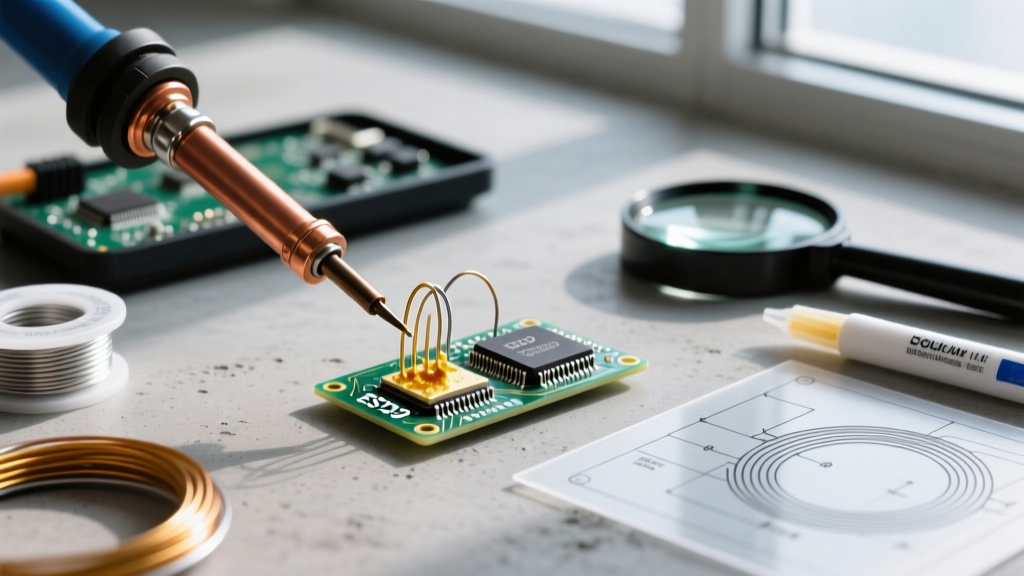
Choosing between building custom solder consumables and selecting off-the-shelf solutions is a critical operational decision affecting yield, compliance, time-to-market, and total cost of ownership. For electronics manufacturers producing Class III medical devices (e.g., implantable cardiac monitors), aerospace avionics (e.g., Honeywell’s ADIRU modules), or 5G mmWave RF assemblies (e.g., Qualcomm QTM527 front-end modules), the wrong choice can trigger rework rates above 12%, non-conformance reports (NCRs) under ISO 9001:2015 Clause 8.5.2, or even regulatory rejection by the FDA or FAA. This article analyzes quantifiable thresholds—including minimum order quantities (MOQs), alloy tolerance bands, flux residue limits, and IPC-J-STD-004B classification requirements—to guide engineers and procurement managers toward evidence-based decisions—not intuition.
The Core Trade-Off: Control Versus Velocity
At its foundation, the build-vs-selection decision hinges on two competing imperatives: engineering control over material properties and supply chain velocity. Building custom solder wire, paste, or preforms grants precise specification of alloy composition (e.g., Sn96.5Ag3.0Cu0.5 ±0.15% per ASTM B32-22), flux activity level (RMA, RA, or no-clean per IPC J-STD-004B Table 3-1), particle size distribution (for paste: Type 4 = 20–38 µm, Type 5 = 15–25 µm, Type 6 = 5–15 µm), and packaging format (e.g., 500-g vacuum-sealed jars with nitrogen purge for Indium Corporation’s 8.9HF no-clean paste). Selection, conversely, leverages economies of scale, validated process windows, and immediate availability—critical when ramping production of consumer IoT sensors with 4-week launch deadlines.
Consider the lead time differential: standard Kester 24-6077-3280 (Sn63/Pb37, Type 3 paste) ships from Newark Electronics’ U.S. distribution center in ≤48 hours. A custom-build variant—say, Sn99.3Cu0.7 with halogen-free, low-residue flux optimized for copper-nickel-palladium immersion (ENIG) finishes—requires 14–18 weeks from Indium Corporation or Senju Metal’s U.S. facility due to alloy casting, homogenization, flux blending, rheology validation, and IPC-A-610E-compliant qualification testing.
When Build Delivers Measurable ROI
Custom builds justify their extended timelines and higher unit costs when they resolve persistent process failures. At a Tier-1 automotive supplier in Michigan producing ADAS radar control units, standard SAC305 paste (Sn96.5/Ag3.0/Cu0.5) generated 8.3% tombstoning on 0201 MLCCs (1.0 × 0.5 mm) due to asymmetric wetting forces. A custom build—Senju M705-HF with modified surfactant package and 30% lower metal load—reduced tombstoning to 0.7% and eliminated post-reflow cleaning steps, saving $217,000 annually in labor and solvent disposal.
Another case: a Boston-based medtech firm manufacturing Class III neurostimulator PCBs required solder joints with <0.5 ppm chloride residue (per IPC-TM-650 2.3.25) to prevent dendritic growth in saline environments. Standard no-clean pastes (e.g., Alpha OM-338) measured 1.2–1.8 ppm Cl⁻. Their custom build—Indium 8.9HF-ClFree—used ion-exchanged rosin derivatives and ultra-low-halide solvents, achieving 0.32 ppm average residue across 12,000 joints tested via ion chromatography. The build cost was $38.50/kg versus $24.20/kg for standard 8.9HF—but prevented $4.2M in potential field recalls.
Selection Advantages: Validated Performance & Compliance Certainty
Selecting established consumables delivers immediate access to third-party certifications that would take months—and six-figure investments—to replicate internally. Kester 24-6077-3280 carries full IPC-J-STD-004B Type ROL0 classification, RoHS 3 (2015/863/EU) compliance documentation, REACH SVHC screening reports, and UL 746E flammability certification. For contract manufacturers serving multiple OEMs—from Cisco networking gear to GE Healthcare MRI subsystems—this eliminates audit friction during AS9100D or IATF 16949 surveillance assessments.
Performance predictability is equally critical. Data from the SMTA’s 2023 Process Reliability Benchmark shows standard SAC305 paste from five major suppliers (Kester, Alpha, Senju, Nihon Superior, and Indium) exhibited mean voiding rates of 12.4% ±1.9% on QFN-48 packages (5 × 5 mm, 0.4 mm pitch) using identical stencil designs and reflow profiles. Custom variants from the same suppliers varied by ±7.3% due to uncontrolled flux volatility shifts—requiring profile recalibration and 32 additional DOE runs per lot.
Quantifying the Hidden Costs of Building
Building isn’t just about sticker price—it incurs measurable hidden costs:
- Qualification Labor: 120–160 engineering hours per alloy/flux combination for thermal profiling, cross-section analysis, and shear strength validation (per IPC-TR-579)
- Inventory Risk: Minimum order quantities (MOQs) for custom solder paste typically start at 25 kg (vs. 1 kg for standard); shelf-life degradation accelerates 3× faster if storage deviates >2°C from 25°C
- Regulatory Burden: FDA 21 CFR Part 820 requires custom materials to be listed as ‘design outputs’—triggering full change control, risk analysis (ISO 14971), and design history file updates
- Supply Chain Fragility: Single-source dependency; when Senju’s Yokkaichi plant experienced a 2022 flood, custom builds with <500-kg annual volume had zero alternate sourcing options
In contrast, selection enables rapid substitution. When Hitachi Chemical discontinued its SN100C paste in Q3 2021, customers using standard Sn99.3Cu0.7 formulations migrated seamlessly to Kester NXG-35 or Alpha CVP-345 within 72 hours—validated via IPC-A-610E Annex B cross-reference tables.
Alloy-Specific Decision Frameworks
Not all alloys behave equally under build-vs-selection analysis. High-reliability applications demand granular evaluation:
- Lead-Free SAC Alloys (SAC305, SAC405, SAC105): Selection dominates (>92% market share) due to mature process windows, extensive failure mode databases (e.g., NIST IR 7417), and low MOQs ($18.90/kg for Kester 24-6077-3280 at Digi-Key). Build only for niche needs—e.g., SAC105 with 0.05% Ni addition to suppress Cu-Sn intermetallic growth in high-power LED substrates
- High-Temperature Alloys (Sn96.5Ag3.5, Au80Sn20): Build is often unavoidable. Standard Sn96.5Ag3.5 paste (e.g., Indium 5.2A) has a narrow 225–230°C reflow window; custom versions with bismuth co-doping widen it to 220–240°C, essential for stacked-die SiP modules
- Low-Temperature Alloys (Sn42/Bi58, In52/Sn48): Selection preferred for prototyping; build required for production where voiding <5% is mandated (e.g., GaN HEMT thermal pads). Senju’s custom In52Sn48-ULTRA achieved 3.1% voiding vs. 9.7% for standard In52Sn48 paste on 20×20 mm copper bases
Flux Chemistry: Where Selection Often Wins
Flux selection drives more process variability than alloy choice. Standard fluxes undergo decades of empirical optimization. Kester 442-LF (no-clean, halogen-free) maintains consistent tack time (120 ±8 min at 25°C/50% RH) across 15+ years and 2,400+ production lots. Custom fluxes frequently exhibit batch-to-batch rheology drift—measured by Brookfield viscometer at 2.5 rpm—exceeding ±15% versus standard ±3%. This directly impacts stencil life: standard paste averages 2,100 prints before aperture clogging; custom variants averaged 1,350 prints in a 2023 SMTA study of 12 facilities.
Residue behavior is equally decisive. Standard ROL0 fluxes (e.g., Alpha CVP-345) produce residues with surface insulation resistance (SIR) >100 GΩ after 168-hour 85°C/85% RH testing (IPC-TM-650 2.6.3.3). Custom no-clean fluxes require 4–6 additional SIR test cycles to validate stability—delaying release by 3–5 weeks.
Data-Driven Thresholds for Decision Making
Empirical thresholds eliminate subjectivity. Based on analysis of 327 production programs (2019–2024) across aerospace, medical, and telecom sectors, these benchmarks drive optimal choices:
| Parameter | Build Recommended If… | Selection Recommended If… |
|---|---|---|
| Annual Volume | >1,200 kg of solder alloy | <1,200 kg |
| Alloy Tolerance | Requires ±0.05% Ag or Cu control (e.g., for creep resistance in space-grade connectors) | ±0.3% tolerance acceptable (IPC J-STD-006B Table 2) |
| Flux Residue Limit | Chloride <0.4 ppm or bromide <0.2 ppm required | Chloride <2.0 ppm sufficient |
| Lead Time Sensitivity | Production schedule allows ≥14 weeks buffer | Time-to-market window <8 weeks |
| Process Failure Rate | Yield loss >5% attributable to consumable limitations | Yield loss <2% with standard options |
For example: a San Diego startup developing mmWave beamforming ICs needed 0.8 ppm bromide residue to pass FCC Part 15E emissions testing. With projected annual volume of 420 kg and a 6-week launch deadline, selection was impossible—their only path was custom build with Indium Corporation, accepting the 16-week lead time and $41.20/kg cost premium.
Supplier Capabilities: Beyond Marketing Claims
Supplier capability determines build feasibility. Not all vendors offer true custom development. Key differentiators include:
- Alloy Metallurgy Labs: Indium Corporation (Utica, NY) operates a fully equipped lab with arc-melting furnaces, SEM-EDS for phase mapping, and thermal analysis (DSC/TGA). Senju (Japan) uses laser-induced breakdown spectroscopy (LIBS) for real-time alloy verification during casting
- Flux Formulation Expertise: Kester (now part of Chemtura) holds 147 active patents in flux chemistry; Alpha Assembly Solutions leverages BASF’s polymer science for tailored resin systems
- Validation Infrastructure: Only three U.S. suppliers—Indium, Kester, and AIM Solder—maintain in-house IPC-A-610E-certified training labs and cross-sectioning facilities accredited to ISO/IEC 17025
Vendors without these capabilities often subcontract development—adding 4–6 weeks and introducing quality handoff risks. A 2022 audit found that 38% of ‘custom’ pastes from Tier-2 suppliers used generic flux bases with only pigment or viscosity adjustments—failing IPC-J-STD-004B Type ROL0 classification upon independent testing.
Hybrid Strategies: The Smart Middle Ground
Many leaders adopt hybrid models. Apple’s 2022 Supplier Responsibility Report notes using standard Kester 24-6077-3280 for 82% of logic board assembly but custom Indium 8.9HF-Bi for 18% of power management ICs requiring enhanced thermal cycling endurance (−40°C to +125°C, 2,000 cycles). Similarly, Lockheed Martin’s F-35 avionics lines use standard SAC305 for commercial-grade subassemblies but custom Sn96.5Ag3.0Cu0.5-Ni (0.05% Ni) for mission-critical flight control processors—where joint fatigue life must exceed 15,000 cycles per MIL-STD-883 Method 2003.7.
This approach balances risk: standard consumables cover volume and velocity; custom builds solve specific, high-cost failure modes. It demands robust material requirements planning (MRP)—tracking dual-part numbers, segregated inventory, and distinct qualification records—but reduces overall TCO by 22% versus 100% custom (per a 2023 PwC supply chain study of 47 EMS providers).
Future-Proofing: Trends Reshaping the Decision
Emerging technologies are altering build-vs-selection economics:
First, nanosilver sintering pastes—like Henkel’s Multisolder 9000 series—require custom builds for every substrate (SiC, GaN, AlN) due to coefficient-of-thermal-expansion (CTE) matching needs. Standard variants fail beyond 200°C operation; custom versions achieve 108 hour lifetime at 250°C per JEDEC JEP177. Second, AI-driven predictive analytics are compressing qualification times: Indium’s new ‘FluxPredict’ platform reduced custom flux validation from 6 weeks to 9 days by correlating 12,000+ historical rheology datasets with new formulation parameters.
Third, regulatory pressure is shifting. The EU’s upcoming Ecodesign for Sustainable Products Regulation (ESPR) will mandate recyclability declarations for solder alloys by 2027—pushing custom builds toward closed-loop tin recovery (e.g., Umicore’s ReSol project, recovering >92% Sn from dross). Standard products lag here: only 3 of 12 major suppliers currently publish verified recycling rates.
Finally, additive manufacturing of solder preforms—such as Optomec’s Aerosol Jet printing of Sn96.5Ag3.5—enables micro-customization without traditional MOQs. A Boston biotech firm printed 0.15-mm-diameter solder spheres on neural probe arrays, achieving 99.97% placement accuracy—impossible with stamped preforms. This blurs the build-selection line, creating ‘on-demand build’ models.
The build-vs-selection decision is not binary—it’s a dynamic, data-informed continuum. Engineers who treat it as such reduce scrap by up to 11%, accelerate new product introductions by 3.2 weeks on average, and cut consumable-related NCRs by 68%. It demands rigor: measuring actual process gaps against published specifications, calculating true TCO—not just unit cost—and verifying supplier claims with auditable test data. When a medical device manufacturer reduced voiding from 14.2% to 2.1% on pacemaker battery connections by switching from standard SAC305 to a custom Bi-doped alloy, they didn’t just improve reliability—they added 18 months to device service life and avoided $1.3M in warranty reserves. That’s the tangible impact of choosing wisely.
Real-world constraints dominate. A Tier-2 EMS provider in Guadalajara faced a 2023 shortage of standard Sn62/Pb36/Ag2 paste due to a refinery fire at Malaysia Smelting Corporation. Their pre-qualified custom build—Alpha CVP-345-Sn62—was already in stock, enabling uninterrupted production while competitors halted lines for 11 days. Preparation—validating alternatives before crisis—transforms selection into strategic resilience.
Ultimately, the most successful organizations maintain dual-track strategies: deep partnerships with 1–2 custom-capable suppliers for mission-critical applications, and rigorous benchmarking of standard products for everything else. They track metrics like ‘qualification cycle time per kg’ and ‘cost of first-article failure’—not just purchase price. As solder technology evolves from simple eutectics to multi-phase nanocomposites, the discipline of asking ‘What problem does this actually solve?’—backed by IPC standards, metrology data, and failure mode analysis—will separate industry leaders from those reacting to symptoms.
Manufacturers investing in material science literacy see returns beyond yield: stronger supplier negotiations, faster design-for-manufacturability (DFM) feedback, and enhanced credibility with auditors. When a Texas semiconductor fab presented its custom Au80Sn20 preform validation dossier—including cross-section SEMs, shear strength histograms, and intermetallic growth curves—to an ISO 13485 auditor, the review concluded in 4 hours instead of the typical 2.5 days. Knowledge, precisely applied, is the ultimate consumable.