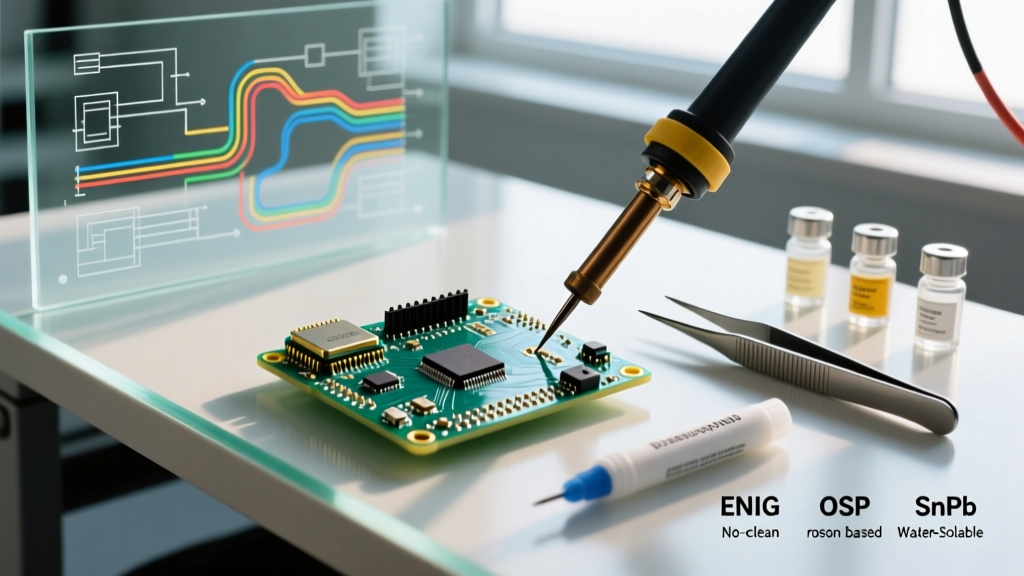

The Core Misconception: Solder Doesn't Just 'Melt and Stick'
If you are asking how does soldering flux work, you have already realized that simply melting solder wire onto a copper pad rarely results in a reliable electrical connection. Beginners often assume solder behaves like hot glue. In reality, soldering is a metallurgical process called wetting, where the molten alloy forms an intermetallic compound (IMC) with the base metal. However, this process is entirely blocked by a microscopic layer of copper oxide that forms on your PCB pads the moment they are exposed to air.
When you apply a 350°C soldering iron to bare copper, the heat accelerates oxidation exponentially. Without a chemical intervention, the molten solder will ball up and roll off the pad—a phenomenon known as de-wetting. This is where flux becomes the most critical consumable in your toolkit.
The Dual Mechanism: How Soldering Flux Actually Works
To understand the chemistry, we must break down the two distinct physical jobs flux performs during the soldering thermal profile.
1. Chemical Deoxidation (The Scrubber)
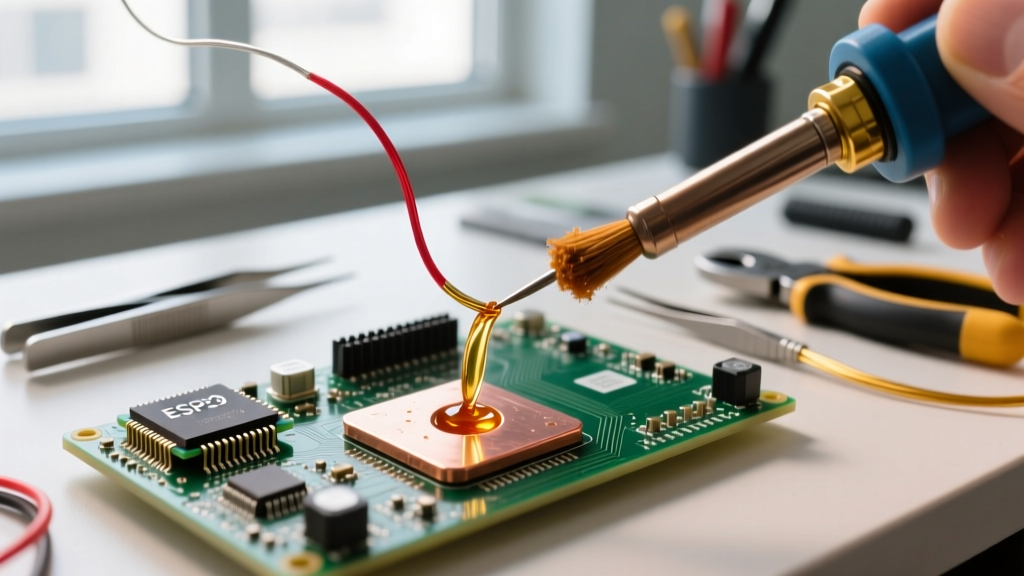
Flux contains mild organic or inorganic acids. In traditional rosin flux, the primary active ingredient is abietic acid, derived from pine tree sap. When heated to its activation temperature (typically between 150°C and 180°C), abietic acid reacts with the copper oxide (CuO) on the pad. This chemical reaction strips the oxygen away, forming a soluble compound called copper abietate, which floats to the surface of the molten solder and becomes trapped in the flux residue. By dissolving the oxide layer, the flux exposes pure, reactive copper underneath.
2. Surface Tension Reduction (The Wetting Agent)
Once the metal is clean, the flux acts as a surfactant. Molten solder has high surface tension, causing it to form spherical beads (much like water on a freshly waxed car). Flux lowers the interfacial tension between the molten alloy and the copper substrate. According to the TWI Global soldering guidelines, proper wetting is achieved when the contact angle between the solder and the pad drops below 90 degrees. Flux allows the solder to flow outward into a smooth, concave fillet, ensuring maximum mechanical and electrical contact area.
Expert Insight: Flux does not make solder stick; flux cleans the metal so the solder's natural metallurgical affinity for copper can take over. If your solder isn't sticking, adding more solder won't help. You need more flux or more heat to activate the flux you already have.
The Thermal Lifecycle: Flux Activation Temperatures
A common beginner mistake is assuming flux is 'active' the moment it touches a hot iron. Flux chemistry is strictly temperature-dependent. If you do not respect the thermal lifecycle, the flux will fail. Below is the standard thermal profile for a typical SAC305 (Lead-Free) soldering process using a rosin-based flux:
| Thermal Stage | Temperature Range | Chemical Action |
|---|---|---|
| Solvent Boil-Off | 80°C - 120°C | Carrier solvents (like isopropanol) evaporate. If heated too fast, this causes violent spitting and solder balling. |
| Activation Zone | 150°C - 180°C | Acid activators become chemically active, aggressively dissolving copper oxides and preparing the surface. |
| Peak Soldering | 217°C - 245°C | Solder melts and flows. Flux forms a protective barrier over the molten pool, preventing re-oxidation from ambient air. |
| Decomposition | Above 260°C | Flux resins begin to carbonize and burn off, leaving a hard, dark crust that is extremely difficult to clean. |
The Big Three: Flux Chemistries in 2026
Under the current IPC J-STD-004B standard, fluxes are categorized by their chemical composition and activity levels. Here is what you need to know about the three main types available on the market today.
Rosin Mildly Activated (RMA)
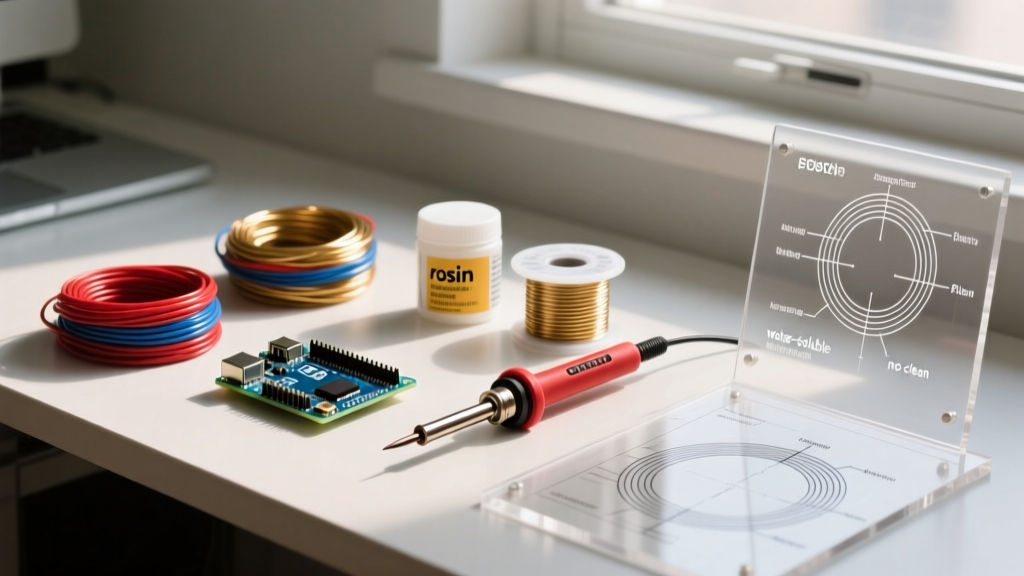
The undisputed king of through-hole and hobbyist soldering. RMA flux uses natural pine rosin mixed with mild activators like dimethylammonium chloride.
Top 2026 Pick: Kester 186 Liquid Flux.
Cost: ~$18 for a 2oz bottle.
Best For: Hand soldering wires, repairing vintage electronics, and general PCB rework. It leaves a sticky, amber residue that is non-corrosive but can attract dust. It can be cleaned with 99% Isopropyl Alcohol (IPA), though many hobbyists safely leave it on the board.
Water-Soluble (Organic Acid / OA)
OA fluxes use synthetic organic acids (like lactic or citric acid) instead of rosin. They are incredibly aggressive and can solder through heavy oxidation that would defeat RMA flux.
Top 2026 Pick: Kester 245 Water-Wash Flux.
Cost: ~$22 for a 2oz bottle.
Best For: Heavily oxidized pads, thick ground planes, and automated wave soldering.
Critical Warning: OA flux residue is highly corrosive and electrically conductive. It must be cleaned off using 60°C deionized (DI) water within 4 hours of soldering. Never use tap water, as the minerals will cause galvanic corrosion.
No-Clean (Synthetic Resin)
No-clean fluxes dominate modern Surface Mount Technology (SMT) and fine-pitch rework. They use synthetic resins that, upon cooling, encapsulate any unreacted activators in a hard, glass-like shell, rendering them electrically inert.
Top 2026 Pick: Amtech NC-559-V2-TF Solder Paste (for SMT) or MG Chemicals 8341 No-Clean Liquid Flux (for hand soldering).
Cost: ~$32 for a 10cc syringe of Amtech paste; ~$25 for a 100ml pen of MG Chemicals liquid.
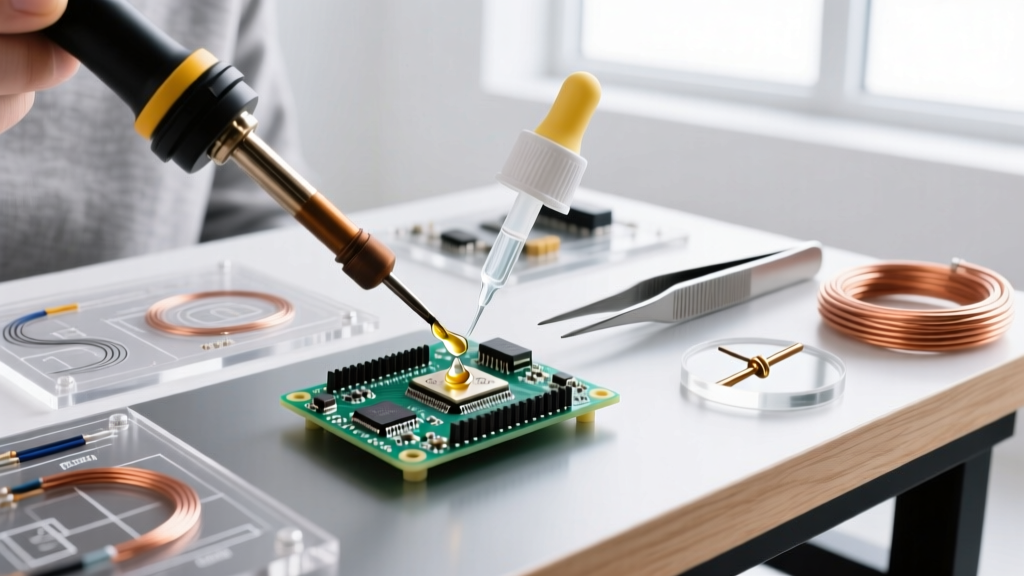
Best For: 0402 SMD components, BGA reballing, and dense PCBs where cleaning under components is impossible. Do not attempt to clean no-clean residue with IPA; it will only smear the resin and create a sticky, conductive mess.
Troubleshooting Matrix: Flux Failure Modes
Even with the right chemistry, improper technique leads to catastrophic joint failures. Use this diagnostic matrix to identify your flux-related issues:
| Visual Symptom | Root Cause (Flux Related) | Corrective Action |
|---|---|---|
| Solder Balling / Spitting | Iron applied directly to liquid flux at 380°C. Solvents flash-boil, exploding molten solder across the board. | Preheat the PCB to 100°C before applying liquid flux, or switch to a gel/paste flux which releases solvents slower. |
| Cold / Grainy Joints | Flux exhausted (burned off) before the solder fully wetted the pad, usually due to excessive iron dwell time (>4 seconds). | Remove the iron, apply fresh flux to the joint, and reheat for 1-2 seconds. Never just hold the iron longer. |
| Green Fuzz / Corrosion | Accidental use of plumbing flux (Zinc Chloride / Acid paste) on electronics. | Scrap the board if possible. Plumbing acid cannot be neutralized and will destroy copper traces within weeks. |
| Tombstoning (SMT) | Uneven flux activation on a small capacitor pad, causing one side to wet and pull the component upright. | Ensure uniform preheating of the entire PCB to activate the paste simultaneously on both pads. |
Expert Sourcing & Industry Standards
When selecting flux, always verify that the manufacturer complies with recognized industry standards. The NASA-STD-8739.3 Workmanship Manual explicitly dictates that fluxes used in high-reliability aerospace applications must meet the rigorous testing requirements of IPC J-STD-004 for copper mirror corrosion and surface insulation resistance (SIR).
Furthermore, when sourcing popular brands like Kester or Amtech, be highly vigilant of counterfeits on third-party marketplaces. Counterfeit no-clean pastes often contain hidden halide activators that will corrode your fine-pitch ICs over time. Always purchase directly from authorized distributors like Digi-Key, Mouser, or the official Kester Technologies portal to guarantee chemical purity and proper cold-chain storage for temperature-sensitive solder pastes.
Final Beginner Takeaway
Understanding how soldering flux works transforms you from someone who 'melts metal' into a technician who controls metallurgy. Respect the activation temperatures, match the chemistry to your specific cleaning capabilities, and never underestimate the power of adding a fresh drop of high-quality rosin flux to a stubborn joint.