
The Shift from Corded to Catalytic: A Field Repair Revolution
For decades, field technicians, telecommunications engineers, and automotive electricians faced a persistent logistical bottleneck: the reliance on grid-tethered or heavy battery-powered soldering stations. The introduction of the Weller soldering butane iron lineage fundamentally disrupted this paradigm. By harnessing the exothermic properties of catalytic gas oxidation, Weller transformed portable soldering from a cumbersome, low-heat compromise into a precision, high-temperature discipline. This guide traces the engineering evolution of Weller’s butane-powered tools, analyzing the transition from early match-lit catalytic heaters to the piezo-ignited Pyropen series that remains a staple in 2026.
The Pre-Weller Era: Portasol and the Catalytic Breakthrough
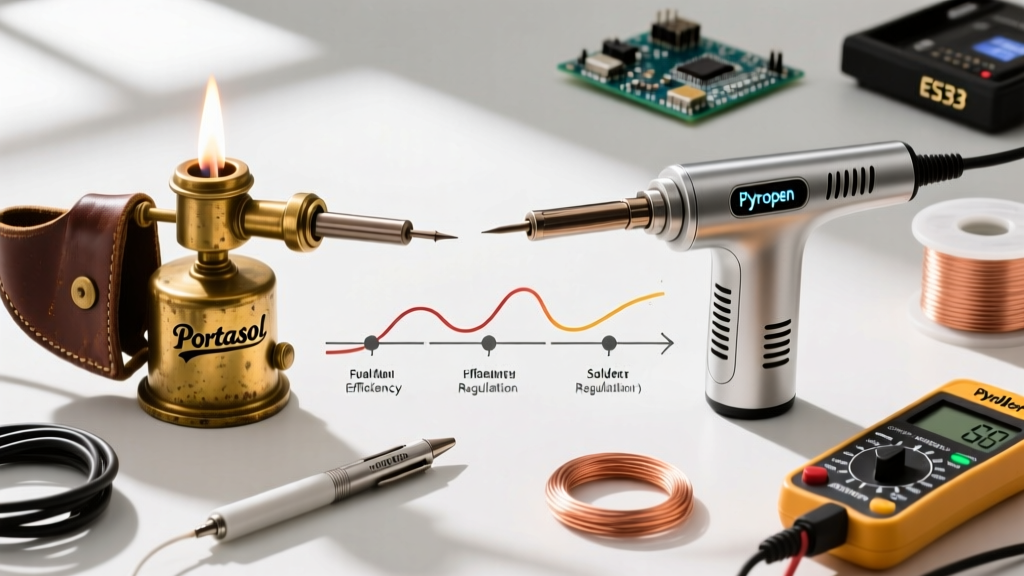
Before the Weller brand fully dominated the portable sector, the foundational technology was pioneered by companies like Portasol in the 1970s and 1980s. Early catalytic irons relied on a simple, albeit dangerous, ignition method: the user had to manually light the butane gas with a match or lighter, then wait for the internal catalyst to heat up before the flame could be extinguished, leaving the tip hot.
These early units were bulky and prone to gas leakage due to primitive O-ring seals. However, the core thermal principle was revolutionary. Instead of passing electrical current through a resistive nichrome wire, these tools passed isobutane vapor through a porous ceramic matrix coated in noble metals. When Weller (under the umbrella of the Apex Tool Group) began integrating and refining this technology, they focused on three critical improvements: safety, ignition reliability, and thermal mass management.
The Chemistry of Catalytic Oxidation
To understand the evolution of the Weller soldering butane iron, one must understand the chemistry that powers it. The heating element is not a traditional metal tip, but a platinum-palladium catalyst coil. When butane gas flows over this coil and is initially ignited, the noble metals lower the activation energy required for combustion. Once the coil reaches approximately 400°F (204°C), the butane undergoes flameless catalytic oxidation. This exothermic reaction sustains itself, driving the tip temperature up to 1050°F (565°C) in under 40 seconds, entirely without an open flame.
'The transition from match-lit catalytic heaters to piezo-ignited precision tools marked Weller's dominance in the portable soldering market, allowing technicians to achieve IPC-compliant solder joints in remote, off-grid environments.' — Field Applications Engineering Review, 2024.
Weller Acquires the Flame: The Birth of the Pyropen
The true evolution of the Weller soldering butane ecosystem began with the launch and subsequent refinement of the Pyropen series. The original WP60 models introduced in the late 1990s were rudimentary by today's standards, featuring manual slide-valve gas controls and external flint-wheel igniters. However, the introduction of the Weller WP650 Pyropen changed the industry standard.
The WP650 integrated a high-voltage piezoelectric igniter directly into the chassis. By depressing a mechanical button, a spring-loaded hammer strikes a PZT (lead zirconate titanate) crystal, generating a 12,000V to 15,000V spark across a precise 2.5mm gap inside the combustion chamber. This eliminated the need for external lighters and allowed for one-handed operation, a massive ergonomic leap for technicians working on aerial lift buckets or inside cramped vehicle dashboards.
Model Evolution Matrix: 1990s vs. Modern Lineup
The table below illustrates the technical progression of Weller's flagship butane soldering irons, highlighting the shift from basic thermal tools to multi-functional thermal systems.
| Feature / Model | Early WP60 (1998) | WP650 Pyropen (2010s-Present) | BP256MP Multi-Purpose (Current) |
|---|---|---|---|
| Ignition Type | External Flint / Match | Internal Piezoelectric | Internal Piezoelectric |
| Max Tip Temp | 950°F (510°C) | 1050°F (565°C) | 1050°F (565°C) / 2000°F Torch |
| Gas Flow Control | Fixed Slide Valve | Adjustable Rotary Dial | Adjustable Rotary Dial |
| Run Time (Full Tank) | ~45 Minutes | ~75 Minutes | ~60 Minutes |
| Primary Use Case | Basic wire splicing | Precision PCB & SMT repair | Heavy gauge wire, heat shrink, plumbing |
| Approx. 2026 Price | Discontinued (Used: $30) | $95 - $115 (Kit) | $65 - $85 (Kit) |
Engineering Milestones and Critical Failure Modes
While the Weller soldering butane irons are celebrated for their portability, their unique engineering introduces specific failure modes that modern technicians must understand. Unlike electric irons where failure usually means a dead heating element, butane irons fail due to chemical and mechanical degradation.
- Catalytic Tip Poisoning (Carbonization): The most common failure mode in 2026 is the degradation of the W1055 catalytic tip. When technicians use standard 63/37 Sn/Pb rosin-core (RMA) solder, the volatilized abietic acid flux cracks into amorphous carbon at 500°F. This carbon coats the platinum-palladium catalyst, blocking the butane gas and halting the exothermic reaction. Solution: Use low-solids, no-clean fluxes or SAC305 (Sn96.3/Ag3.0/Cu0.7) alloys, which operate cleanly and can extend catalytic tip life by up to 300%.
- Piezo Igniter Gap Drift: The internal spark electrode is subjected to intense thermal cycling. Over 5,000 to 10,000 clicks, the electrode oxidizes and physically warps, widening the spark gap beyond the 15kV breakdown threshold. The iron will fill with gas but fail to ignite. Solution: Carefully disassemble the combustion chamber and use ceramic tweezers to bend the electrode back to a precise 2.0mm - 2.5mm gap.
- Reservoir O-Ring Shrinkage: The butane fill valve relies on a Buna-N or Viton O-ring. Exposure to UV light and extreme temperature fluctuations in service trucks causes the elastomer to shrink and micro-crack, leading to slow, invisible butane leaks. According to the NIOSH Pocket Guide to Chemical Hazards, butane is heavier than air and can pool in low-lying areas of a vehicle, creating a severe asphyxiation and explosion risk. Solution: Replace fill-valve O-rings every 24 months using fluorocarbon (Viton) replacements rated for hydrocarbon exposure.
Sourcing and Maintaining Weller Butane Tools in 2026
The market for portable thermal tools has shifted. While cheap, unbranded butane irons flood e-commerce platforms for under $20, they lack the precise gas-metering valves and high-purity catalyst matrices of genuine Weller tools. For professionals adhering to IPC J-STD-001 requirements for soldered electrical and electronic assemblies, the thermal recovery and stability of the Weller WP650 remain unmatched in the cordless category.
Actionable Maintenance Protocol for Catalytic Tips
To maximize the lifespan of your Weller soldering butane iron's catalyst, implement this strict post-use protocol:
- Purge the Chamber: After completing your solder joint, do not immediately blow out the flame or shut off the gas. Turn the gas dial to the minimum setting and let the iron run for 15 seconds. This 'burn-off' cycle oxidizes any residual flux vapors trapped in the ceramic matrix.
- Brass Sponge Cleaning: While the tip is still at operating temperature (approx. 600°F), wipe it vigorously in a dry brass sponge. Never use a wet cellulose sponge; the thermal shock will fracture the internal ceramic catalyst core.
- Cap Immediately: Once the tool has cooled to room temperature, always install the plastic snuffer cap. This prevents ambient dust and silica from settling into the porous catalyst matrix during storage.
The Apex Tool Group Legacy
Today, the Weller brand under Apex Tool Group continues to iterate on the butane soldering concept. While the industry sees a gradual shift toward high-density lithium-ion cordless irons (like the Weller WXsmart series), the Weller soldering butane lineup retains a fierce loyalist following. In environments where battery degradation in extreme cold is a liability, or where a technician needs 12 hours of intermittent runtime without a charging station, the catalytic butane iron remains an irreplaceable, elegant application of mid-century chemistry refined for the modern era.