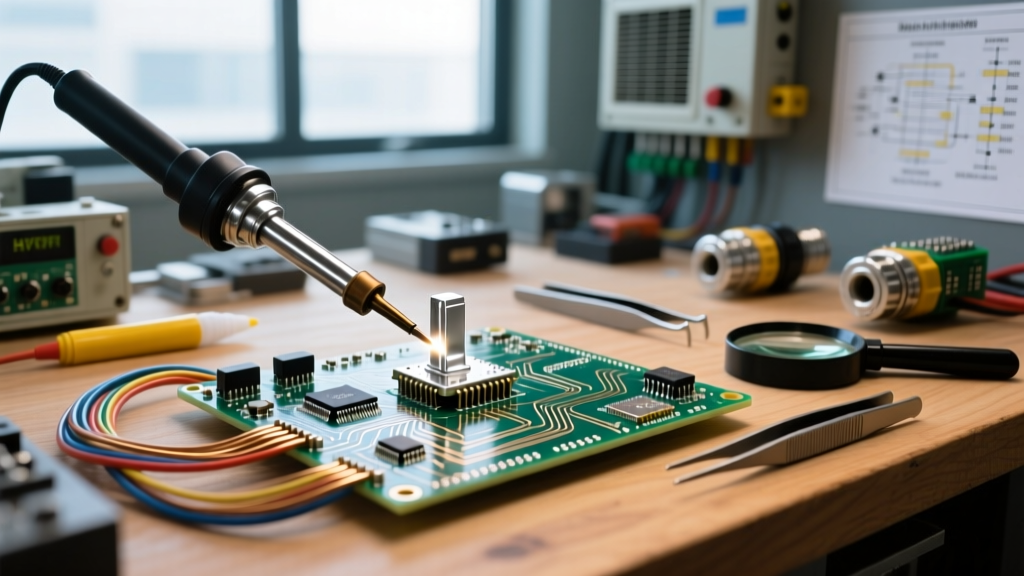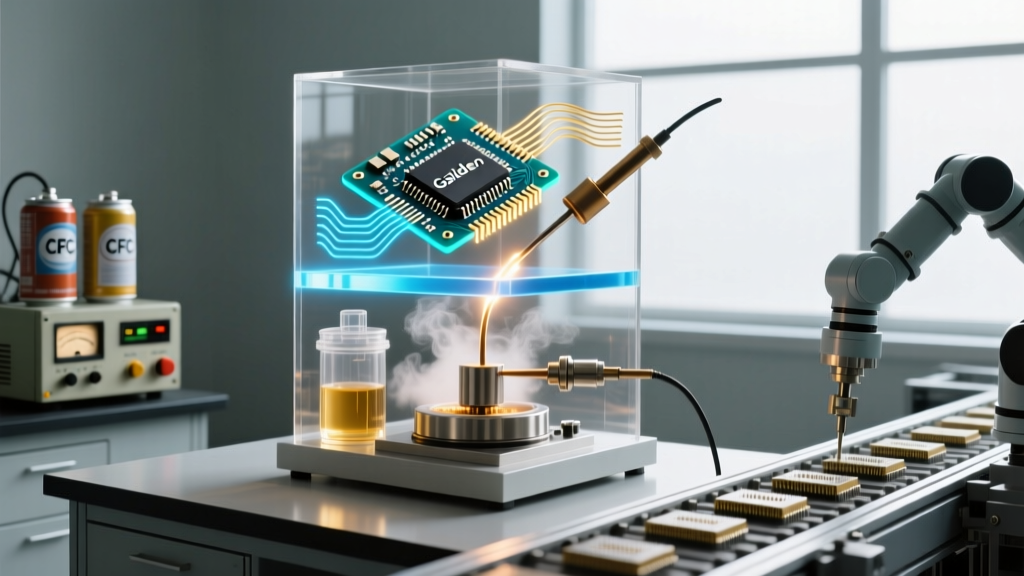

The Genesis: Western Electric and the CFC Era (1970s)
Vapor phase soldering (VPS) did not begin as a commercial electronics manufacturing staple; it was born out of aerospace and telecommunications necessity in the early 1970s. Engineers at Western Electric and NASA were struggling with the thermal mass disparities of early hybrid microcircuits. Traditional infrared (IR) and early convection methods caused severe thermal shock and uneven heating, leading to micro-cracking in ceramic substrates.
The breakthrough came from utilizing the physics of phase change. By submerging a printed circuit board assembly (PCBA) in the saturated vapor of a boiling inert liquid, engineers achieved uniform, oxygen-free heating. The early workhorse fluids were chlorofluorocarbons (CFCs) and specifically engineered perfluorinated compounds like 3M’s Fluorinert FC-70, which boiled at 215°C—perfectly suited for the standard 63/37 Tin-Lead (SnPb) eutectic solder that melted at 183°C.
The Physics Advantage: When a relatively cool PCBA enters the saturated vapor zone, the vapor condenses on the board's surfaces. This phase change releases the fluid's latent heat of vaporization directly onto the components, yielding a heat transfer coefficient of 1,000 to 5,000 W/m²K—up to 100 times more efficient than forced convection air.
The Ozone Crisis and the 'Dark Ages' of Reflow (1980s–1990s)
By the mid-1980s, vapor phase soldering was the undisputed king of high-reliability SMT reflow. However, the environmental reckoning of the era brought its reign to a screeching halt. The discovery of the Antarctic ozone hole led directly to the U.S. EPA Montreal Protocol in 1987, which mandated the global phase-out of ozone-depleting substances (ODS), including the CFCs and HCFCs used in early VPS systems.
The electronics manufacturing industry faced a crisis. The alternative fluids available at the time were either too toxic, too expensive, or lacked the precise boiling points required for SMT profiles. Consequently, the industry aggressively pivoted to forced convection reflow ovens. Throughout the 1990s, VPS was largely relegated to niche, low-volume, high-reliability sectors like military and medical devices, while high-volume consumer electronics adopted multi-zone convection ovens.
The Renaissance: Engineered PFPE Fluids (2000s–Present)
The resurrection of vapor phase soldering was driven by two major industry shifts: the transition to lead-free soldering and the chemical engineering of advanced perfluoropolyethers (PFPEs).
When the RoHS directive forced the industry to adopt SAC305 (Tin-Silver-Copper) lead-free alloys, reflow peak temperatures jumped from 220°C to 250°C+. Convection ovens struggled with the narrow process windows of lead-free pastes, often causing component warpage and pad cratering due to prolonged exposure to high delta-T (temperature differentials).
Chemical giants responded with advanced PFPE fluids, most notably Syensqa/Solvay’s Galden HT line. These fluids offered zero ozone depletion potential (ODP), zero global warming potential (GWP), and non-flammability. Crucially, fluids like Galden HT 230 (boiling at 230°C) and HT 240 provided the exact thermal ceilings needed for SAC305 reflow, ensuring components could never exceed the fluid's boiling point, effectively eliminating thermal overshoot.
2026 Equipment and Fluid Economics
As of 2026, modern VPS systems have overcome the historical issue of 'drag-out' (fluid loss via vapor escaping on the boards). Manufacturers like Asscon and IBL have integrated advanced active cooling coils and secondary vapor traps that reduce fluid consumption by up to 85% compared to 1990s era machines.
Current Market Pricing and OPEX (2026 Estimates)
| Category | Specific Model / Fluid | Estimated Cost (USD) | Notes |
|---|---|---|---|
| Batch VPS System | IBL BL-600 | $42,000 - $48,000 | Ideal for prototyping and low-to-medium volume. |
| Inline VPS System | Asscon VP 1000 | $115,000 - $145,000 | High-volume, integrates with automated conveyor lines. |
| Lead-Free Fluid | Galden HT 230 | $220 - $260 / Liter | Boiling point 230°C. Standard for SAC305. |
| SnPb Fluid | Galden HT 170 | $190 - $230 / Liter | Boiling point 170°C. Used for aerospace/medical SnPb. |
Note: While the initial capital expenditure (CapEx) for an inline VPS system is roughly 20-30% higher than a comparable 10-zone convection oven, the operational expenditure (OpEx) savings in nitrogen consumption (VPS requires zero N2) and reduced scrap rates often yield an ROI within 18 to 24 months for high-mix manufacturers.
Comparison Matrix: VPS vs. Convection vs. Infrared
Understanding where vapor phase soldering fits in the modern SMT landscape requires a direct comparison of heat transfer mechanisms and process limitations.
| Feature | Vapor Phase Soldering (VPS) | Forced Convection Reflow | Infrared (IR) Reflow |
|---|---|---|---|
| Heat Transfer Medium | Condensing inert vapor | Heated air / Nitrogen gas | Radiant electromagnetic waves |
| Heat Transfer Coefficient | 1,000 - 5,000 W/m²K | 50 - 100 W/m²K | Variable (depends on surface color) |
| Shadowing Effect | None (vapor envelops all geometry) | Moderate (tall components block airflow) | Severe (components block line-of-sight IR) |
| Oxygen Environment | Inherently oxygen-free (no N2 needed) | Requires N2 purge for low O2 (<100ppm) | Requires N2 purge |
| Maximum Temp Limit | Strictly capped by fluid boiling point | Unlimited (depends on oven max setting) | Unlimited (risk of component burning) |
Modern Failure Modes and Troubleshooting
Despite its thermal superiority, VPS is not immune to defects. Modern process engineers must monitor specific failure modes unique to condensation heating.
1. Solder Balling and Splattering
- The Cause: If the PCBA is introduced into the primary vapor zone too quickly, the rapid condensation can cause the flux vehicle in the solder paste to boil violently, ejecting microscopic solder spheres.
- The 2026 Fix: Utilize machines with a 'pre-heat' or secondary lower-temperature vapor zone (e.g., using a fluid blend or a specialized thermal gradient chamber) to slowly ramp the board to 150°C before it hits the primary 230°C vapor blanket.
2. Tombstoning on 0201 and 01005 Passives
- The Cause: Because VPS heats all exposed surfaces simultaneously and aggressively, unequal thermal masses on the pads of micro-passives can cause one side of the solder paste to reflow milliseconds before the other, pulling the component upright via surface tension.
- The 2026 Fix: Stencil aperture reduction. Home-plate or U-shaped apertures for 01005 components reduce the solder volume on the inner pad edges, delaying the wetting force until both pads reach the liquidus state simultaneously.
3. Fluid Degradation and Acidification
- The Cause: While PFPE fluids are chemically inert, flux residues (specifically rosin and organic acids) that drip into the boiling sump can carbonize over time, lowering the fluid's pH and potentially causing long-term corrosion on subsequent boards.
- The 2026 Fix: Implement weekly sump filtration using activated alumina or specialized bypass filtration cartridges designed for PFPE reclamation. Monitor the fluid's acid number (TAN) monthly; replace or distill if TAN exceeds 0.05 mg KOH/g.
Conclusion
The evolution of vapor phase soldering is a testament to the electronics industry's ability to adapt to environmental and technological mandates. From the ozone-depleting CFCs of the 1970s to the highly engineered, eco-friendly PFPE fluids of 2026, VPS has transitioned from a banned hazard to a premium, high-yield SMT solution. For manufacturers dealing with complex, high-thermal-mass assemblies—such as EV power inverters, 5G RF amplifiers, and aerospace avionics—vapor phase soldering remains the undisputed champion of uniform, defect-free reflow.