
Beyond the Hobbyist: The Industrial Definition
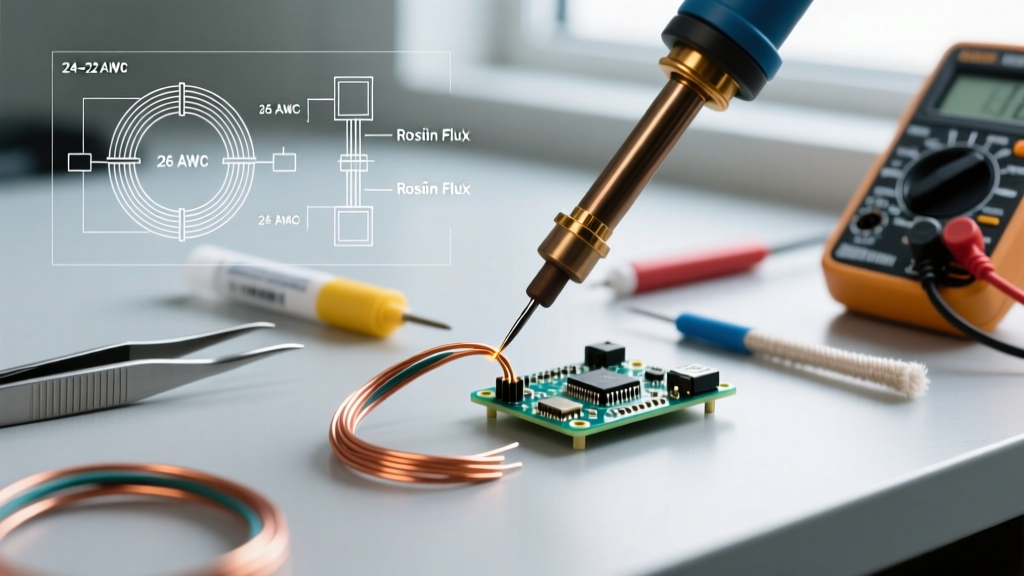
When beginners ask, what does soldering mean, they are usually referring to the manual process of melting a tin-lead wire with a handheld iron to join two copper strands. However, in modern electronics manufacturing, the definition shifts dramatically. At an industrial scale, soldering is a highly controlled metallurgical bonding process governed by strict thermal profiles, alloy chemistry, and wetting dynamics.
In surface mount technology (SMT) and high-density interconnect (HDI) PCB assembly, soldering means creating a reliable intermetallic compound (IMC) layer between the component termination and the PCB pad. This IMC layer—typically a Cu6Sn5 or Cu3Sn structure—must be precisely 1 to 3 microns thick. If the thermal profile is too cold, the IMC fails to form (a cold joint). If the time above liquidus (TAL) is too long, the IMC grows excessively thick, resulting in a brittle joint susceptible to mechanical shock and thermal cycling fatigue.
Industrial Soldering Methods Matrix
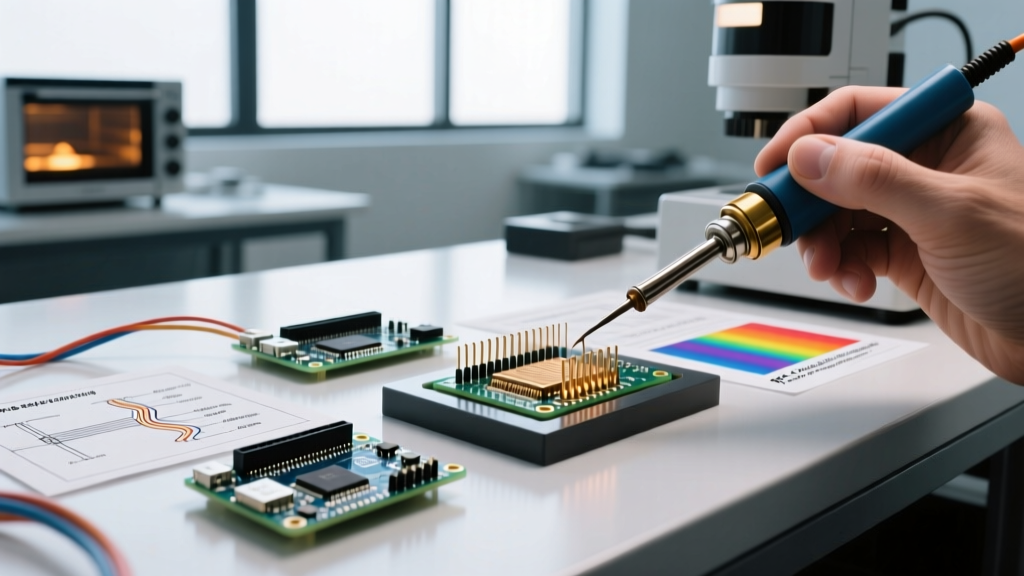
To understand what soldering means on a factory floor, one must look at the automated machinery driving production. Manual soldering is reserved for rework or low-volume prototyping. High-volume facilities rely on the following primary methodologies:
| Method | Primary Application | Typical Equipment (2026 Models) | Peak Temp Range |
|---|---|---|---|
| Reflow Soldering | SMD components, BGAs, QFNs | Heller 1913 Reflow Oven | 235°C - 250°C |
| Wave Soldering | Through-hole (THT), heavy copper | ERSA POWERFLOW e N2 | 255°C - 265°C |
| Selective Soldering | Mixed tech (SMD + THT) without masking | Pillarhouse Jade MKII | 260°C - 275°C |
| Vapor Phase | Thermally sensitive, high-mass boards | Asscon VP System | 230°C (Fixed by fluid BP) |
Reflow soldering dominates the industry, accounting for over 85% of all SMT assemblies. It utilizes a precisely engineered solder paste (flux + alloy powder) that undergoes distinct thermal stages: preheat, thermal soak, reflow (liquidus), and cooling. According to the Surface Mount Technology Association (SMTA), controlling the ramp-to-spike or soak profile is critical to preventing flux spatter and solder balling.
The Role of Stencil Design in Solder Paste Deposition
Before any heat is applied, the success of the soldering process is determined by the stencil. In high-density PCB assembly, what does soldering mean if the paste volume is incorrect? It means guaranteed failure. Modern SMT facilities use laser-cut stainless steel stencils, often with nano-coatings (like NanoSlic) to improve paste release.
For fine-pitch components (0.4mm pitch QFNs or micro-BGAs), engineers employ aperture reduction. Instead of a 1:1 ratio with the PCB pad, the stencil aperture is reduced by 10% to 15% to prevent solder bridging. Furthermore, the aspect ratio (aperture width divided by stencil thickness) must remain above 1.5 to ensure the solder paste releases cleanly from the stencil walls during the separation stroke. If the aspect ratio drops below 1.2, the paste will stick to the stencil, resulting in insufficient solder volume and subsequent open circuits.
Alloy Selection: The Shift to Advanced Lead-Free Chemistries
Historically, the answer to 'what does soldering mean' involved eutectic 63/37 Tin-Lead (SnPb), which melts cleanly at 183°C. Today, RoHS compliance mandates lead-free alternatives, fundamentally changing the thermal and mechanical landscape of PCB assembly.
- SAC305 (Sn96.5/Ag3.0/Cu0.5): The industry workhorse. Melts between 217°C and 220°C. It offers excellent tensile strength but requires higher reflow temperatures (peak 245°C), which can warp large BGAs.
- SN100C (Sn99.3/Cu0.7/Ni): A popular wave soldering alloy. The addition of nickel stabilizes the copper dissolution rate in the solder pot, significantly extending the lifespan of the machine's impellers and nozzles.
- SAC-Bi (Bismuth-Doped): As detailed in technical resources from Indium Corporation, adding Bismuth drops the melting point to roughly 190°C. This is increasingly used in 2026 for ultra-thin consumer electronics to prevent substrate warpage.
Equally important is the flux chemistry inside the paste. Under IPC J-STD-004, most high-reliability boards utilize ROL0 (Rosin, Low activity, zero halides) flux to prevent post-assembly electrochemical migration, even if left uncleaned.
Expert Insight: The transition to Bismuth-doped alloys requires a complete redesign of the reflow profile. Because the solidus and liquidus temperatures are closer together, the 'soak' zone must be shortened to prevent the flux from exhausting before the alloy reaches full liquidus.
Decoding the IPC-A-610 Class 3 Standard
In industrial applications, soldering quality is not subjective; it is dictated by the IPC-A-610 Acceptability of Electronic Assemblies standard. While consumer electronics might pass under Class 2, aerospace, medical, and automotive sectors demand Class 3 compliance.
For a Class 3 through-hole solder joint, what does soldering mean in practice? It means achieving a minimum 270-degree wetting angle around the lead, complete fill of the plated through-hole (PTH) barrel, and a distinctly concave fillet with zero evidence of disturbed or cold crystallization. Any deviation—such as a convex fillet or a blowhole exceeding 10% of the pad diameter—results in immediate board rejection.
High-Volume Failure Modes and Mitigation
Understanding industrial soldering also requires diagnosing high-volume defects that do not exist in manual, low-temp applications.
- Head-in-Pillow (HiP): A notorious BGA defect where the solder paste on the PCB pad and the solder sphere on the BGA component reflow but fail to coalesce. Mitigation: Upgrade from Type 3 to Type 4 or Type 5 solder paste (smaller powder mesh) to improve stencil release on micro-pads, and utilize a nitrogen-inerted reflow oven to reduce oxidation.
- Tombstoning: A surface-mount capacitor or resistor stands on one end during reflow. This is caused by unequal wetting forces on the two pads. Mitigation: Balance the thermal mass of the PCB traces connected to both pads, and ensure the pick-and-place machine's Z-axis pressure is calibrated to exactly 0.1mm paste displacement.
- Solder Voiding: Trapped flux gases create bubbles inside BGA spheres, reducing the cross-sectional area and thermal conductivity. Mitigation: Implement a vacuum reflow oven (e.g., Rehm V8 VACUUM) which pulls a negative pressure of up to 20 mbar during the liquidus phase, physically extracting trapped volatiles and reducing voiding to under 5%.
Capital Expenditure: Industrial Equipment Pricing in 2026
Transitioning from manual to automated soldering requires significant capital. For a mid-sized contract manufacturer (CM) setting up a new SMT line in 2026, the equipment costs for the soldering and deposition phase alone are substantial:
- Inline Stencil Printer (e.g., DEK Horizon 03iX): $75,000 - $90,000
- Convection Reflow Oven (8-Zone, Nitrogen capable): $65,000 - $95,000
- Inline Selective Soldering System: $120,000 - $180,000
- 3D Solder Paste Inspection (SPI) Laser System: $70,000 - $110,000
Furthermore, the operational cost of Nitrogen (N2) generation for inerting the reflow process adds roughly $0.12 to $0.18 per board, but reduces defect rates by up to 40% by preventing oxidation of the molten SAC305 alloy during the critical 60-second liquidus window.
Conclusion
Ultimately, answering the question of what soldering means in an industrial context requires looking past the simple melting of metal. It is a rigorous discipline of materials science, thermodynamics, and statistical process control. Whether utilizing a $100,000 vapor phase system for aerospace flight controllers or tuning the thermal soak zone on a standard convection oven for consumer IoT devices, modern soldering is the foundational process that ensures electronic reliability in the 21st century.