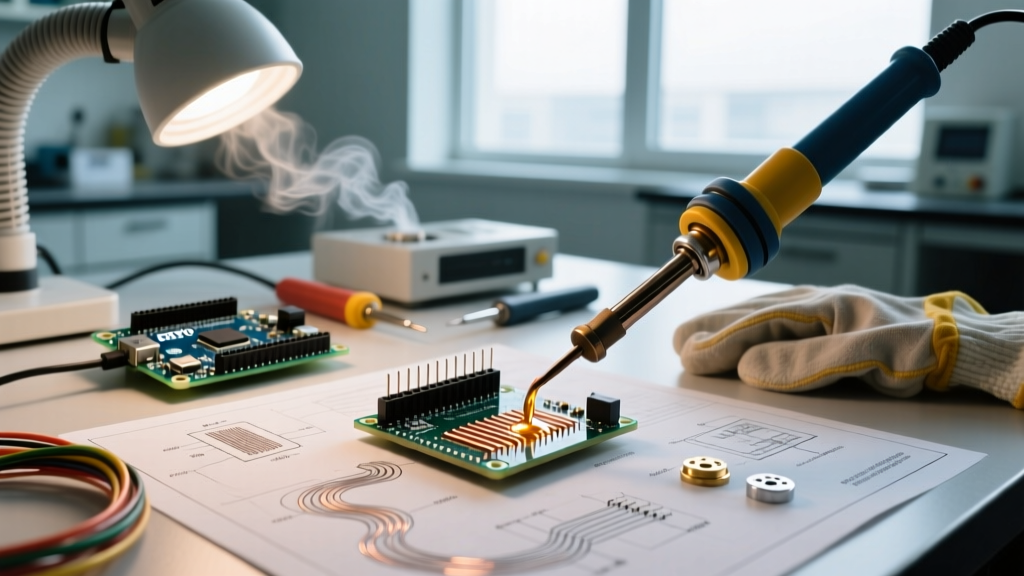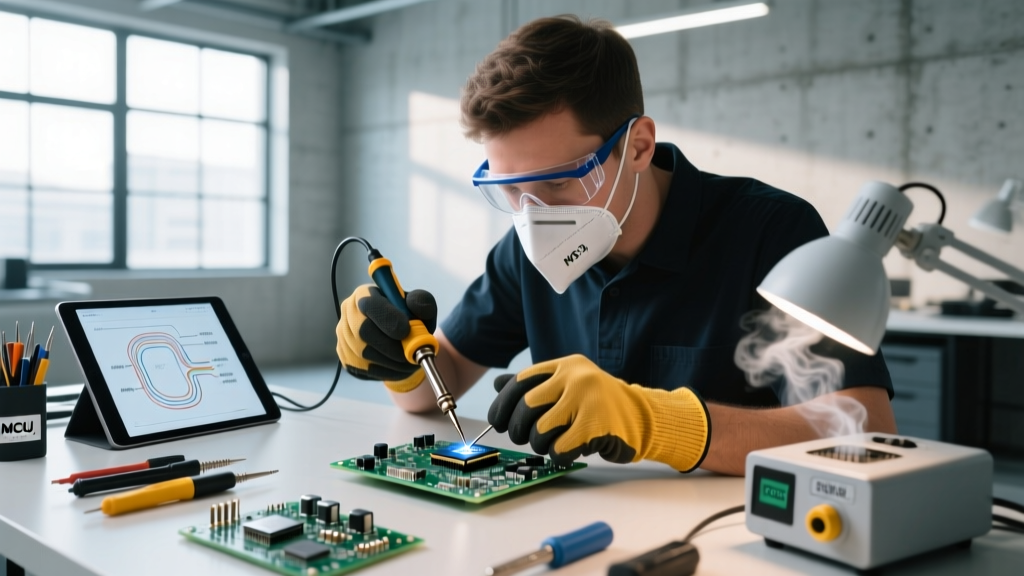

The Reality of Soldering With Lead in 2026
Despite the global push toward RoHS-compliant lead-free manufacturing, soldering with lead remains the undisputed standard for high-reliability electronics, aerospace, medical devices, and advanced DIY prototyping. The eutectic Sn63/Pb37 alloy, which melts at a precise 183°C (361°F) without a plastic phase, produces superior wetting and shinier, more reliable solder joints compared to SAC305 (lead-free) alternatives. Under IPC Standards (specifically IPC-A-610 Class 3), lead-based solders are frequently mandated for mission-critical applications where thermal cycling and mechanical shock resistance are paramount.
However, working with leaded solder introduces severe occupational health hazards. The risks are twofold: heavy metal exposure and toxic flux vaporization. To maintain a safe workspace, hobbyists and professionals alike must implement rigorous engineering controls and personal protective equipment (PPE) protocols. This guide details the exact safety best practices, equipment specifications, and hygiene routines required for soldering with lead safely.
Hazard Breakdown: Lead Particulate vs. Flux Fumes
A common misconception among beginners is that the smoke rising from a solder joint is vaporized lead. In reality, lead has a boiling point of 1,749°C (3,180°F)—far beyond the 350°C–400°C operating temperatures of standard soldering irons. The visible smoke is actually vaporized flux. However, lead exposure occurs through a different, equally dangerous vector: microscopic particulate transfer.
| Hazard Type | Source & Mechanism | Health Impact | Primary Mitigation Strategy |
|---|---|---|---|
| Lead Particulate | Handling solder wire, touching contaminated tools, sanding/desoldering wick. | Neurological damage, cardiovascular issues, kidney toxicity (via hand-to-mouth ingestion). | Nitrile gloves, strict handwashing, HEPA vacuuming. |
| Flux Fumes (Rosin/Colophony) | Vaporization of rosin-based or synthetic flux cores at 250°C+. | Occupational asthma, respiratory sensitization, dermatitis, eye irritation. | Source-capture fume extraction, P100/OV respirators. |
Engineering Controls: Fume Extraction Systems
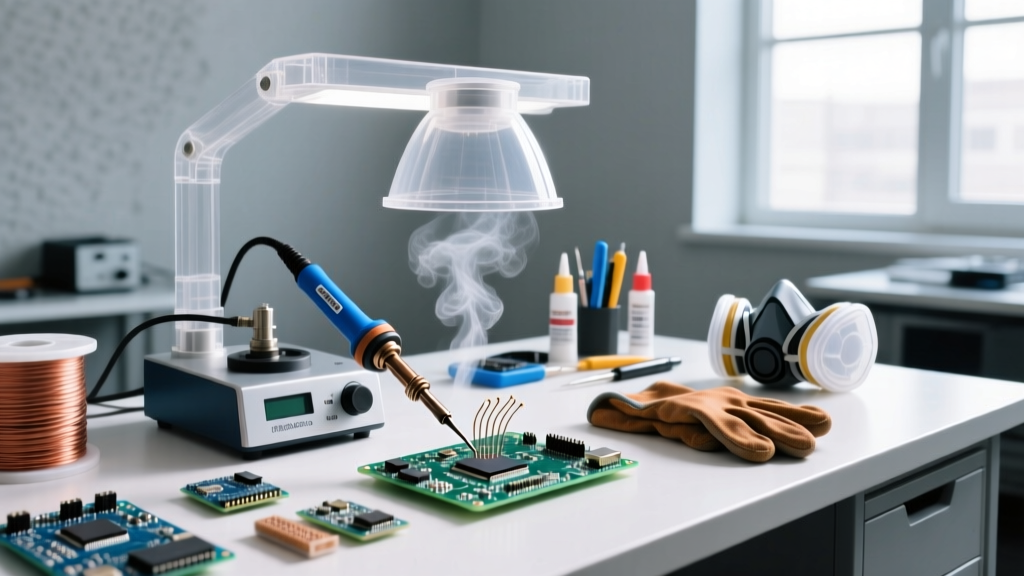
When soldering with lead, relying on open windows or standard ceiling fans is a critical safety failure. These methods merely disperse toxic rosin fumes and microscopic lead dust into the broader environment. You must utilize source-capture fume extractors equipped with multi-stage filtration (HEPA for particulates and Activated Carbon for volatile organic compounds).
Top Fume Extractors for Leaded Soldering
- Hakko FA-400 (Light DIY/Prototyping): Priced around $55, this is the baseline for hobbyists. It features a replaceable carbon filter and pulls roughly 23 CFM (Cubic Feet per Minute). Limitation: It only captures fumes if the extraction arm is positioned within 2 to 3 inches of the solder joint.
- Metcal MX-FE (Professional Benchtop): At approximately $650, this unit offers superior static-safe (ESD) operation and a multi-stage HEPA/Carbon filter. It provides adjustable airflow up to 60 CFM, ensuring aggressive capture of colophony vapors before they reach the operator's breathing zone.
- Weller WFE 4DX (Industrial/Production): Costing upwards of $1,400, this heavy-duty unit utilizes a brushless motor for whisper-quiet operation and continuous 24/7 runtime. It features an intelligent filter monitoring system that alerts operators when the activated carbon bed is saturated—a crucial feature, as saturated carbon will off-gas trapped VOCs back into the air.
Expert Tip: Activated carbon filters do not last forever. If you solder with leaded rosin-core wire for 4 hours a day, expect to replace your carbon filter every 3 to 6 months. Once you can smell the sweet, pine-like scent of rosin through the exhaust, the filter is completely saturated and must be replaced immediately.
Personal Protective Equipment (PPE) Requirements
While fume extractors handle airborne hazards, PPE protects against direct contact and inhalation of escaped vapors. According to the Occupational Safety and Health Administration (OSHA), employers and individuals must minimize heavy metal exposure through strict barrier methods.
1. Respiratory Protection
If you are soldering in a poorly ventilated room or cannot position a fume extractor within 3 inches of the joint, a half-face respirator is mandatory. The 3M 6291 (approx. $35) is the industry benchmark. It combines P100 particulate filters (blocking 99.97% of airborne dust and lead particles) with Organic Vapor (OV) cartridges to neutralize flux fumes. Standard N95 masks are entirely ineffective against flux vapors, as they only block particulates, not gases.
2. Hand and Skin Protection
Lead cannot be absorbed through intact skin, but it easily transfers from your fingers to your mouth, eyes, or food. Always wear 4-mil to 6-mil powder-free nitrile gloves when handling leaded solder wire, desoldering braid, or contaminated PCBs. Avoid latex gloves, as they offer poor chemical resistance to flux activators and can cause allergic contact dermatitis. Change gloves immediately after finishing your soldering session before touching doorknobs, keyboards, or your phone.
3. Eye Protection
Flux spitting is a universal annoyance that can cause severe corneal irritation. ANSI Z87.1-rated safety glasses with side shields are mandatory. For those wearing prescription glasses, polycarbonate over-glasses provide the necessary impact and splash resistance.
Workspace Hygiene & OSHA Compliance
The Environmental Protection Agency (EPA) and OSHA maintain strict guidelines regarding lead dust accumulation. When soldering with lead, your workbench becomes a contamination zone. Implementing the following hygiene protocols will keep your blood lead levels (BLL) well below the OSHA Permissible Exposure Limit (PEL) of 50 micrograms per cubic meter of air.
- Never Use Compressed Air: Blowing off your workbench with compressed air aerosolizes lead dust and flux residue, forcing it into the air you breathe and embedding it into carpets or HVAC systems.
- Use HEPA Vacuums Only: Clean your workspace using a vacuum equipped with a true HEPA filter. Standard shop-vacs will simply exhaust microscopic lead particles out of their exhaust ports.
- Wet Wiping: At the end of every session, wipe down your soldering mat, iron stand, and tools with isopropyl alcohol (IPA) or a dedicated lead-removal wipe (like those used in firearms cleaning). This dissolves sticky flux residue that traps lead dust.
- Strict Handwashing: Wash your hands with cold water and a heavy-duty pumice soap (like Fast Orange) immediately after removing your nitrile gloves. Cold water keeps pores closed, preventing dermal absorption of any residual contaminants.
- Zero Food or Drink Policy: Never keep open beverage containers, coffee mugs, or snacks within 10 feet of a lead soldering station. Vaporized flux and microscopic lead dust will settle on the surface of your drink.
Frequently Asked Questions (FAQ)
Is it safe to solder with lead at home?
Yes, provided you treat it with the same respect as hazardous chemicals. Using a dedicated, well-ventilated room (not your kitchen or bedroom), a source-capture fume extractor, nitrile gloves, and rigorous handwashing protocols makes home soldering with lead perfectly safe for adults. Keep children and pets out of the soldering area entirely.
Does soldering with lead cause lead poisoning?
Lead poisoning from soldering is almost exclusively caused by ingestion, not inhalation. Because the soldering iron does not get hot enough to vaporize lead, the primary risk is touching contaminated solder wire, tools, or workbenches, and then touching your mouth, eating, or smoking without washing your hands first.
What is the safest leaded solder alloy to use?
Sn63/Pb37 (63% Tin, 37% Lead) is the safest and most reliable choice. Because it is a eutectic alloy, it transitions from liquid to solid instantly at 183°C. This prevents "cold joints" caused by moving the component while the solder is in a plastic (semi-solid) state, reducing the time you need to spend reheating the joint and generating excess flux fumes.