
The Metallurgical Challenge of Ag925
Whether you are fabricating high-end audio connectors, custom RF shielding, or precision jewelry, soldering sterling silver presents a unique metallurgical puzzle. Sterling silver (Ag925) is an alloy consisting of 92.5% silver and 7.5% copper. While the silver provides exceptional electrical and thermal conductivity, the copper introduces severe oxidation risks and narrows your thermal working window.
Pure silver melts at 1763°F (961°C), but sterling silver melts at approximately 1640°F (893°C). Because silver brazing alloys (commonly referred to as silver solders in the trade) flow between 1240°F and 1450°F, your margin for error is incredibly tight. Overheat the joint by mere seconds, and you will melt your workpiece; under-heat it, and the solder will ball up without achieving capillary action.
With silver spot prices remaining highly volatile in 2026, minimizing scrap and avoiding failed joints is more critical than ever. This decision framework will guide you through selecting the precise alloy, flux, and thermal delivery system for your specific application.
Phase 1: The Silver Solder Alloy Matrix
Unlike electronics soldering (which utilizes tin-lead or SAC305 alloys at low temperatures), joining sterling silver requires silver brazing. The filler metal must contain a high percentage of silver to match the color, conductivity, and structural integrity of the base metal. According to Lucas-Milhaupt's brazing guidelines, the key to multi-step fabrication is stepping down the melting temperatures of your filler metals.
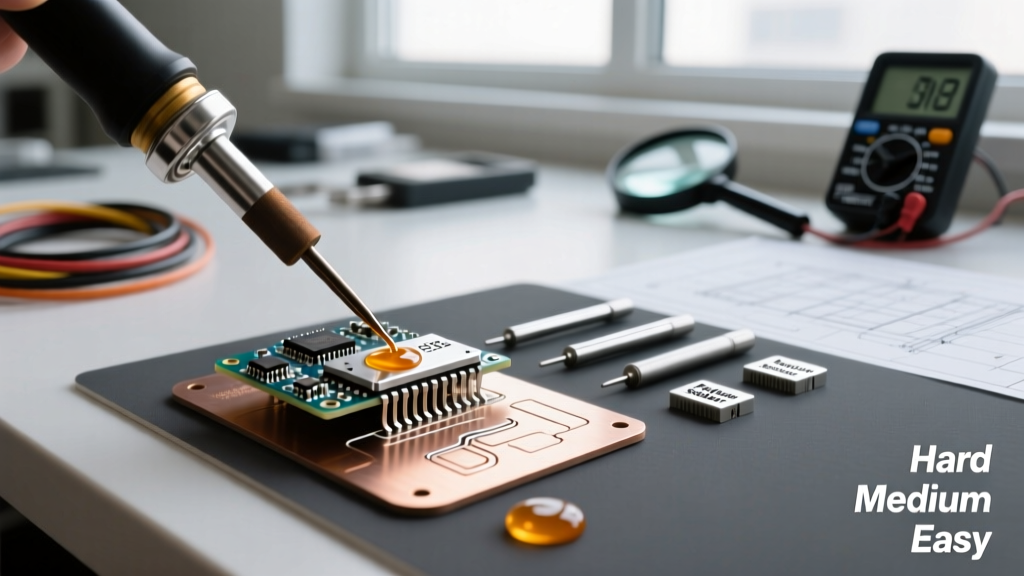
| Grade | Silver Content | Solidus / Liquidus | Flow Temperature | Primary Use Case |
|---|---|---|---|---|
| Hard | 75% - 80% | 1425°F / 1450°F | 1450°F (788°C) | First joints, structural seams, high-stress electrical lugs. |
| Medium | 70% - 72% | 1325°F / 1390°F | 1390°F (754°C) | Secondary joints, adding components to existing assemblies. |
| Easy | 65% - 68% | 1240°F / 1325°F | 1325°F (718°C) | Final joints, low-temp repairs, attaching delicate findings. |
| Extra Easy | 55% - 60% | 1145°F / 1240°F | 1240°F (671°C) | Emergency repairs, heat-sensitive component integration. |
The Step-Soldering Protocol
If your project requires multiple joints in close proximity, you must use the Step-Soldering Method. Begin with Hard solder for the first joint. Once complete, clean and flux the piece, then use Medium solder for the second joint. The flow temperature of the Medium solder is lower than the melting point of the Hard solder, ensuring your first joint does not re-melt and fail.
Expert Warning: Never use cadmium-bearing silver solders (often labeled as 'Extra Easy' in older international catalogs) in unventilated spaces. Cadmium vapor is highly toxic. Modern 2026 formulations from suppliers like Rio Grande utilize tin, zinc, and indium to lower flow temperatures safely without cadmium.
Phase 2: Flux Selection Framework
Flux is non-negotiable when soldering sterling silver. The 7.5% copper content in Ag925 rapidly forms cupric oxide (firestain) when heated in the presence of oxygen. This black scale prevents the molten silver solder from wetting the surface, resulting in a failed joint.
1. Fluoride-Based Fluxes (e.g., Stay-Silv White, Handy Flux)
- Composition: Potassium fluoroborate and potassium fluoride.
- Active Range: 1100°F to 1600°F.
- Best For: General purpose sterling silver soldering, wire-to-lug connections, and jewelry fabrication.
- Pros: Dissolves existing oxides and creates a protective glassy shield over the copper.
- Cons: Leaves a hard, glassy residue that requires pickling (acid bath) to remove.
2. Borax-Based Fluxes (Traditional Cone or Liquid)
- Composition: Sodium borate.
- Active Range: 1400°F to 1800°F.
- Best For: High-temperature Hard soldering and large, heavy-gauge silver bus bars.
- Pros: Excellent for prolonged heating sessions without burning out.
- Cons: Less effective at lower temperatures; can be messy to apply.
3. Firestain Preventatives (e.g., Prips Flux)
While not a primary soldering flux, Prips is a borax/boric acid/potassium dichromate solution sprayed onto the entire workpiece before heating. It prevents firestain from forming on the body of the silver, saving hours of polishing or destructive depletion gilding later.
Phase 3: Thermal Delivery Decisions
Sterling silver is a thermal sink. It pulls heat away from the joint rapidly. Using an underpowered torch will result in prolonged heating, which oxidizes the flux before the solder reaches its flow point.
- Micro-Torch (Butane/Isobutane): Ideal for 24AWG to 18AWG silver wires, delicate sensor leads, and small jump rings. Recommendation: Blazer Big Shot or similar precision butane torch. Max temp ~2500°F, but low total BTU output prevents melting thin stock.
- Oxy-Propane / Oxy-Acetylene (Smith Little Torch): The industry standard for 16AWG and thicker, or multi-layered assemblies. The Smith Little Torch (Model 23-1001C) with a #4 or #5 tip provides a concentrated, reducing flame that actively pulls oxygen away from the silver surface.
- Induction Heating: For high-volume production of silver RF connectors or audio plugs in 2026, localized induction heaters are replacing open flames, offering precise temperature control via infrared pyrometers and eliminating firestain entirely through inert gas atmospheres.
Troubleshooting Matrix: Failure Modes & Fixes
Even experienced fabricators encounter metallurgical anomalies. Use this diagnostic matrix to correct your process.
| Failure Mode | Visual Symptom | Root Cause | Metallurgical Fix |
|---|---|---|---|
| Solder Balling | Solder forms a sphere and rolls off the joint. | Flux burned out before flow temp; surface oxidized. | Quench, re-pickle, apply fresh fluoride flux, and heat the base metal, not the solder wire. |
| Firestain (Cupric Oxide) | Deep purple/black shadow beneath the surface of the silver. | Copper in the sterling oxidized due to prolonged air exposure. | Use a reducing flame; apply Prips flux; minimize heating time. |
| Brittle / Crystalline Joint | Joint snaps under light mechanical stress; grainy appearance. | Overheating Easy solder, causing zinc/tin volatilization. | Stop heating the moment the solder flashes and flows. Do not 'cook' the joint. |
| Pitting / Porosity | Tiny holes in the solder bead after pickling. | Trapped flux or organic contaminants (skin oils, polishing compounds). | Ultrasonically clean parts in isopropyl alcohol before fluxing. Ensure proper venting of the joint. |
Post-Soldering: The Pickling Process
Once the solder has flowed and the piece has cooled to a dull black, the flux residue and surface oxides must be removed. According to The Silver Institute, maintaining the surface integrity of silver is vital for both electrical contact resistance and aesthetic finish.
Do not use nitric or sulfuric acid in a standard DIY shop environment. Instead, use a Sodium Bisulfate based pickle (e.g., Sparex #2). Mix the granules with distilled water (1 part Sparex to 10 parts water) and maintain the solution in a dedicated slow-cooker at 140°F (60°C). Submerge the sterling silver piece for 5 to 10 minutes. The copper oxides will dissolve, leaving a bright, matte white silver surface ready for burnishing or final electrical testing.
Final Verdict for 2026 Fabricators
Soldering sterling silver successfully requires abandoning the 'one-size-fits-all' electronics mindset. By treating your alloy selection as a sequential thermal ladder, matching your flux chemistry to your specific heat source, and strictly controlling your atmospheric oxidation via pickling and reducing flames, you will achieve joints that are electrically flawless and mechanically permanent.