
The 2026 Hako Soldering Ecosystem: An Expert Roundup
In 2026, the electronics manufacturing landscape is defined by high-density interconnects (HDI), ultra-fine pitch components, and the uncompromising thermal demands of advanced lead-free alloys like SAC305 and SAC405. For professionals navigating these challenges, Hako remains the undisputed benchmark in thermal management and soldering reliability. But with a product lineup spanning from prosumer desktop units to industrial nitrogen-integrated rework systems, how do you choose the right tool for your specific workflow?
To cut through the marketing noise, we convened a panel of three senior industry experts to evaluate Hako's core soldering lineup. Their insights reveal exactly where specific models excel, where they fall short, and how to maximize tip economics in high-volume environments.
The Expert Panel:
- Sarah Jenkins: IPC-A-610 Certified Master Trainer & Aerospace Soldering Consultant
- Marcus Thorne: High-Volume SMT Production Lead (Consumer Electronics)
- David Lin: Advanced BGA Rework & Micro-Soldering Specialist
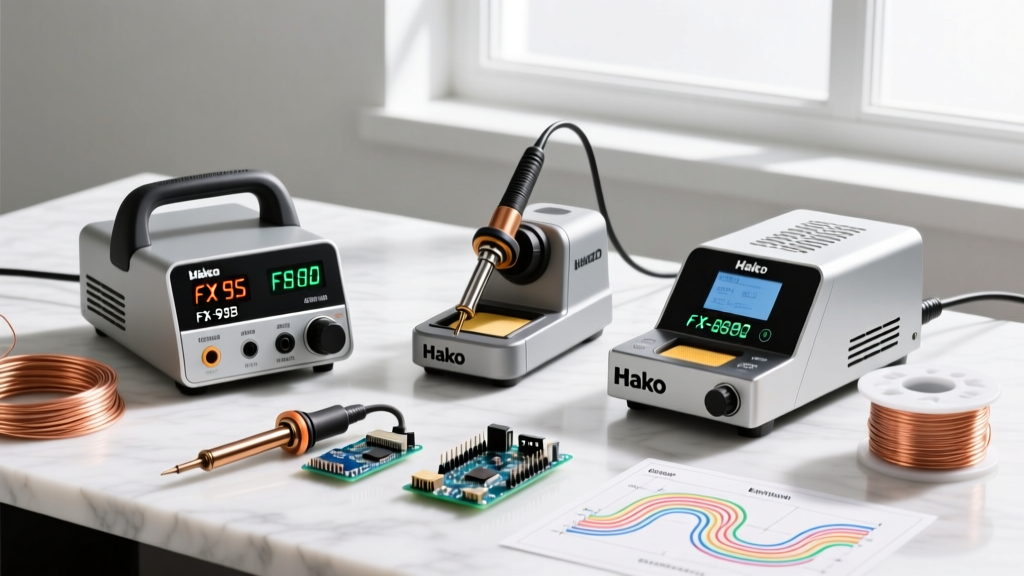
The Precision Workhorse: Hako FX-951 Evaluation
Expert Insight: Sarah Jenkins (Aerospace & IPC Compliance)
'When building IPC Class 3 aerospace assemblies, thermal dwell time is your biggest enemy,' explains Jenkins. 'The NASA Workmanship Standards strictly limit the time a soldering iron can contact a pad to prevent delamination and thermal shock. This is where the Hako FX-951 earns its $285 to $320 price tag.'
The FX-951 utilizes Hako's composite ceramic heater technology, which embeds the sensor directly inside the heating element. Unlike older wire-wound heaters that suffer from thermal lag, the FX-951 detects temperature drops at the tip instantaneously.
- Recovery Time: Drops from 350°C to 280°C on a 10oz copper ground plane and recovers to 345°C in under 6 seconds.
- Power Dynamics: Rated at 70W, but the rapid-response algorithm simulates the thermal mass of a 140W station.
- Auto-Sleep Protocol: Drops to 200°C after 5 minutes of inactivity, extending T18 tip life by up to 40%.
Jenkins' Verdict: 'For any technician doing mixed-technology through-hole and fine-pitch SMD work, the FX-951 is non-negotiable. The integrated card-lock system prevents unauthorized temperature changes on the production floor, a massive plus for IPC J-STD-001 compliance audits.'
Tip Economics & High-Volume Durability
Expert Insight: Marcus Thorne (Manufacturing Lead)
Marcus Thorne manages a line producing 50,000 IoT nodes daily. For Thorne, the station is only as good as its consumables. 'People obsess over the handpiece, but in high-volume, your P&L is dictated by tip degradation,' he notes.
Thorne's team relies heavily on the Hako T18 tip series. However, he warns against a common failure mode: using water-soaked cellulose sponges.
The Thermal Shock Failure Mode
'When a 380°C T18 tip hits a wet cellulose sponge, the rapid thermal contraction causes micro-fractures in the iron plating. Once the plating cracks, the underlying copper core dissolves into the tin-silver-copper (SAC) alloy, creating a pitted, unusable tip in less than 48 hours.'
| Tip Series | Heater Compatibility | Avg. Cost (2026) | Best Application | Thermal Mass |
|---|---|---|---|---|
| T18 | FX-951 / FM-2028 | $9.50 - $12.00 | General SMD, 0603 to 1210 | Medium |
| T15 | FX-888D / 936 | $7.00 - $9.00 | Through-hole, heavy wire | High |
| T12 | FX-9501 / Portable | $14.00 - $18.00 | Micro-soldering, 0201 | Low (Fast response) |
Thorne's Actionable Advice: 'Switch to Hako's 599B brass wire sponge immediately. It cleans via friction without dropping the tip temperature. We reduced our T18 replacement costs by 62% in Q1 2026 just by eliminating water sponges from the line.'
Advanced Rework: The Hako FR-810B Hot Air Station
Expert Insight: David Lin (BGA Rework Specialist)
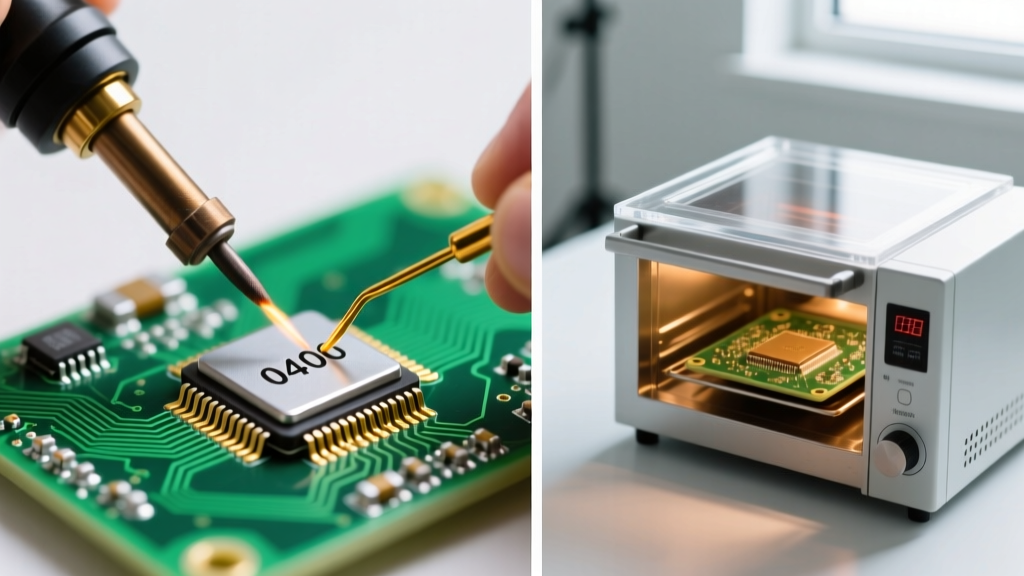
For complex rework involving 0.4mm pitch QFNs and large BGAs, soldering irons are insufficient. David Lin evaluates the Hako FR-810B, a dedicated hot air rework station priced between $750 and $850.
'The FR-810B is a 600W beast, but raw power isn't what makes it special,' Lin explains. 'It's the closed-loop airflow and thermal profiling capabilities. When removing a 25x25mm BGA on a 12-layer motherboard, you need precise pre-heating and localized top-heat without blowing adjacent micro-components off the board.'
Key FR-810B Specifications for Rework:
- Airflow Control: Adjustable from 3 to 23 Liters/minute. Lin recommends 8 L/min for 0402 components and 18 L/min for large ground-plane BGAs.
- Nozzle Ecosystem: The bayonet-mount nozzles ensure perfect concentricity, critical for directing heat evenly across a BGA die.
- Thermal Offset: Allows programming specific temperature offsets for different board thicknesses, preventing pad lifting.
Lin's Verdict: 'If you are doing board-level repair on modern server hardware or automotive ECUs, the FR-810B's ability to hold a stable 320°C at the nozzle exit, regardless of ambient draft conditions, makes it the best investment in the Hako catalog.'
2026 Hako Station Comparison Matrix
To help you align your budget with your technical requirements, our panel compiled this direct comparison of Hako's most requested units for 2026.
| Model | Target User | Max Power | Temp Range | 2026 Street Price | Panel Rating |
|---|---|---|---|---|---|
| Hako FX-888D | Hobbyists / Prosumers | 65W | 120°C - 480°C | $110 - $130 | 4.2 / 5 |
| Hako FX-951 | Production / Aerospace | 70W (Sim 140W) | 120°C - 480°C | $285 - $320 | 4.9 / 5 |
| Hako FR-810B | BGA Rework / SMT | 600W | 100°C - 500°C | $750 - $850 | 4.8 / 5 |
| Hako FX-952 | Dual-Operator Lines | 140W Total | 120°C - 480°C | $450 - $500 | 4.7 / 5 |
Critical Maintenance: Calibration & Troubleshooting
Even the best equipment fails if improperly maintained. Sarah Jenkins outlines the mandatory calibration protocol using the Hako FG-100 Thermometer ($180), emphasizing that relying on the station's digital display is a violation of most ISO 9001 quality manuals.
Step-by-Step FG-100 Offset Calibration
- Set the station to 350°C and allow a fresh, tinned T18-D24 tip to stabilize for 3 minutes.
- Apply a small bead of high-thermal-conductivity solder to the tip to ensure a thermal bridge.
- Press the FG-100 sensor wire firmly into the solder bead (do not scrape the tip).
- Record the FG-100 reading. If it reads 342°C, your offset is -8°C.
- Enter the FX-951 calibration mode (hold the UP arrow while powering on) and input the offset value.
Troubleshooting the 'H-Er' Code
A common panic point for new technicians is the flashing H-Er (Heater Error) code on the FX-951 display. This does not always mean a dead station. According to Hako engineering documentation, this indicates a sensor continuity break.
- Cause 1: The tip is not fully seated. The T18 sleeve must be pushed down and locked while the handpiece is cool.
- Cause 2: Flux carbon buildup on the handpiece connector pins. Clean the 5-pin connector with 99% isopropyl alcohol.
- Cause 3: A broken internal heating wire, usually caused by dropping the handpiece or severe cord tangling. Requires a $45 replacement heater (Part # B2032).
Final Verdict from the Panel
The consensus among our 2026 expert panel is clear: Hako's dominance is not based on flashy features, but on uncompromising thermal physics and ecosystem longevity.
For the serious hobbyist or field repair tech, the FX-888D remains a legendary entry point. However, for any environment where joint reliability, IPC compliance, and tip economics dictate the bottom line, the FX-951 is the undisputed champion of the decade. Pair it with a brass sponge and a rigorous FG-100 calibration schedule, and it will outlast the competition by years.