
The Hidden Price Tag of Internet Humor
If you spend any time on r/AskElectronics, r/diyelectronics, or hardware Discord servers, you have inevitably encountered the classic soldering meme. Whether it is a charred plastic connector with the caption "It still works," or a completely blackened iron tip paired with the "This is Fine" dog, these images are a cornerstone of maker culture. But as a senior electronics technician and buyer, I look at these viral jokes through a different lens: cost analysis.
Behind every humorous soldering meme lies a trail of destroyed components, wasted consumables, and lost engineering hours. In 2026, with the rising cost of raw electronics and custom PCB fabrication, the financial penalty for poor soldering practices is higher than ever. This guide dissects the most popular soldering memes, calculates their true financial impact, and provides the exact buyer recommendations to ensure your workbench never becomes the punchline.
Meme Scenario 1: The "Melted JST Connector"
The Meme: A close-up photo of a 4-pin JST-PH connector melted into a unrecognizable plastic blob, soldered directly to a custom PCB. The caption reads: "Structural integrity is a myth."
The Technical Failure Mode
This scenario occurs when a user applies a high-wattage, unregulated soldering iron (often a cheap 60W stick iron) to a small pin for far too long. Without active temperature regulation, the thermal mass of the iron transfers excessive heat directly into the component lead, melting the nylon or PBT plastic housing of the connector. Worse, the heat travels down the via, potentially delaminating the PCB pad or damaging adjacent surface-mount ICs.
The Cost Breakdown
- Direct Hardware Loss: Replacing a custom 4-layer ENIG PCB ordered from a fab house like JLCPCB or PCBWay costs roughly $6.00 to $12.00 per board in low volumes. If the heat cooked an adjacent STM32 microcontroller ($4.50) or a TI buck converter ($2.80), add that to the total.
- Rework Consumables: Desoldering braid ($5.50 for MG Chemicals 424-NS) and isopropyl alcohol for cleanup ($4.00).
- Time Penalty: 45 minutes of careful desoldering, board cleaning, and re-flowing. At a conservative freelance engineering rate of $60/hour, that is $45.00 in lost time.
Total Estimated Cost: $67.80
The Buyer's Prevention Guide
To avoid this meme, you must invest in a temperature-controlled station. The Hakko FX-888D (retailing around $115 in 2026) uses a T18 tip and a ceramic heater that recovers heat instantly, allowing you to melt solder in 2 seconds without soaking the component in lethal heat. For a budget alternative, the Pine64 Pinecil V2 ($26) offers PD-powered precision that outperforms irons costing five times as much.
Meme Scenario 2: The "Cold Joint on a Ground Plane"
The Meme: A side-by-side comparison. Left: A shiny, perfectly concave through-hole joint. Right: A dull, grey, bulbous blob of solder on a massive copper ground plane. Caption: "The multimeter says it's connected."
The Technical Failure Mode
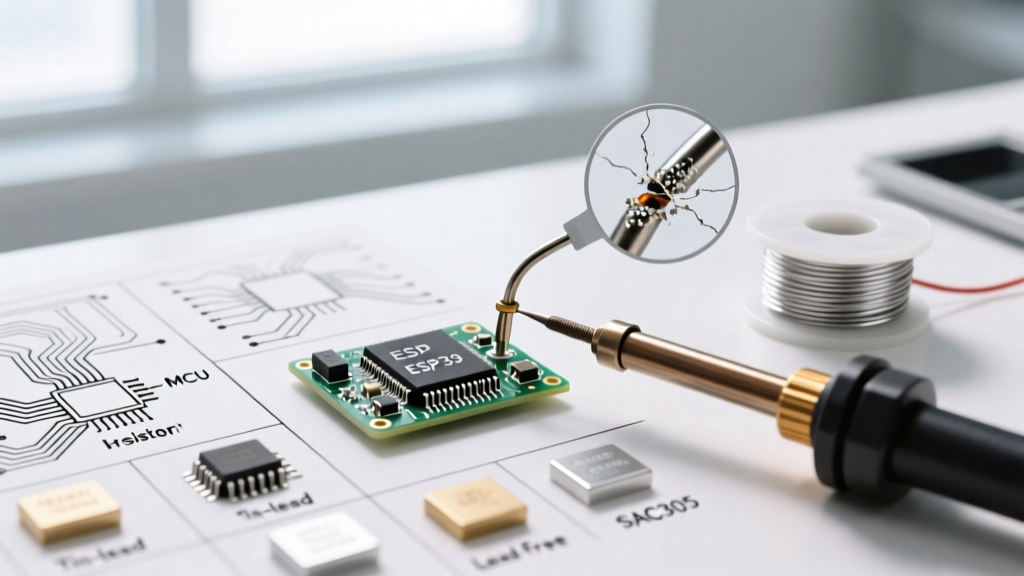
According to the IPC J-STD-001 Standards for soldered electrical assemblies, a cold or disturbed joint is a primary point of field failure. When soldering a component lead to a large thermal ground plane, an underpowered iron loses its thermal energy to the copper pour. The solder melts just enough to stick, but fails to reach the proper wetting temperature (typically 183°C for Sn63/Pb37 or 217°C for SAC305 lead-free). The result is a high-resistance, mechanically weak joint that will inevitably crack under thermal cycling or vibration.
The Cost Breakdown
- Debugging Time: The true cost here is diagnostic. Chasing an intermittent hardware fault caused by a microscopic crack in a cold joint can take 3 to 10 hours of oscilloscope probing and multimeter continuity testing.
- Consumables: High-quality flux is mandatory to rework this. A 10cc syringe of Amtech NC-559-V2-TF no-clean flux costs approximately $12.00.
- Opportunity Cost: Delayed project delivery or failed prototype demonstrations.
Total Estimated Cost: $200+ (primarily in lost engineering hours)
The Buyer's Prevention Guide
You need high thermal recovery. If you frequently solder to heavy ground planes, upgrade your tip geometry. A standard chisel tip will fail here. Purchase a Hakko T18-D24 or a Weller RTW2002 broad chisel tip ($9 to $14) to maximize surface area contact. Pair this with a station capable of pushing 70W+ of continuous power, like the Weller WE1010NA ($135).
Meme Scenario 3: The "Blackened Tip of Death"
The Meme: A soldering iron tip completely encased in a thick, black, crusty layer of burnt flux and oxidized copper. A piece of solder is bent against it, refusing to melt. The "This is Fine" dog sits in the background.
The Technical Failure Mode
Soldering tips are made of a copper core plated with iron to prevent the solder from dissolving the copper. When left at high temperatures (above 350°C) without a coating of solder, or when exposed to air without flux, the iron plating oxidizes. This black iron oxide layer acts as a severe thermal insulator. As noted by Hakko Technical Support, an oxidized tip cannot transfer heat, forcing the user to press harder, which physically damages the iron plating and ruins the tip permanently.
The Cost Breakdown
- Replacement Tips: A genuine Hakko T18 tip costs $9.40. A genuine Weller ETA tip is $8.50. Users who abuse their tips often burn through one a week, spending nearly $500 a year.
- The "Clone" Trap: Buying $2 counterfeit tips on Amazon seems like a savings, but the iron plating is often microns too thin, dissolving into the solder pool within hours and contaminating your joints with copper.
Total Estimated Cost: $45 to $500 annually, depending on tip authenticity and maintenance.
The Buyer's Prevention Guide
Stop buying counterfeit tips. Budget $10 for a genuine manufacturer tip and $6 for a Hakko 599B Tip Tinner (a brass sponge embedded with mild abrasive and flux). Always "tin and bin"—leave a blob of fresh solder on the tip before turning the station off. This sacrificial layer oxidizes instead of the iron plating.
Comparative Cost Matrix: Meme Scenarios vs. Prevention Gear
To visualize the ROI of proper soldering equipment, review the matrix below. The cost of preventing a meme scenario is almost always lower than the cost of recovering from it.
| Meme Scenario | Average Financial Loss (Per Incident) | Primary Cause | Recommended Prevention Gear (2026) | Gear Cost |
|---|---|---|---|---|
| Melted JST Connector | $67.80 | Unregulated heat / slow technique | Pine64 Pinecil V2 + T18-B Tip | $32.00 |
| Cold Ground-Plane Joint | $200.00+ | Insufficient thermal mass / low wattage | Weller WE1010NA + Broad Chisel Tip | $149.00 |
| Oxidized Black Tip | $45.00 / month | Improper storage / high idle temps | Hakko 599B Tip Tinner + Genuine Tips | $16.00 |
| Spaghetti Wire Rat's Nest | $85.00+ | Avoiding PCB design / poor planning | KiCad (Free) + JLCPCB 2-Layer Fab | $17.00 |
Meme Scenario 4: The "Spaghetti Wire Rat's Nest"
The Meme: A breadboard or perfboard completely obscured by a chaotic, multi-colored bird's nest of 22 AWG jumper wires. Caption: "Clean wiring is for people who don't use hot glue."
The Technical Failure Mode
While point-to-point wiring has its place in high-end audio or RF applications, using it for complex digital logic prototypes is a recipe for disaster. The meme highlights a reliance on friction-fit breadboard wires or poorly twisted perfboard joints. These connections suffer from high contact resistance, parasitic capacitance, and extreme vulnerability to mechanical shock. Furthermore, debugging a 50-wire rat's nest requires tracing every single node, turning a 10-minute firmware fix into a weekend-long hardware audit.
The Cost Breakdown
- Materials: Spools of silicone wire ($15), heat shrink tubing ($10), and copper standoffs ($8).
- Time Penalty: 5 to 15 hours of wiring, tracing, and debugging intermittent breadboard contact failures.
The Buyer's Prevention Guide
The barrier to entry for custom PCBs has collapsed. As detailed in the SparkFun Soldering Tutorials, transitioning from perfboard to a custom PCB drastically improves reliability. Use a free ECAD tool like KiCad to design a simple 2-layer breakout board. In 2026, fabricating 5 boards via JLCPCB or PCBWay costs as little as $2.00, plus roughly $15.00 for economy shipping. The total cost is under $20, and you gain a professional, debuggable, and reproducible platform.
Final Verdict: Invest in the Iron, Save the Project
The next time you laugh at a soldering meme on your feed, remember that the creator likely paid a steep tuition fee in ruined silicon and lost weekends to achieve that level of failure. Soldering is a thermodynamic process, not a brute-force mechanical one. By investing $30 to $150 in a properly regulated soldering station, authentic tips, and high-quality no-clean flux, you insulate your budget from the hidden costs of internet humor. Treat your workbench like an engineering lab, and your projects will yield results that are anything but a joke.