
Introduction to Brazilian Power Infrastructure
Setting up an electronics repair lab, managing industrial manufacturing lines, or performing field microcontroller repairs in Brazil presents a unique challenge for soldering professionals. Unlike the standardized 120V/60Hz grid of North America or the uniform 230V/50Hz standard of Europe, Brazil operates on a highly fragmented electrical grid. Understanding the physical and electrical nuances of electrical outlets in Brazil is critical. Plugging a 120V Hakko FX-888D into a 220V socket in Brasília will instantly destroy the ceramic heating element and blow the internal thermal fuse. This guide provides an in-depth, technical roadmap for adapting your soldering equipment to the Brazilian grid safely and efficiently.
The Voltage Divide: 127V vs. 220V States
The most critical factor when deploying soldering stations in Brazil is the regional voltage split. The country operates entirely on a 60Hz frequency, but the nominal voltage varies drastically by state and sometimes even by municipality. While locals often refer to the lower voltage as '110V', the actual nominal standard is 127V RMS. Running a US-spec 120V soldering iron on 127V will cause it to run approximately 12% hotter, which can degrade the tip plating and shorten the lifespan of the heating element over time.
Voltage Map for Major Tech and Industrial Hubs
| City / Region | Nominal Voltage | Primary Industry Focus | Soldering Equipment Note |
|---|---|---|---|
| São Paulo (Capital) | 127V | Consumer Electronics, Prototyping | US 120V gear works, but runs slightly hot. |
| Rio de Janeiro | 127V | Telecom, Marine Electronics | US 120V gear works, but runs slightly hot. |
| Manaus | 127V / 220V | Industrial Manufacturing (Free Trade Zone) | Split grid; verify outlet before plugging in. |
| Brasília | 220V | Government, IT Infrastructure | Requires EU 230V gear or step-down transformer. |
| Florianópolis | 220V | Software, IoT Hardware Startups | Requires EU 230V gear or step-down transformer. |
| Recife / Fortaleza | 220V | Medical Devices, Automotive | Requires EU 230V gear or step-down transformer. |
Source: Data verified via the IEC World Plugs Database and regional utility standards.
Type N Outlets: ABNT NBR 14136 Standard
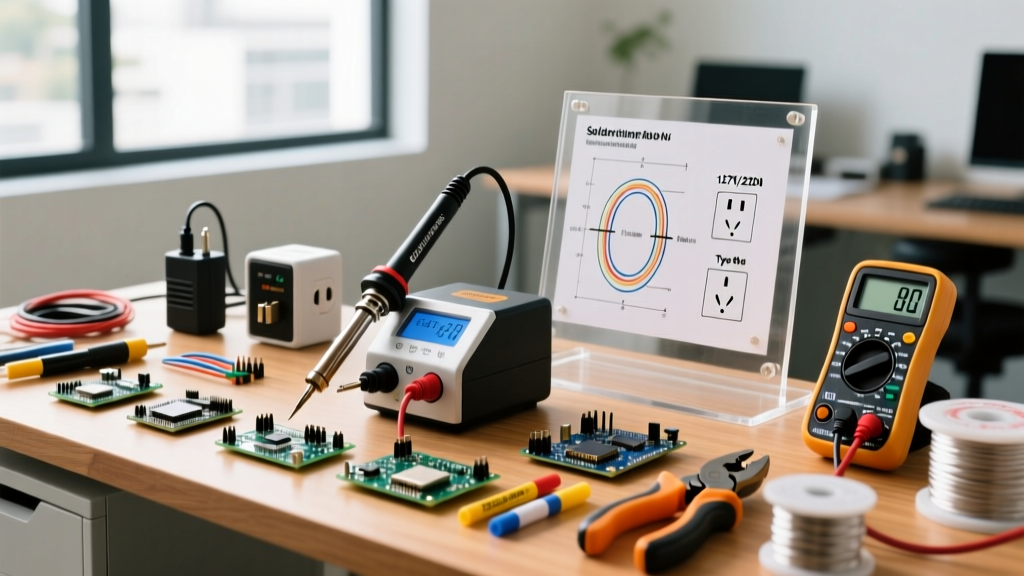
In 2011, Brazil mandated the Type N plug and socket standard (ABNT NBR 14136), making it the only country in the world to officially adopt this IEC 60906-1 derivative as its national standard. The Type N outlet features a hexagonal recess with three round pins: Line, Neutral, and Ground. According to World Standards, this design was chosen for its superior safety and recessed cavity, which prevents accidental contact with live pins during insertion.
10A vs. 20A Pin Configurations
Type N outlets come in two distinct amperage ratings, physically differentiated by pin diameter and hole size:
- 10A Standard (4.0mm pins): Handles up to ~1270W (at 127V) or ~2200W (at 220V). This is the standard wall outlet found in 95% of residential and commercial buildings. It is perfectly adequate for standard soldering stations like the Weller WE1010 (70W) or Hakko FX-888D (70W).
- 20A Standard (4.8mm pins): Handles higher current loads. Required for heavy industrial rework stations. For example, the Quick 861DW 1000W Hot Air Rework Station will draw roughly 8.3A on a 127V circuit. While technically within the 10A limit, continuous high-draw inrush currents necessitate a dedicated 20A Type N circuit to prevent breaker trips and voltage sags.
Equipment Selection Strategies for Technicians
When outfitting a lab or preparing for field repairs across different Brazilian states, you must choose your soldering architecture carefully to avoid voltage incompatibility.
Strategy 1: DC-Input Smart Irons (The Ultimate Workaround)
The most resilient solution for the fragmented Brazilian grid is utilizing DC-input smart soldering irons. Devices like the Pinecil V2, FNIRSI HS-01, or Miniware TS101 do not plug directly into the AC wall outlet. Instead, they use an external AC/DC power brick (typically outputting 24V DC). Because modern laptop-style power bricks support universal auto-switching input (100V-240V AC, 50/60Hz), you can plug the brick into a 127V outlet in São Paulo or a 220V outlet in Recife without changing any hardware. You only need a simple, cheap Type N physical adapter for the brick's figure-8 (C7) or cloverleaf (C5) cable.
Strategy 2: Toroidal Isolation Transformers
If your lab relies on traditional AC-powered stations (e.g., Weller WES51, Hakko FX-951), and you are operating in a 220V state with 120V North American equipment, you must use a step-down transformer. Do not buy cheap, high-frequency switching travel adapters; they cannot handle the inductive inrush current of a cold soldering iron heating element. You need a Toroidal Step-Down Transformer rated for at least 2.5x the wattage of your station. For a 70W Hakko FX-888D, purchase a minimum 200VA (Volt-Ampere) toroidal transformer. Expect to pay between $45 and $80 USD for a quality, locally manufactured unit in Brazil (brands like Microsol or TS Shara).
Comparison Matrix: Soldering Solutions in Brazil
| Equipment Type | Voltage Flexibility | Physical Plug Adaptation | Best Use Case in Brazil |
|---|---|---|---|
| Traditional AC Station (e.g., Hakko FX-888D) | None (Fixed 120V or 230V) | Requires Type N adapter or rewiring | Fixed-location labs where voltage is verified and stable. |
| DC Smart Iron (e.g., Pinecil V2) | Universal (via AC/DC Brick) | Only need adapter for the power brick | Field technicians traveling between 127V and 220V states. |
| Cordless / Butane (e.g., Weller Pyropen) | N/A (Gas Powered) | None required for operation | Remote industrial sites, automotive wiring, outdoor repairs. |
ESD Risks and Grounding Realities
The third pin on the Type N outlet is designated for Earth Ground. However, the reality of Brazilian infrastructure is that many buildings constructed before the 2011 ABNT NBR 14136 mandate lack proper grounding. In older installations, the third pin may be entirely absent (using legacy Type C Europlugs), or worse, the ground pin is present but not bonded to an actual earth rod.
⚠️ Critical ESD Warning: If you are soldering bare, ESD-sensitive microcontrollers (like STM32, ESP32, or raw FPGA boards), never assume a Brazilian Type N outlet provides true earth ground. Always use a multimeter to verify continuity between the Ground pin and a known earth reference, or utilize a dedicated ESD mat with an independent ground rod, especially in older commercial buildings in São Paulo or Rio.
Troubleshooting Common Failures
- Station Powers On but Won't Heat: If you brought a 230V European station to a 127V region (like São Paulo), the station will power on, but the heating element will only receive roughly 25% of its required power. The display may show a sensor error (e.g., Hakko 'H-E' code) because the tip temperature isn't rising fast enough. Fix: You need a step-up transformer.
- Blown Internal Thermal Fuse: Plugging a 120V station into a 220V outlet (common in Brasília or Florianópolis) will cause an immediate, violent pop. The 220V will push four times the rated wattage through the heating element for a fraction of a second before the internal thermal fuse blows to prevent a fire. Fix: The station must be opened, the heating element replaced, and the thermal fuse soldered in-line.
- Tripped Breakers on Rework Stations: Using a 1000W+ hot air rework station on a standard 10A Type N circuit in a 127V region will draw nearly 8A continuous, plus inrush. If other equipment (like an oscilloscope or lighting) is on the same circuit, the 10A breaker will trip. Fix: Move to a dedicated 20A circuit with 4.8mm Type N receptacles.
Frequently Asked Questions
Can I use a US Type A/B plug in Brazil?
Physically, no. The legacy Type C (two round pins) might fit into the recess of a Type N outlet, but it lacks the grounding pin and will sit loosely, creating an arc-flash hazard under high loads. US flat-blade Type A/B plugs will not fit. You must purchase a high-quality Type N adapter or cut the plug off and wire a genuine 10A Type N plug (readily available at Brazilian hardware stores like Leroy Merlin or Constrular for under $3 USD).
Do I need a 60Hz to 50Hz frequency converter for my soldering iron?
No. Brazil operates exclusively on 60Hz. If you are bringing equipment from Europe (which is 50Hz), resistive heating elements in soldering irons do not care about frequency. A 230V/50Hz Hakko station will work perfectly on Brazil's 220V/60Hz grid, provided the physical plug is adapted. However, if your station uses a heavy 50Hz laminated transformer (like older analog ESD-safe models), running it on 60Hz will actually cause it to run slightly cooler and more efficiently.
Where can I buy replacement Type N plugs and transformers locally?
For industrial-grade transformers, look for local Brazilian manufacturers like TS Shara or Microsol, available on Mercado Livre (the dominant e-commerce platform in Latin America). For replacement Type N plugs, any local material de construção (hardware store) will stock ABNT-certified 10A and 20A plugs for roughly 10 to 15 BRL ($2-$3 USD). Always look for the INMETRO certification seal on electrical components to ensure fire safety compliance.
For further reading on global plug standards and safety, refer to the Power Plugs & Sockets Brazil Guide and ensure your lab setup complies with local electrical codes.