
The Dawn of Metallurgical Joining: Ancient Origins
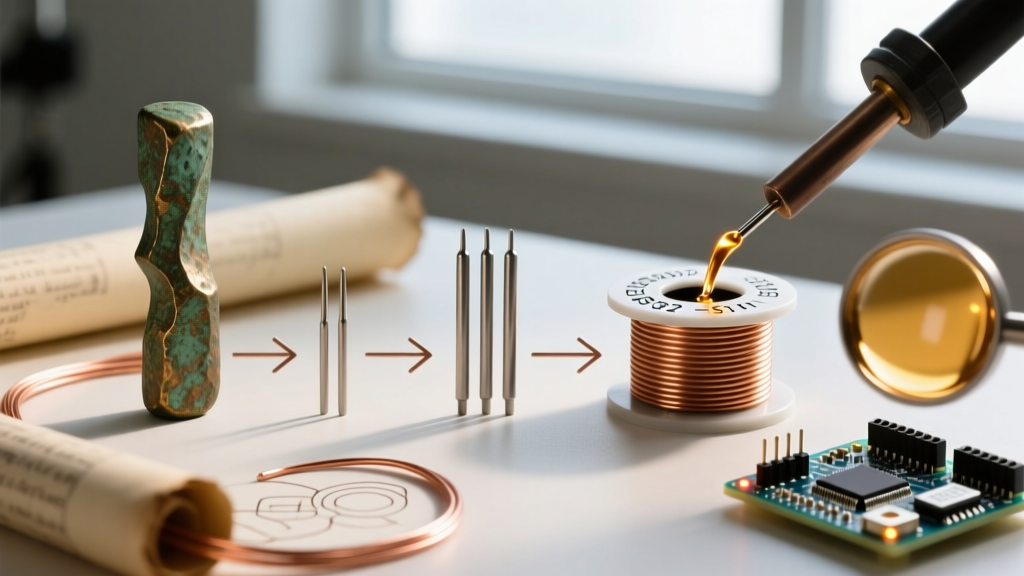
Long before the advent of printed circuit boards and surface-mount technology, early civilizations relied on a primitive but effective rod for soldering to join metals. The history of soldering stretches back over 5,000 years. According to Encyclopedia Britannica, ancient Egyptians and Mesopotamians utilized early forms of soldering around 4000 BC to craft intricate gold and silver jewelry, as well as functional copper tools.
These ancient artisans did not use the tin-lead alloys we recognize today. Instead, they relied on gold-copper and silver-copper mixtures, heating them with blowpipes and charcoal fires. The concept of a standardized "rod" did not yet exist; solder was applied as raw filings or paste. It wasn't until the Roman Empire that the metallurgical landscape shifted dramatically.
The Roman Innovation: Lead-Tin Alloys
The Romans were the first to widely document the use of lead-tin alloys to join lead pipes for their extensive aqueduct systems. The English word "solder" itself is derived from the Latin word solidare, meaning "to make solid." Roman plumbers cast their solder into crude, stick-like forms—the earliest ancestral version of the modern rod for soldering. These early rods lacked internal flux, requiring the application of external organic resins or animal fats to prevent oxidation during the heating process.
The Industrial Revolution and the Standardization of the Rod
The 19th century brought the Industrial Revolution, the telegraph, and early electrical wiring. As the demand for reliable metal joining surged, the physical form factor of solder evolved. Blacksmiths and tinsmiths required a portable, easily measurable consumable. The solid solder rod—typically cast in 1/8-inch to 1/4-inch diameters and cut into 36-inch lengths—became the industry standard for plumbing, roofing, and early electrical splicing.
"The transition from bulk solder chunks to standardized rods allowed 19th-century tradesmen to precisely control material consumption, fundamentally changing the economics of metal fabrication and early electrical grid assembly."
During this era, the most common alloy was a 50/50 lead-tin mix. It melted at approximately 212°C (414°F) and provided a wide "pasty range" (the temperature gap between the solidus and liquidus states). This pasty range was highly desirable for plumbers wiping lead joints, as it allowed the solder to be molded with a gloved hand before it fully solidified.
The Electronics Boom: Eutectic Alloys and the Shift to Wire
The mid-20th century introduced the semiconductor and the printed circuit board (PCB). The heavy, solid plumbing rod was entirely unsuited for the delicate copper traces of early radios and televisions. This necessitated a metallurgical and structural evolution.
The Magic of Sn63Pb37
Metallurgists discovered that a specific ratio of 63% tin and 37% lead created a eutectic alloy. Unlike 50/50 solder, Sn63Pb37 has no pasty range; it transitions directly from solid to liquid at exactly 183°C (361°F). This prevented "cold joints" caused by micro-movements during the cooling phase, a critical failure mode in early electronics manufacturing.
From Solid Rod to Flux-Cored Wire
To eliminate the need for brushing external flux onto tiny PCB pads, manufacturers invented the flux-cored wire. By extruding the solder into thin wires (0.031" to 0.062") and filling the center with rosin-based flux, the electronics industry effectively retired the traditional solid rod for precision work. However, as noted in Wikipedia's comprehensive history on soldering, the solid rod remained dominant in HVAC, heavy plumbing, and wave-soldering baths where bulk alloy was required.
The RoHS Directive and the Lead-Free Revolution
The most significant disruption to solder metallurgy in the last century occurred in 2006 with the enforcement of the Restriction of Hazardous Substances (RoHS) Directive in the European Union. As detailed by the US EPA's overview of international RoHS standards, the mandate forced the global electronics industry to abandon lead-tin alloys.
This birthed the modern SAC (Tin-Silver-Copper) family of alloys. The industry standard quickly became SAC305 (96.5% Tin, 3.0% Silver, 0.5% Copper). This transition presented massive challenges:
- Higher Melting Points: SAC305 melts at 217°C (430°F), requiring hotter soldering irons and increasing thermal stress on components.
- Poor Wetting: Lead-free alloys do not flow as easily as leaded ones, requiring more aggressive, no-clean flux formulations.
- Tin Whiskers: The absence of lead increased the risk of microscopic tin crystalline growths that could cause short circuits in high-reliability aerospace and medical electronics.
Metallurgical Comparison: Historical vs. Modern Solder Alloys
Understanding how the rod for soldering has evolved requires looking at the exact chemical compositions and thermal properties that define each era.
| Alloy Designation | Composition | Melting Point (Solidus/Liquidus) | Primary Era & Application |
|---|---|---|---|
| Roman Plumbing | ~70% Pb / 30% Sn | 183°C - 250°C (Pasty) | Antiquity: Aqueducts, lead pipes |
| Traditional 50/50 | 50% Pb / 50% Sn | 183°C - 212°C (Pasty) | 19th-20th C: Plumbing, auto radiators |
| Eutectic 63/37 | 63% Sn / 37% Pb | 183°C (True Eutectic) | 1950s-2006: PCB assembly, electronics |
| SAC305 | 96.5% Sn / 3.0% Ag / 0.5% Cu | 217°C - 220°C (Near Eutectic) | 2006-Present: RoHS compliant electronics |
| Stay-Brite 8 | 92% Sn / 8% Ag | 268°C - 299°C | Modern: HVAC, refrigeration, stainless steel |
Why the "Rod" Form Factor Still Matters in 2026
While hobbyists and PCB designers buy solder on spools, the traditional rod for soldering remains a critical consumable in specific trades today. If you are working in HVAC, stained glass, or heavy-duty electrical grounding, you are still buying rods.
Modern Applications for Solid Rods
- HVAC and Refrigeration: Technicians use silver-bearing rods (like the Harris Stay-Brite 8) to braze copper refrigerant lines. These rods withstand high pressures and vibration that standard electronic solder cannot.
- Stained Glass and Copper Foil: Artisans prefer solid 60/40 or 50/50 rods (where legally permitted) or lead-free alternatives like Oatey Lead-Free 95/5, applying liquid gel flux externally for smooth, rounded beads.
- Wave Soldering Baths: In high-volume PCB manufacturing, factories use bulk solid solder bars (essentially thick, short rods) to fill 50kg+ wave soldering machines.
Buyer's Guide: Sourcing the Right Solder Rod Today
If your project demands a rod rather than a spooled wire, navigating the 2026 market requires attention to metallurgy, flux compatibility, and pricing.
Pricing and Availability Realities
The cost of solder is inextricably linked to the commodities market, specifically tin and silver. As of 2026, silver-bearing HVAC rods are a premium investment. A standard 1/2 lb tube of Harris Stay-Brite 8 (8% silver) typically retails between $85 and $115. In contrast, a 1-pound box of standard lead-free plumbing rods (like Oatey Safe Flo) costs roughly $35 to $45.
Edge Cases and Failure Modes to Avoid
- Galvanic Corrosion: Never use an acid-core or high-chloride flux rod on electrical connections. The residual flux will cause galvanic corrosion, eventually severing the copper wire inside the insulation. Always use rosin-core or externally apply a no-clean electronic flux.
- Thermal Shock on Ceramics: When using high-temperature silver rods (melting >260°C) near ceramic capacitors or glass-to-metal seals, the rapid heat transfer can crack the component. Pre-heat the assembly to 100°C before applying the torch and rod.
- Counterfeit Alloys: With the high cost of tin, the market has seen an influx of counterfeit "lead-free" rods that secretly contain cadmium or beryllium to lower melting points. Always purchase from authorized distributors (e.g., Digi-Key, Mouser, or licensed HVAC wholesalers) and verify the manufacturer's lot-testing certificates.
Conclusion
The evolution of the rod for soldering is a testament to human metallurgical ingenuity. From the rudimentary gold-copper pastes of ancient Egypt to the highly engineered, silver-doped, lead-free alloys of 2026, the fundamental goal remains unchanged: creating a reliable, conductive, and mechanically sound bond between metals. Whether you are restoring a vintage tube amplifier with 63/37 wire or brazing a commercial chiller with a silver-bearing rod, understanding the history and chemistry of your alloy is the first step toward a flawless joint.