
The Ancient Divergence: How Humanity Learned to Join Metals
The decision between soldering or welding is a modern engineering dilemma, but the roots of these two distinct metal-joining disciplines stretch back thousands of years. Long before the invention of the electrical grid or the arc welder, ancient metallurgists were forced to innovate based on the thermal limits of their forges. Understanding the historical evolution of these processes provides crucial context for modern makers, fabricators, and electrical engineers when selecting the right technique and equipment today.
Archaeological evidence from Mesopotamia and ancient Egypt (circa 3000 BCE) reveals the earliest use of soldering. Artisans utilized gold-silver-copper alloys to join intricate jewelry and weapons. Because their charcoal forges struggled to reach the melting points of solid iron or thick bronze, they relied on capillary action and lower-melting-point filler metals to bond base materials without altering their structural integrity. The Romans later perfected this with lead-tin alloys, 'sweating' together lead pipes to build the vast aqueduct networks that sustained their empire.
Welding, conversely, has a more violent and thermally demanding history. Forge welding—the process of heating two pieces of iron until they are white-hot and hammering them into a single mass—was the domain of the blacksmith. It wasn't until the late 19th century, specifically the 1881 invention of the carbon arc by Nikolay Benardos and Stanisław Olszewski, that welding transitioned from brute-force mechanical hammering to precise, localized metallurgical fusion.
Metallurgical Milestones: Soldering or Welding at the Atomic Level
To make an informed purchasing decision in 2026, one must understand the atomic difference between these processes. The fundamental dividing line is the solidus temperature of the base metal.
| Characteristic | Soldering | Brazing (The Middle Ground) | Welding |
|---|---|---|---|
| Base Metal State | Solid (Never Melts) | Solid (Never Melts) | Liquid (Melts & Fuses) |
| Filler Metal Temp | < 450°C (842°F) | > 450°C (842°F) | > 1370°C (2500°F) for Steel |
| Joining Mechanism | Capillary Action & Surface Alloying | Capillary Action | Coalescence & Fusion Zone |
| Typical Joint Strength | Low to Moderate (2,000 - 5,000 PSI) | Moderate to High (Up to 60,000 PSI) | Equal to or Greater than Base Metal |
| Primary 2026 Alloys | SAC305, Sn63/Pb37 | BAg-8 (Silver), Brass | ER70S-6 (MIG), E7018 (Stick) |
According to The Welding Institute (TWI), welding creates a Heat-Affected Zone (HAZ) that fundamentally alters the grain structure of the base metal, requiring post-weld heat treatment in high-stress applications. Soldering bypasses this entirely, making it the undisputed king of heat-sensitive components like microelectronics and copper plumbing.
The Modern Buyer’s Matrix: Choosing Your Joining Discipline
When outfitting a workshop or specifying a manufacturing process, the choice between soldering or welding dictates vastly different capital expenditures, safety protocols, and skill trees.
When the Application Demands Soldering
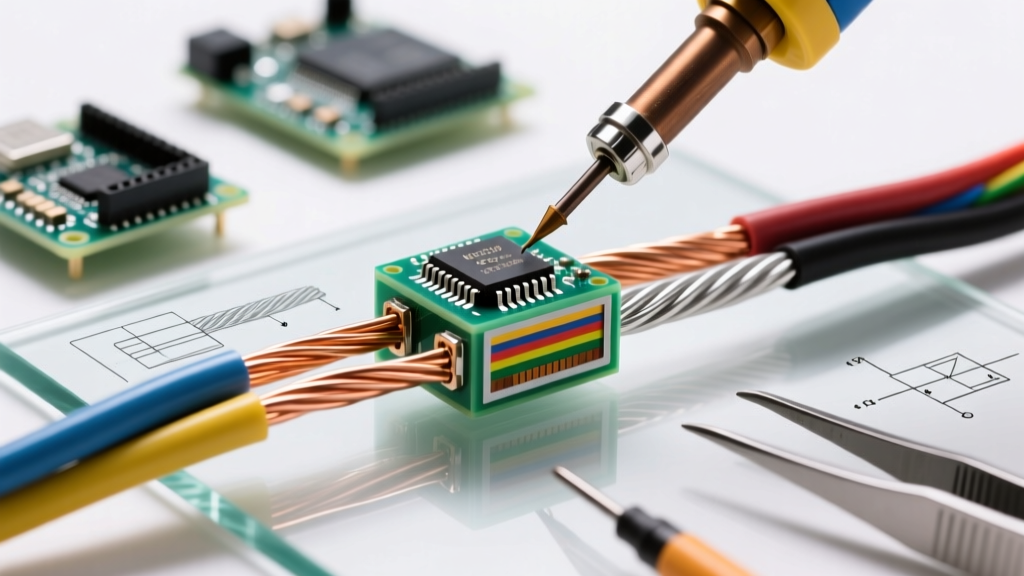
The evolution of electronics forced soldering to adapt. The transition from traditional eutectic leaded solder (Sn63/Pb37, melting at 183°C) to RoHS-compliant lead-free alloys like SAC305 (Sn96.5/Ag3.0/Cu0.5, melting at 217°C) changed the buyer's landscape. SAC305 requires higher thermal mass and more aggressive fluxes to achieve proper wetting.
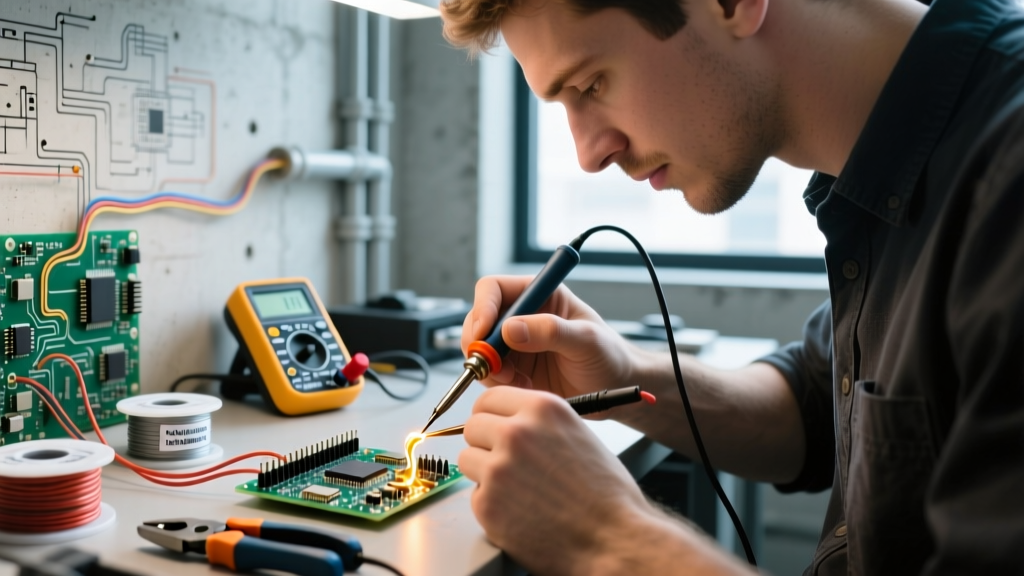
- The Hobbyist/Prototyper Setup: The market has shifted toward smart, PD-powered irons. The Pine64 Pinecil V2 (approx. $30) utilizes a RISC-V chip to control a 65W heating element, recovering from thermal drops in milliseconds. It is a marvel of modern miniaturization.
- The Professional Rework Station: For multi-layer PCBs with heavy ground planes, a standard iron will fail due to thermal sinking. Buyers must invest in RF-powered or high-wattage stations like the Hakko FX-951 ($250–$300) or the Weller WE1010NA ($130). These stations utilize active tip sensing to push 70W+ into the joint exactly when the thermal mass demands it.
Expert Insight: Never use plumbing solder (acid core) on electronics. The zinc chloride flux will rapidly corrode copper traces and cause dendritic short circuits. Always specify rosin-core (RMA or RA) or water-soluble organic fluxes designed for IPC J-STD-001 compliance.
When Structural Integrity Demands Welding
If the joint must bear mechanical loads, resist sheer forces, or contain high-pressure gases, welding is mandatory. The modern welding market has been revolutionized by IGBT inverter technology, replacing massive copper-wound transformers with lightweight, microprocessor-controlled power supplies.
- Multi-Process Inverters: Machines like the Lincoln Electric POWER MIG 260 (approx. $1,800) or the Miller Multimatic 220 ($3,600) allow users to switch between MIG (GMAW), DC TIG (GTAW), and Stick (SMAW) welding via digital interfaces. These units run on standard 240V single-phase power but deliver industrial-grade arc stability.
- Precision TIG for Aerospace/Bicycle Fabrication: For welding thin-wall 4130 chromoly steel or 6061 aluminum, AC/DC TIG is required. The Miller Dynasty 210 ($4,200) offers adjustable AC frequency and balance, allowing the operator to precisely focus the arc cone and minimize the HAZ on thin materials.
Capital Expenditure & Facility Requirements (2026 Outlook)
Beyond the tools, the environmental requirements for soldering or welding diverge sharply. Buyers must budget for facility upgrades.
- Ventilation & Fume Extraction: Soldering generates colophony (rosin) fumes and volatile organic compounds (VOCs). A localized HEPA/Carbon fume extractor (e.g., Hakko FA-400, $120) is mandatory to prevent occupational asthma. Welding generates hexavalent chromium (from stainless steel) and ozone, requiring high-CFM downdraft tables or heavy-duty PAPR (Powered Air Purifying Respirator) helmets costing $800+.
- Power Infrastructure: Advanced soldering stations draw 100W–300W from standard 120V/15A wall outlets. Inverter welders drawing 200A+ output require dedicated 240V/50A circuits with 6 AWG copper wiring, adding $300–$600 in electrical contracting costs to a new shop build-out.
- Fire Safety: Welding produces UV radiation and 3,000°F spatter, necessitating fire-resistant welding curtains (approx. $80 per panel) and Class ABC fire extinguishers. Soldering poses minimal fire risk but requires ESD (Electrostatic Discharge) matting and grounding straps ($25) to protect sensitive silicon.
Failure Modes: When the Wrong Method is Chosen
Understanding historical failures helps modern engineers avoid catastrophic design flaws. The most common error in DIY and junior engineering circles is attempting to use solder for structural mechanical joints, or applying welding techniques to heat-sensitive assemblies.
The Soldering Failure Mode: Solder alloys possess extremely low shear and tensile strength compared to steel or aluminum. A bracket joined with SAC305 solder will experience catastrophic creep and shear failure under sustained vibrational loads or temperatures exceeding 100°C. Solder is an electrical and sealing joiner, not a structural one.
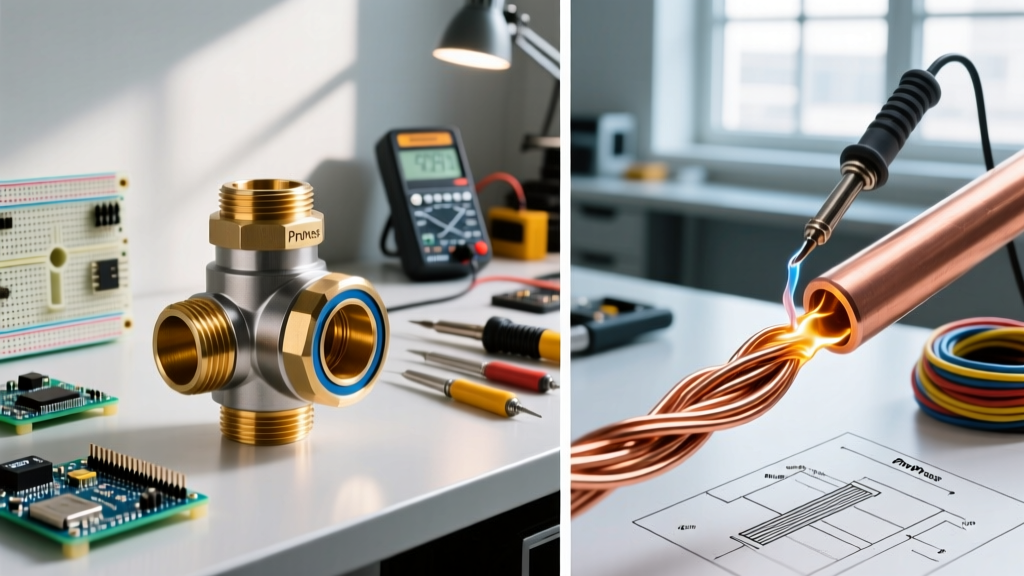
The Welding Failure Mode: Attempting to 'weld' or braze a copper pipe near a soldered brass valve will result in the melting of the existing lead-free solder joint, causing immediate water damage. Furthermore, applying arc welding near electronic control modules (ECUs) can induce high-frequency electromagnetic interference (EMI) or ground loops that instantly fry microprocessors.
Governing Standards: IPC vs. AWS
Professional buyers and fabricators must align their equipment purchases with industry standards. For electronics and electrical soldering, the IPC (Association Connecting Electronics Industries) sets the global benchmark. The IPC J-STD-001 dictates flux types, wire preparation, and thermal profiles, while IPC-A-610 provides the visual acceptance criteria for soldered joints (e.g., proper fillet wetting and shine).
Conversely, structural welding is governed by the American Welding Society (AWS). The AWS D1.1 Structural Welding Code for steel dictates everything from pre-heat temperatures and interpass temperatures to the specific radiographic testing (RT) required to verify the absence of subsurface porosity and slag inclusions.
Conclusion: The Right Tool for the Atomic Bond
The evolution from ancient Egyptian gold-smithing to 2026's microprocessor-controlled IGBT inverters and RISC-V smart soldering irons highlights a singular truth: there is no universal metal joiner. Choosing between soldering or welding requires a strict evaluation of thermal limits, mechanical load requirements, and base metallurgy. By respecting the atomic boundaries of capillary action versus full coalescence, engineers and makers can select the precise equipment needed to build structures and circuits that endure.