
The Hidden Danger: Why Rosin Flux Fumes Require More Than a Fan
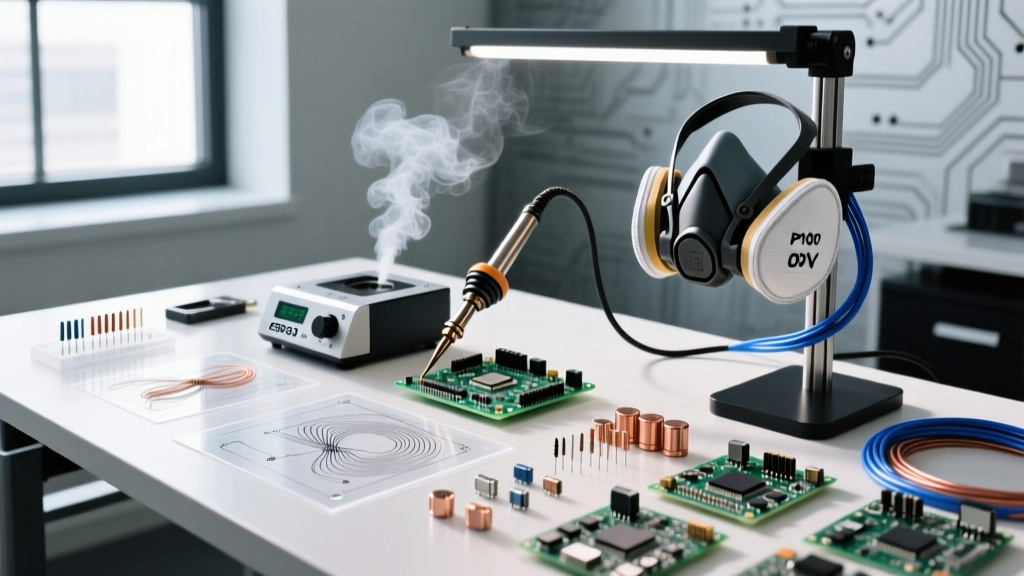
For decades, the electronics hobbyist and professional technician community relied on a simple desk fan to blow soldering fumes away. In 2026, this practice is not just outdated; it is a recognized occupational hazard. When rosin-based fluxes are heated to typical soldering temperatures (300°C to 400°C), they undergo thermal decomposition, releasing a complex plume of particulate matter and volatile organic compounds (VOCs). According to the UK Health and Safety Executive (HSE), rosin flux fumes are a known cause of occupational asthma and can lead to severe respiratory sensitization over time.
A standard N95 mask or a basic HEPA fume extractor will capture the visible white smoke (particulates), but it will completely fail to stop the invisible, harmful VOCs—specifically aliphatic aldehydes like formaldehyde and hydrogen chloride gas (if using certain activated fluxes). To truly protect your respiratory system, you need a properly fitted soldering respirator equipped with the correct combination of particulate and organic vapor filtration.
Particulate vs. Organic Vapor: Decoding the Cartridge Matrix
The most common mistake buyers make when selecting a soldering respirator is purchasing a particulate-only filter (like the popular pink P100 pancake filters) and assuming they are protected from flux fumes. They are not. Below is a breakdown of what you actually need based on your soldering volume and flux chemistry.
| Filter / Cartridge Type | NIOSH Rating | What It Stops | What It Misses | Best Use Case |
|---|---|---|---|---|
| P100 Particulate Filter | P100 | 99.97% of airborne particles (rosin smoke, lead dust) | All VOCs, aldehydes, and acidic gases | Lead-free soldering with VOC-free flux (rare), or sanding PCBs |
| P100 with Nuisance OV Relief | P100 + Nuisance OV | Particulates + trace organic vapors below OSHA PEL | High-concentration VOCs during prolonged sessions | Light hobbyists soldering 1-2 hours a week |
| Multi-Gas / P100 Cartridge | OV/AG/FM/P100 | Particulates, Organic Vapors, Acid Gases, Formaldehyde | Nothing (when properly sealed and within lifespan) | Professionals, heavy hobbyists, and production environments |
For any serious electronics work involving rosin-core solder wire or liquid flux pens, the Multi-Gas / P100 cartridge is the only acceptable standard. The Occupational Safety and Health Administration (OSHA) mandates that respiratory protection must be matched to the specific chemical hazards present, and rosin decomposition products span both particulate and vapor categories.
Top Soldering Respirator Configurations for 2026
Based on current market availability, filtration efficiency, and ergonomic comfort for bench work, here are the definitive setups for different user profiles.
1. The Gold Standard: 3M 6200 Half-Mask with 60926 Cartridges
Estimated Cost: $45 - $55 (Mask + Cartridges)
Target User: Professional technicians, repair shop owners, and dedicated daily hobbyists.
The 3M 6200 (Medium) half-facepiece is the industry workhorse. When paired with the 3M 60926 Multi-Gas/P100 cartridges, it provides comprehensive protection against rosin fumes, acid gases, and heavy metal particulates. The 60926 features a swept-back design, which is crucial for soldering; it keeps the cartridges out of your peripheral vision and prevents them from bumping into your bench microscope or magnifying lamp. The silicone face seal is hypoallergenic and comfortable enough for 4-hour continuous wear.
2. The Light Hobbyist: 3M 6200 with 2097 P100/OV Filters
Estimated Cost: $25 - $30 (Mask + Filters)
Target User: Weekend makers, Arduino builders, and occasional repairers.
If you only solder for an hour or two a week, the bulky 60926 cartridges might feel like overkill. The 3M 2097 P100 filters with nuisance-level organic vapor relief are the pink "pancake" filters with a thin layer of activated carbon. Warning: The "nuisance" rating means the carbon layer is only designed to filter VOCs at concentrations below the OSHA Permissible Exposure Limit (PEL). If you are doing heavy rework or using copious amounts of extra flux, you will quickly saturate this thin carbon layer, rendering the VOC protection useless. Use these only for light, well-ventilated tasks.
3. The Production Floor: 3M Versaflo TR-300+ PAPR System
Estimated Cost: $1,800 - $2,200
Target User: High-volume manufacturing, cleanroom rework stations, and users with facial hair.
Powered Air-Purifying Respirators (PAPR) use a belt-mounted blower to push filtered air into a hood or visor. The National Institute for Occupational Safety and Health (NIOSH) notes that PAPRs offer a higher Assigned Protection Factor (APF) of 25 to 1000, compared to the APF of 10 for half-mask respirators. Furthermore, because the TR-300+ uses a loose-fitting hood, it is the only viable option for technicians with beards, as facial hair breaks the seal of traditional half-masks. While the upfront cost is steep, the reduced breathing resistance and superior cooling make it indispensable for 8-hour production shifts.
Step-by-Step: Performing a Positive and Negative Pressure Seal Check
A $50 respirator provides zero protection if it leaks around the nose bridge or jawline. According to OSHA respiratory protection standards, you must perform a user seal check every time you don the mask. Here is the exact procedure for half-mask respirators:
- Don the Mask: Place the mask over your nose and mouth, pull the bottom straps over your head and secure them at the base of your neck, and pull the top straps over your head to the crown. Tighten evenly until snug, but not painfully tight.
- Negative Pressure Check (Inhalation): Place the palms of your hands firmly over the filter cartridges to block the air inlets. Inhale gently. The facepiece should collapse slightly against your face, and you should feel a vacuum hold for 10 seconds without any inward leakage around the edges. If you feel air entering, adjust the straps and retest.
- Positive Pressure Check (Exhalation): Remove your hands from the cartridges and place your palm over the exhalation valve cover on the bottom center of the mask. Exhale gently. The mask should bulge slightly outward, but no air should escape around the face seal. If air leaks out near your eyes, tighten the top straps; if it leaks near your jaw, tighten the bottom straps.
Cartridge Lifespan: The 40-Hour Rule and Proper Storage
One of the most frequent failure modes in workshop safety is the use of expired or saturated carbon cartridges. Activated carbon works via adsorption; once all the microscopic pores are filled with VOC molecules, the cartridge will begin "channeling," allowing unfiltered fumes to pass directly to your lungs.
- The 30-Day / 40-Hour Limit: Even if you only use the respirator for a few hours a week, organic vapor cartridges should be discarded after 30 days from the moment they are unsealed, or after 40 hours of active use—whichever comes first.
- The Smell Test is a Failure: If you can smell the sweet, pine-like scent of rosin flux while wearing the mask, the cartridge has already experienced "breakthrough" and must be replaced immediately. Relying on your sense of smell means you are already being exposed.
- Storage Protocol: When not in use, store your respirator and cartridges in an airtight container or a heavy-duty Ziploc bag. If left exposed to the ambient air of your workshop, the carbon will continuously adsorb ambient VOCs (from solvents, IPA, or conformal coatings), exhausting its lifespan before you even solder a single joint.
Expert Callout: Source Capture vs. PPE
A soldering respirator (Personal Protective Equipment) is your last line of defense. Best practices dictate that source capture (a high-static-pressure fume extractor with a HEPA/Carbon arm positioned 2-4 inches from the solder joint) should be used in tandem with your respirator. PPE protects your lungs, but a source capture system prevents the flux fumes from settling on your workbench, tools, and clothing, keeping your entire workspace compliant with indoor air quality standards.
Final Verdict on Workshop Safety
Investing in a proper soldering respirator is not about paranoia; it is about preserving your long-term health and maintaining cognitive sharpness by avoiding chronic exposure to neurotoxic and asthmatic compounds. For 90% of electronics enthusiasts and independent repair technicians in 2026, the 3M 6200 half-mask paired with 60926 Multi-Gas cartridges remains the undisputed champion of cost-to-protection ratio. Pair it with a rigorous seal-check routine and a strict cartridge replacement schedule, and you will solder with the confidence that your respiratory system is fully secured.