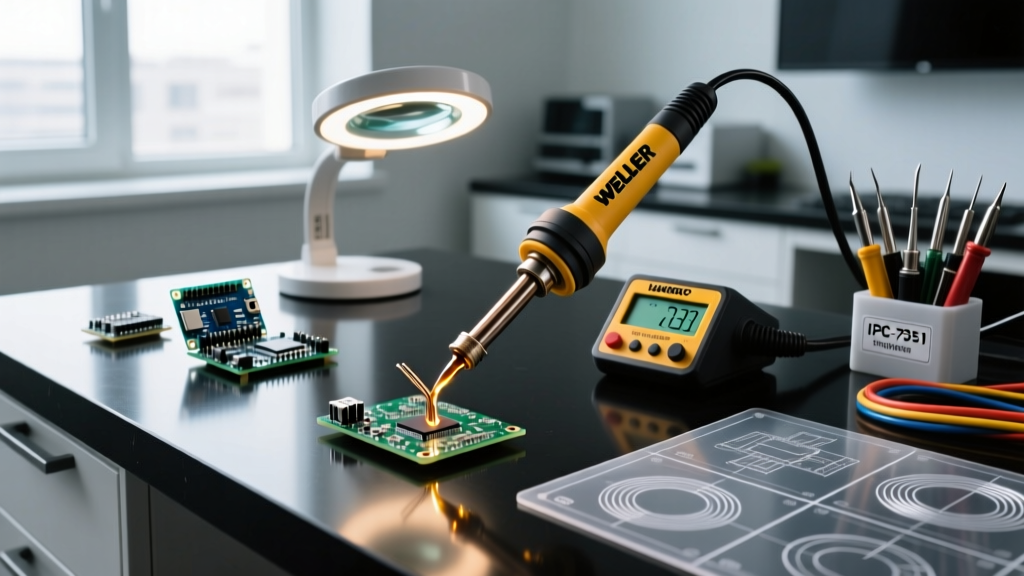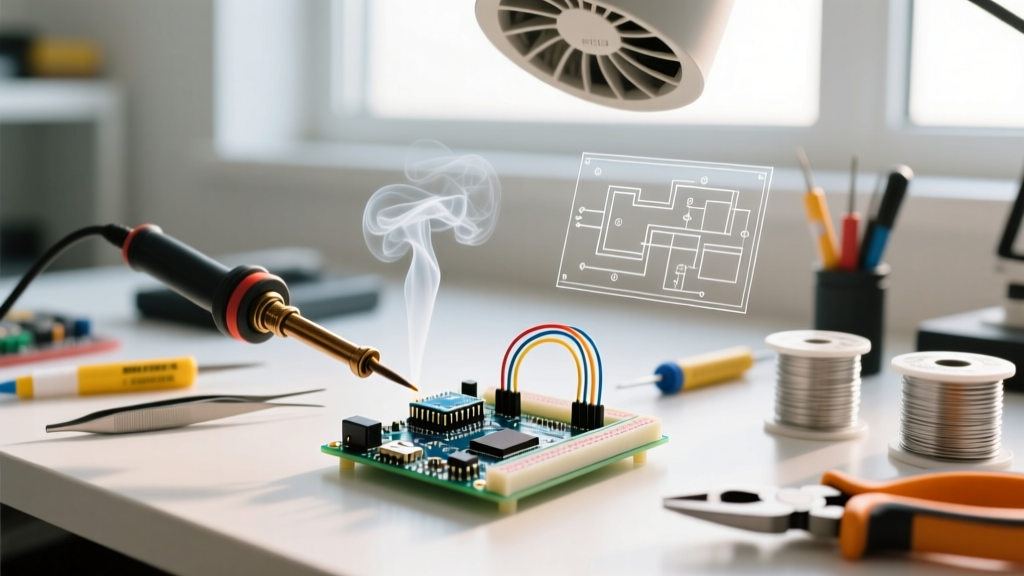

The Hidden Economics of Soldering Lead Exposure & Fume Mitigation
When outfitting a professional electronics repair lab or a high-volume manufacturing floor, safety is often treated as an abstract compliance metric rather than a line-item budget. However, managing soldering lead exposure and mitigating hazardous flux fumes requires a calculated financial strategy. To build an accurate cost analysis, we must first address a pervasive industry misconception: the physics of soldering fumes.
The Physics of Soldering Fumes: Lead (Pb) vaporizes at 1,749°C. Standard reflow and hand-soldering processes operate between 250°C and 400°C. Therefore, the visible smoke rising from your soldering iron is not lead vapor; it is vaporized flux (rosin/colophony and VOCs). Lead exposure in soldering occurs almost exclusively through particulate dust transfer (hand-to-mouth ingestion, or sanding/desoldering abrasive work). A complete mitigation budget must address both heavy metal hygiene and chemical fume extraction.
Below, we break down the Capital Expenditure (CapEx), Operational Expenditure (OpEx), and material premiums required to maintain a safe, compliant soldering environment in 2026.
Capital Expenditure (CapEx): Workshop Ventilation & Extraction
Because flux fumes contain colophony—a known respiratory sensitizer linked to occupational asthma—the UK Health and Safety Executive (HSE) and global equivalents mandate source extraction. Choosing the right fume extractor is your largest upfront safety cost.
| Extraction Tier | Representative Model (2026) | Upfront CapEx | Best Use Case |
|---|---|---|---|
| Tier 1: Benchtop Fan/Carbon | Hakko FA-400 | $75 - $95 | Hobbyists, light DIY, occasional through-hole work. |
| Tier 2: Professional Benchtop HEPA | Metcal BTX-1250 | $850 - $1,100 | Repair shops, daily SMD rework, multi-operator benches. |
| Tier 3: Industrial Centralized | BOFA AD Qubix 3 | $2,800 - $3,500+ | Manufacturing floors, continuous wave soldering, BGA rework. |
While the Tier 1 Hakko FA-400 is a staple for beginners, it merely redirects fumes and relies on a thin carbon mat that saturates quickly. For professional environments dealing with continuous soldering lead exposure risks and heavy flux off-gassing, Tier 2 or Tier 3 systems with true HEPA and deep-bed activated carbon are non-negotiable investments.
The True Cost of Filter Replacements (OpEx)
The initial hardware cost is only half the equation. Filter saturation depends on the flux type (no-clean vs. water-soluble) and daily soldering hours.
- Hakko FA-400 Carbon Filters: ~$12 per pad. Requires replacement every 1-2 months under daily use. Annual OpEx: $72 - $144.
- Metcal BTX-1250 HEPA/Carbon Combo: ~$165 per unit. Lasts 6-9 months. Annual OpEx: $220 - $330.
- BOFA AD Qubix 3 Combined Filter: ~$380 per unit. Features intelligent saturation sensors; lasts 12-18 months. Annual OpEx: $250 - $380.
Operational Expenditure: PPE, Hygiene, and Testing
Mitigating heavy metal ingestion requires strict hygiene protocols. According to OSHA's Lead Standards, employers must provide protective work clothing and equipment where lead exposure limits are a concern. Even in small repair shops, the cost of preventing cross-contamination is an ongoing operational expense.
Annual Hygiene & PPE Budget (Per Technician)
- Nitrile Gloves (MicroFlex or Kimberly-Clark): $18 per box of 100. Assuming 2 pairs a day, a technician uses ~5 boxes a year. Cost: $90/year.
- D-Lead Skin Cleanser (16oz): $14 per bottle. Formulated specifically to chelate and remove heavy metal particulates from skin pores, unlike standard soap. Cost: $28/year (2 bottles).
- LeadCheck Swabs: $25 for a 32-pack. Used to test workbenches, ESD mats, and tools for residual lead dust when transitioning between leaded and lead-free assemblies. Cost: $50/year.
- Blood Lead Level (BLL) Testing: ~$45 out-of-pocket via Quest Diagnostics or Labcorp if not covered by occupational health insurance. Recommended annually for technicians handling Sn63/Pb37 solder daily. Cost: $45/year.
Total Annual Hygiene OpEx per Technician: ~$213. For a 5-person repair shop, budget roughly $1,100 annually strictly for lead-handling hygiene.
Material Costs: Leaded vs. Lead-Free Solder Economics
One of the most effective ways to eliminate soldering lead exposure at the source is to transition entirely to lead-free alloys like SAC305 (96.5% Tin, 3% Silver, 0.5% Copper). However, this introduces material and thermal premiums.
Spool Cost Comparison (1lb / 454g Spools)
- Kester Sn63/Pb37 (Leaded Eutectic): ~$38.00 per spool.
- Kester SAC305 (Lead-Free): ~$48.00 per spool.
At a glance, lead-free solder carries a 26% material premium. For a high-volume shop consuming 100 lbs of solder wire annually, switching to SAC305 adds $1,000 to the yearly consumables budget. Furthermore, lead-free alloys require higher iron tip temperatures (350°C+ vs 315°C), which accelerates tip oxidation. Expect to replace soldering tips 30-40% more frequently when using lead-free wire, adding an estimated $150-$200 per year in tip replacements per technician.
The Hidden Cost of Cross-Contamination
If a facility attempts to save money by running both leaded and lead-free processes without strict spatial separation, the financial risks multiply. Accidentally using a leaded solder wire on a RoHS-compliant lead-free BGA rework job will contaminate the PCB. Under IPC-A-610 Class 3 standards, this assembly will fail inspection. Scrapping a high-density server motherboard or medical PCB due to lead cross-contamination can instantly wipe out $2,000 to $10,000 in component costs, vastly outweighing the savings on solder wire.
The 'Do Nothing' Cost: Regulatory Fines and Health Liabilities
Skipping extraction and hygiene protocols to save $1,500 a year is a catastrophic financial gamble. The OSHA Chemical Hazards guidelines outline severe penalties for failing to protect workers from hazardous particulates and chemical vapors.
- OSHA Serious Violation Fines: As of 2026, serious violations regarding inadequate ventilation or lack of PPE for hazardous dusts and fumes can exceed $16,000 per instance.
- Workers' Compensation Claims: Occupational asthma induced by untreated colophony flux fumes is a well-documented liability. A single successful workers' comp claim for chronic respiratory issues can cost a small business tens of thousands of dollars in premium hikes and settlements.
- Environmental Disposal: Lead-contaminated wipes, gloves, and desoldering braid are classified as hazardous waste in many jurisdictions. Improper disposal in standard municipal trash can trigger EPA fines starting at $70,000+ for egregious violations.
Actionable Framework: Budgeting for a Safe Soldering Station
Whether you are a solo repair technician or a production manager, use this framework to allocate your safety budget effectively.
Tier A: The Solo Repair Tech (Budget: ~$350 CapEx / $250 OpEx)
- Extraction: Metcal or Hakko benchtop HEPA unit ($350-$500 one-time).
- Hygiene: D-Lead soap, nitrile gloves, and dedicated ESD-safe lead-waste bin.
- Protocol: Strict hand-washing before eating; no food or drinks within 15 feet of the soldering bench.
Tier B: The Professional Lab (5-10 Techs) (Budget: ~$5,000 CapEx / $3,000 OpEx)
- Extraction: Centralized BOFA or Weller extraction system ducted to individual bench arms.
- Material: Full transition to SAC305 lead-free solder to eliminate heavy metal handling entirely, negating the need for BLL testing and specialized chelating soaps.
- Protocol: Color-coded tool sets (Red for Leaded R&D, Green for Lead-Free Production) to prevent cross-contamination and IPC compliance failures.
Final Verdict
Mitigating soldering lead exposure and flux fume hazards is not merely a regulatory hurdle; it is a predictable, manageable operational expense. By understanding the distinction between heavy metal particulate risks and chemical vapor risks, shop owners can allocate capital toward HEPA extraction and targeted hygiene protocols. Ultimately, the $1,000 annual premium for lead-free materials and proper filtration is a fractional insurance policy against scrapped PCBs, OSHA fines, and long-term occupational health liabilities.