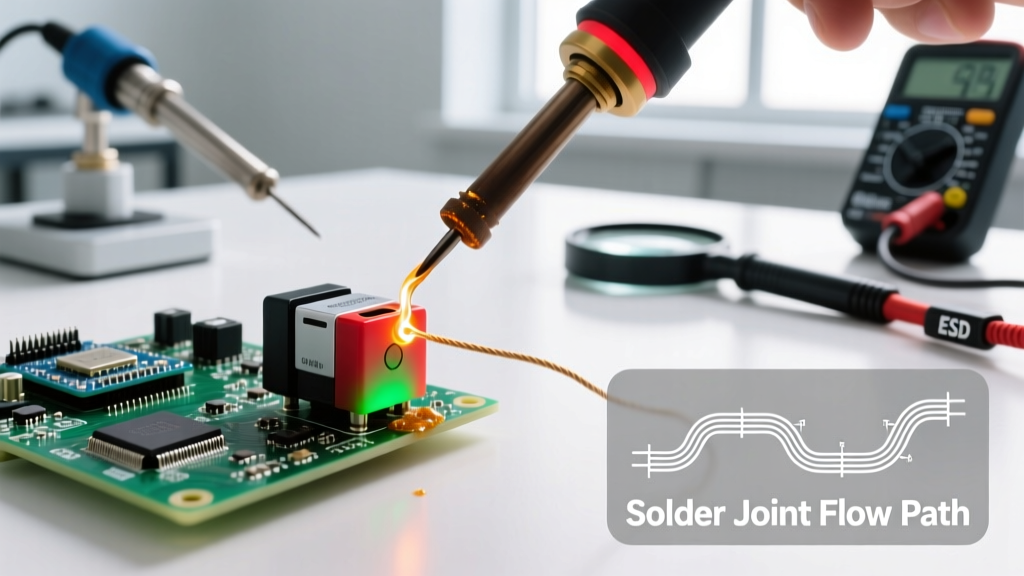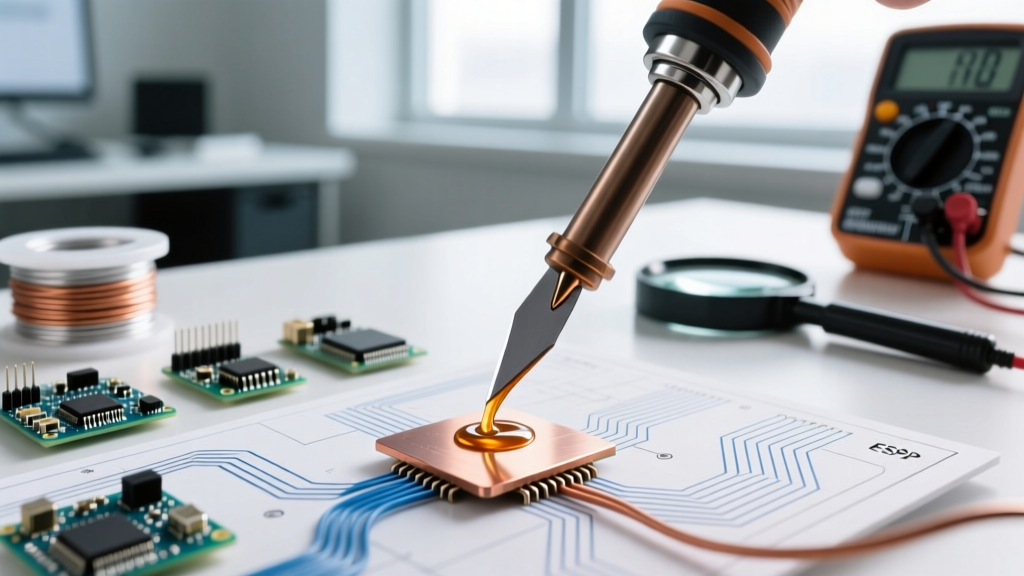

The Soldering Knife Tip: Beyond the Standard Chisel
When building a comprehensive soldering toolkit, most beginners start with a standard chisel or conical tip. However, as projects scale from basic through-hole components to dense surface-mount devices (SMD) and intricate wire prep, the limitations of standard geometries become apparent. Enter the soldering knife tip (often designated as a K-tip or blade tip). This specialized geometry bridges the gap between thermal transfer and mechanical precision. But when exactly should you abandon your trusty chisel for a blade? This decision framework will help you evaluate the specific use cases, physical constraints, and thermal dynamics of the soldering knife to determine if it belongs in your daily rotation.
Anatomy of the Blade: Single vs. Double Bevel
Unlike a symmetrical conical tip or a flat chisel, the soldering knife features an angled, blade-like edge. Understanding the bevel configuration is critical for selecting the right tool for your workstation.
- Single Bevel (Standard K-Tip): Ground at an angle on one side only, typically between 45 and 60 degrees. This creates a sharp leading edge and a flat trailing edge. It is the undisputed king of drag soldering and scraping, as the flat side can rest flush against a PCB pad while the sharp edge cuts through surface tension.
- Double Bevel (Symmetrical Blade): Ground on both sides, resembling a miniature dagger or spearhead. While less common in standard electronics work, double bevels are preferred for cutting through thick zip ties, scoring plastic enclosures, or slicing heat-shrink tubing where a symmetrical cut is required.
The width of the blade also dictates its thermal mass and application. Narrow blades (2.0mm to 2.8mm) excel at 0.5mm pitch SMD work, while wider blades (4.5mm to 6.0mm) provide the thermal reservoir needed for heavy ground planes and thick magnet wire stripping.
Decision Matrix: Knife vs. Chisel vs. Conical vs. Hoof
Use the following framework to select the optimal tip geometry based on your immediate task requirements.
| Tip Geometry | Best Use Case | Thermal Transfer | Accessibility | Verdict for Knife Swap |
|---|---|---|---|---|
| Knife (K-Tip) | Drag soldering, wire scraping, cutting heat-shrink, scoring PCBs | High (when flat side is used) | Moderate to High | Choose this for multi-axis SMD work and mechanical prep. |
| Chisel (D-Tip) | General through-hole, large SMD pads, 0603/0805 components | Very High | Low (bulky) | Stick to chisel for high-volume, uniform pad heating. |
| Conical (B-Tip) | Tight spaces, micro-SMD (0402 and smaller) | Low (point contact) | Very High | Avoid knife if working on ultra-fine 0201 components. |
| Hoof / Mini-Wave | Drag soldering high-pin-count ICs, clearing solder bridges | High (concave holds solder) | Moderate | Use hoof instead of knife if excessive solder bridging occurs. |
Primary Use Cases for the Soldering Knife
1. Drag Soldering Fine-Pitch ICs
The soldering knife is arguably the most effective manual tool for drag soldering Thin Quad Flat Packages (TQFP) and Small Outline Integrated Circuits (SOIC) with pitches of 0.5mm to 0.8mm. The technique relies on capillary action and surface tension. By applying a generous amount of liquid flux and loading the flat side of the knife with a small bead of solder, you can drag the tip across the IC pins. The sharp leading edge breaks the surface tension of the molten solder, while the flat trailing edge smooths it across the pads. According to workmanship guidelines outlined in IPC J-STD-001, achieving proper wetting and fillet formation on fine-pitch components requires precise thermal control, which the broad surface area of a 4.5mm K-tip facilitates beautifully.
2. Stripping Magnet Wire and Enamel
Enamel-coated magnet wire (polyurethane or polyester-imide) is notoriously difficult to strip mechanically without breaking the fragile copper core. A soldering knife set to 350°C - 380°C acts as a thermal stripper. By pressing the sharp edge of the knife against the wire and rotating it, the blade vaporizes the enamel coating while simultaneously tinning the exposed copper. This is a staple technique in motor winding, audio crossover assembly, and custom inductor fabrication.
3. Precision Cutting and Heat-Shrink Scoring
Because the tip is physically shaped like a blade, it serves as an excellent thermal cutter. It effortlessly slices through nylon zip ties flush against a PCB without risking mechanical damage to nearby components. It is also ideal for scoring and splitting heat-shrink tubing that has been applied over bulky connectors where a hobby knife might slip and sever underlying wires.
Top Soldering Knife Models and Specifications (2026 Market)
When purchasing a soldering knife tip, compatibility with your station's heating element is paramount. Here are the industry standards for 2026:
- Hakko T18-K (Standard K-Tip): Priced between $8 and $12. Features a 4.5mm width and a 45-degree single bevel. Compatible with the ubiquitous Hakko FX-888D. Excellent thermal recovery for general SMD work.
- Hakko T12-K (Cartridge K-Tip): Priced around $15 to $20. Integrates the heater and sensor directly into the tip, offering near-instant thermal recovery. Ideal for the FX-951 station. Available in varying widths (T12-KR for wider applications).
- Weller RTW2 Series (Micro Knife): Priced at $35 to $45 per tip. Designed for the Weller WR series stations. These micro-cartridge tips feature an incredibly narrow 2.0mm blade, purpose-built for 0.4mm pitch micro-BGA and ultra-fine pitch QFN rework.
- Pine64 Pinecil / TS100 K-Tip: Priced at $6 to $9. A community favorite for portable soldering. The K-tip for the Pinecil V2 offers a robust 3.5mm blade that punches well above its weight class for field repairs and drone wiring.
Critical Failure Modes and Edge Cases
While versatile, the soldering knife is not a mechanical tool. Misusing it will lead to rapid degradation and catastrophic failure.
- Plating Gouging: The tip is constructed from a copper core plated with iron, then coated in chromium and solder. Using the sharp edge to physically scrape hardened oxidation off thick copper traces or to pry up stubborn components will gouge the iron plating. Once the copper core is exposed, it will dissolve into the solder alloy within hours, destroying the tip.
- Ceramic Heater Fracture: In cartridge-style tips (like the T12 or RT series), the ceramic heating element extends deep into the hollow shaft of the tip. Applying lateral mechanical pressure—such as using the knife to pry a plastic connector off a board—transfers sheer force directly to the ceramic, causing it to snap and instantly killing the tip.
- Solder Wicking Up the Blade: If the knife tip is not kept clean, solder can wick up the flat sides of the blade and oxidize, creating a crust that ruins the thermal transfer. Always use a brass wire sponge to clean the flat sides, wiping in the direction of the bevel to avoid catching the sharp edge.
Expert Insight: Never use your soldering knife to score FR4 fiberglass PCB material for snapping. The abrasive nature of the woven fiberglass will dull the sharp leading edge and micro-abrade the iron plating, permanently reducing its effectiveness for precision drag soldering. Use a dedicated carbide PCB scorer instead.
Industry Standards and Best Practices
Adhering to established workmanship standards ensures both the longevity of your tools and the reliability of your joints. The NASA Electronic Parts and Packaging (NEPP) Program provides extensive documentation on soldering workmanship, emphasizing that mechanical prep (like scraping wire) should never compromise the base metal. When using a soldering knife for wire prep, the temperature must be carefully managed to burn off insulation without annealing the copper wire, which reduces its tensile strength. Furthermore, maintaining the sharp edge of the knife requires regular inspection; if the edge becomes rounded or pitted, it will push solder rather than cutting through surface tension, leading to bridged pins on fine-pitch ICs. By integrating the soldering knife into your workflow strictly for its intended thermal-cutting and drag-soldering applications, you unlock a level of precision that standard geometries simply cannot achieve.