
The Reality of Soldering HVAC Lines: Solder vs. Braze
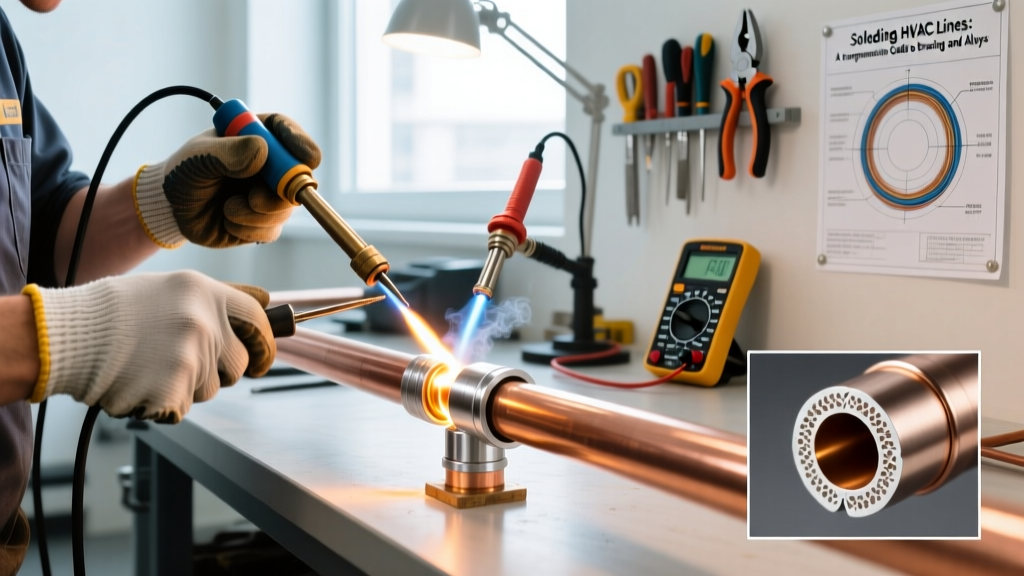
When technicians, apprentices, and advanced DIYers search for guidance on soldering HVAC lines, they are often confronting a critical terminology trap. In the HVAC/R industry, joining copper refrigerant lines is almost exclusively a brazing operation, not a soldering one. According to EPA Section 608 regulations and standard mechanical codes, pressurized refrigerant circuits—which routinely operate at 150 to 600+ PSI depending on the refrigerant (like R-410A or the newer R-32)—require joints that can withstand extreme thermal expansion, vibration, and high pressure.
True soldering (using tin/antimony or low-temperature silver alloys that melt below 840°F/449°C) is strictly reserved for low-pressure applications, such as PVC-to-copper condensate drain transitions or low-temperature hydronic water loops. For the actual refrigerant lineset, you must braze. Understanding this metallurgical distinction is the first step toward achieving leak-free, code-compliant HVAC systems.
Metallurgical Thresholds: A Quick Comparison
| Characteristic | Soldering (Drain/Water Lines) | Brazing (Refrigerant Lines) |
|---|---|---|
| Temperature Threshold | Below 840°F (449°C) | Above 840°F (449°C) up to 1,500°F |
| Base Metal Melting | Base metal does NOT melt | Base metal does NOT melt |
| Joint Strength | Low to Moderate | Extremely High (matches base metal) |
| Typical Alloys | Tin/Antimony, Stay-Brite 8 | BCuP (Sil-Fos), BAg (Silver) |
| HVAC Application | Condensate drains, low-temp water | Suction lines, liquid lines, hot gas |
Selecting the Right Filler Metal for HVAC Systems
The filler metal you choose dictates the structural integrity of the joint. In 2026, with precious metal markets experiencing significant volatility, 15% silver alloys (like BAg-1) have surged past $180 per pound. Consequently, most commercial HVAC contractors have pivoted to highly effective, lower-silver alternatives for copper-to-copper joints to maintain margins without sacrificing joint integrity.
1. Copper-to-Copper Joints: BCuP Alloys
For standard copper-to-copper refrigerant lines, BCuP (Copper-Phosphorus) alloys are the industry standard. The phosphorus in the alloy acts as a built-in fluxing agent, breaking down copper oxide on the surface and allowing capillary action to draw the molten metal into the joint.
- Harris Sil-Fos 5 (5% Silver): The undisputed workhorse of the HVAC trade. It offers excellent flow, high vibration resistance, and costs roughly $75 to $90 per pound. It is ideal for suction and liquid lines.
- Harris Blockade (0% Silver): A copper-phosphorus alloy with no silver. While cheaper (around $35/lb), it is more brittle and should be avoided on lines subject to high vibration, such as short-run connections directly to the compressor.
2. Dissimilar Metals: BAg and Flux Requirements
If you are brazing copper to steel, brass, or stainless steel (common when connecting to compressor stubs or reversing valves), phosphorus will fail. Phosphorus forms brittle phosphide compounds with iron and nickel, leading to catastrophic joint failure under vibration. You must use a BAg (Silver) alloy paired with an external white paste flux.
- Easy-Flo 3 (50% Silver): Excellent for copper-to-steel. Melts at a lower 1,180°F, reducing the risk of melting thin-walled copper.
- Harris Stay-Clean Flux: Essential for preparing brass and steel surfaces before applying BAg alloys.
2026 Market Note: While low-temperature kits like Harris Stay-Brite 8 (which melts around 535°F) are heavily marketed to DIYers for "soldering HVAC lines," they are not approved for pressurized refrigerant circuits by major manufacturers or the American Society of Heating, Refrigerating and Air-Conditioning Engineers (ASHRAE). Restrict Stay-Brite 8 to condensate drain lines and low-pressure water tubing.
The Science of Capillary Action and Joint Clearance
Brazing relies entirely on capillary action to pull the molten alloy deep into the fitting. This physical phenomenon only works if the radial clearance between the tube and the fitting is exact. The Copper Development Association specifies an optimal clearance of 0.002 to 0.005 inches at brazing temperatures.
If the clearance is too tight (below 0.001"), the flux and molten alloy cannot penetrate, resulting in a superficial "ring joint" that will leak under thermal cycling. If the clearance is too loose (above 0.008"), gravity and surface tension fail to hold the alloy in the capillary space, leading to voids and internal drop-throughs that restrict refrigerant flow.
Essential Equipment and Nitrogen Purging
You cannot achieve a professional HVAC braze with a standard propane torch. The thermal mass of copper refrigerant lines requires high-BTU output.
Torch Setups
- Oxy-Acetylene (The Standard): A rig like the Smith AW-1A with a #3 or #5 swirl-tip produces a concentrated, high-velocity flame reaching 5,500°F. This allows you to heat the thick wall of a 1-1/8" suction line rapidly before the flux burns off. Initial setup cost is roughly $350-$450.
- MAP-Pro / Propylene (The Portable Option): Torches like the Bernzomatic TS8000 are acceptable for lines up to 3/4" in diameter. Beyond that, the heat dissipation of the copper outpaces the BTU output of the MAP-Pro gas, leading to cold joints and oxidized filler metal.
The Non-Negotiable: Nitrogen Purging
When copper is heated to 1,200°F in the presence of atmospheric oxygen, it forms cupric oxide scale on the inside of the pipe. This black, flaky scale will eventually break off during system operation, travel through the refrigerant stream, and permanently clog the Thermostatic Expansion Valve (TXV) or capillary tubes, destroying the compressor.
The Protocol: You must flow dry nitrogen through the lineset while brazing. Regulate the flow to 1 to 2 Cubic Feet per Hour (CFH). This low, steady flow displaces the oxygen without creating turbulence that could blow the molten alloy out of the joint.
Step-by-Step Brazing Procedure for Refrigerant Lines
- Clean and Deburr: Use emery cloth to clean the outside of the tube and a wire brush for the inside of the fitting. Remove all internal burrs to maintain the 0.002" clearance.
- Apply Flux (If Required): For Cu-to-Cu with BCuP, no flux is needed. For dissimilar metals, apply a thin, even coat of white paste flux to the male tube only.
- Establish Nitrogen Flow: Open the regulator to 1-2 CFH. Verify flow at the open end of the lineset.
- Preheat the Joint: Apply the flame to the fitting, not the tube. The fitting has more mass and needs to reach temperature first. Keep the flame moving to avoid localized melting.
- Test with the Rod: Touch the brazing rod to the joint. When the copper reaches the correct temperature (around 1,300°F, indicated by a dull cherry-red glow in low light), the rod will instantly melt and flash into the joint via capillary action.
- Feed the Alloy: Melt the rod into the joint until a continuous "fillet" or ring of alloy appears completely around the perimeter. Never melt the rod directly with the flame.
- Quench Safely: Allow the joint to cool naturally for a few seconds, then quench with a damp rag to stop thermal expansion and prevent the flux from crystallizing into a hard, corrosive shell.
Troubleshooting Common HVAC Brazing Failures
Pinhole Leaks Under Pressure
Cause: Internal oxidation (lack of nitrogen purge) or insufficient preheating. If the base metal isn't hot enough, the alloy "balls up" on the surface rather than drawing into the capillary space. When the system is pressurized with 600 PSI of R-410A, these superficial joints fail.
TXV Starvation and Compressor Burnout
Cause: Cupric oxide scale or excessive flux inclusions. If you use too much flux on a brass-to-copper joint, the excess gets drawn inside the pipe. Unlike oxide scale, flux is a glassy substance that shatters into microscopic shards, bypassing standard filter driers and seizing the TXV needle.
Cracking at the Joint Edge (Cold Cracking)
Cause: Using a phosphorus-bearing alloy (Sil-Fos) on a brass or steel component, or subjecting a 0% silver BCuP joint to severe compressor vibration. Always match the alloy to the base metals and the vibration profile of the specific line.
Frequently Asked Questions
Can I use standard plumbing solder on AC copper lines?
No. Standard 95/5 tin/antimony plumbing solder melts at roughly 450°F and lacks the tensile strength to contain high-pressure refrigerants. Furthermore, the heat of the compressor discharge line (often exceeding 200°F) will cause standard solder to fatigue and creep over time, leading to catastrophic refrigerant leaks.
Do I need to flux copper-to-copper joints?
Not if you are using a BCuP alloy (like Sil-Fos). The phosphorus in the rod acts as the fluxing agent. Adding external flux to a copper-to-copper BCuP braze is unnecessary and dangerous, as it increases the risk of flux inclusions contaminating the refrigerant circuit.
How do I know if my nitrogen purge flow is correct?
A common mistake is flowing nitrogen at 10+ CFH, which creates a wind tunnel inside the pipe, blowing the molten silver out of the joint and causing porosity. Use a precision regulator and test the flow by holding a piece of plastic wrap over the exit of the lineset; it should gently billow, not snap violently.