
The Hidden Hazards of Precious Metal Fabrication
Unlike joining copper wire with 60/40 rosin-core solder at 700°F, soldering gold jewelry requires temperatures exceeding 1,300°F and introduces severe chemical, thermal, and respiratory hazards. As jewelry fabrication techniques evolve in 2026, the fundamental chemistry of gold alloys and fluoride fluxes remains unchanged. Whether you are sizing a 14k yellow gold ring or fabricating an 18k white gold setting, ignoring safety best practices can result in lethal fume inhalation, permanent retinal damage, or catastrophic workshop fires.
This guide breaks down the exact metallurgical realities, required personal protective equipment (PPE), and benchtop engineering controls necessary to solder precious metals safely.
Understanding Gold Solder Metallurgy and Toxicity
Gold solder is not a tin-lead or tin-silver mixture. To ensure the soldered joint matches the color and karat of the base metal, gold solder is an alloy of gold, silver, copper, and zinc. Historically, manufacturers added cadmium to lower the melting point and improve flow characteristics. However, heating cadmium releases highly toxic fumes that can cause severe pulmonary edema and long-term organ damage. The CDC's National Institute for Occupational Safety and Health (NIOSH) strictly outlines the severe respiratory risks associated with cadmium exposure.
Actionable Buyer Advice: Only purchase solder explicitly stamped or certified as "Cadmium-Free" from reputable refiners like Hoover & Strong or Rio Grande. While cadmium-free solders require slightly more precise heat control due to narrower melting ranges, the elimination of lethal fume exposure is non-negotiable.
Flux Handling and Fume Extraction
To solder gold, you must dissolve metal oxides at high temperatures. This requires a fluoride-based flux, such as Handy Flux Type B-2 (active range 1100°F–1600°F). When heated, potassium fluoroborate and potassium fluoride compounds release hydrogen fluoride gas. Inhaling these fumes causes severe respiratory tract irritation and long-term skeletal fluorosis.
Standard electronics fume extractors (like the $50 Hakko FA-400) are entirely insufficient for jewelry soldering. They lack the static pressure and chemical filtration required for heavy fluoride particulates.
Required Extraction Specifications
- Pre-Filtration: HEPA filter to capture metallic particulates and borax glass dust.
- Gas-Phase Filtration: Deep-bed activated carbon filter (minimum 5 lbs of carbon) to adsorb hydrogen fluoride and sulfur gases.
- Capture Velocity: A flexible snorkel arm positioned 4 to 6 inches from the soldering block, pulling at least 150 CFM (Cubic Feet per Minute).
- Cost Expectation: A proper benchtop jewelry extractor (e.g., BOFA Print PRO 3 or equivalent) will cost between $1,200 and $2,500. Do not compromise on this investment.
Essential Eye and Skin Protection
When fluoride flux reaches its active temperature, it emits a blinding yellow "sodium flare." Staring at this flare without proper filtration causes retinal fatigue and "welder's flash" (photokeratitis). Furthermore, oxy-acetylene torches emit harmful UV and IR radiation.
According to OSHA's Eye and Face Protection standards, workers must use appropriate shade filters based on the light intensity of the operation.
Expert Gear Recommendation: Invest in Didymium safety glasses. Didymium is a rare-earth glass that specifically filters out the 589nm sodium yellow light band, allowing you to see the exact moment the solder flows without being blinded by the flux flare. For oxy-acetylene torch users, a #5 shade welding goggle is required over the didymium lenses to block UV/IR radiation.
Thermal Safety and Fire Prevention Protocols
A 14k gold ring shank requires concentrated heat, often from a Smith Little Torch (Oxy-Acetylene) or a Blazer Stingray (Butane). Misdirected heat or a dropped torch can ignite a workbench in seconds.
Bench Surface and Soldering Block Selection
| Material | Thermal Property | Safety Profile & Best Use |
|---|---|---|
| Charcoal Block | Reflects heat back into the workpiece | High fire risk if left unattended. Can spark and pop. Use only for melting ingots, not general bench soldering. |
| Solderite Board | Absorbs heat rapidly, cools quickly | Excellent safety profile. Non-combustible. Ideal for general ring sizing and chain repair. |
| Ceramic Honeycomb | Withstands extreme heat, insulates | Very safe, but fragile. Best for supporting complex 3D fabrications where pins are needed. |
| Magnesite Block | Withstands direct flame without degrading | Highly durable and fireproof. Ideal for heavy prong soldering and bezel setting. |
Fire Safety Rule: Always keep a Class B/C fire extinguisher (CO2 or dry chemical) within 5 feet of the bench. Never use water on a butane or grease fire. Additionally, cover your wooden workbench with a 2mm thick Kevlar or fiberglass bench skin to prevent scorching and secondary ignition.
The Pickle Pot: Chemical and Galvanic Hazards
After soldering, gold jewelry is quenched in a "pickle" solution to dissolve oxidized flux and copper oxides. The industry standard is Sparex #2 (sodium bisulfate), mixed at a ratio of 1 cup per gallon of water and heated to 140°F–180°F in a dedicated slow cooker.
Hidden Pickle Dangers
- Hydrogen Gas Accumulation: The chemical reaction between the acid and the base metals releases hydrogen gas. If your pickle pot has a sealed, locking lid, the gas will accumulate and create a severe explosion hazard. Solution: Always leave the lid slightly ajar or drill a vent hole in the slow cooker lid.
- Galvanic Copper Plating: Never use standard steel tweezers to retrieve jewelry from the pickle. The acidic solution acts as an electrolyte. Introducing steel creates a galvanic cell that instantly flash-plates dissolved copper ions onto your gold, turning it pink/orange. Solution: Exclusively use titanium or copper tongs.
- Acid Handling: Always add the Sparex granules to the water, never water to the acid, to prevent exothermic splashing. Follow OSHA Hazard Communication guidelines for proper labeling and neutralization (use baking soda to neutralize spent pickle before disposal).
Torch Gas Line Safety & Flashback Arrestors
If you are using an Oxy-Acetylene setup like the Smith Little Torch, you are managing highly volatile gases. Acetylene is unstable at pressures above 15 PSI. A "flashback" occurs when the flame burns back into the torch tip or hoses, potentially reaching the regulator and causing an explosion.
Mandatory Protocol: Install flashback arrestors on both the oxygen and acetylene regulators, not just the torch handles. Check your O-rings annually; the high heat of jewelry soldering degrades the rubber seals inside the torch handle, leading to micro-leaks that can ignite when you strike your flint lighter.
Step-by-Step Safe Soldering Workflow
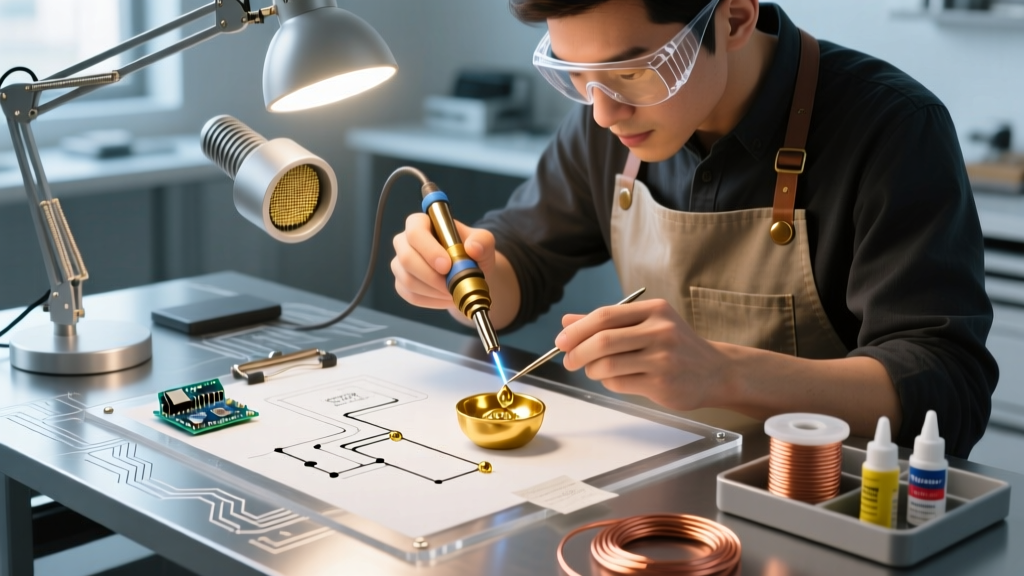
- Prep & Ventilate: Turn on the fume extractor 5 minutes before lighting the torch to establish negative air pressure at the bench. Don your didymium glasses and tie back long hair.
- Apply Flux: Paint the joint with Handy Flux. Ensure the piece is completely dry before applying the flame to prevent steam explosions that can blow hot flux onto your skin.
- Heat Management: Use a broad, bushy flame to heat the entire mass of the jewelry first (the "heat sink" effect). Only focus the inner blue cone on the joint when the flux turns clear and glassy (approx. 1100°F).
- Solder Flow: Touch the solder wire to the joint. Capillary action will draw the molten solder toward the heat source. Remove the flame immediately upon flow to prevent melting the base gold.
- Quench & Pickle: Allow the piece to air-cool until the red glow dissipates (about 30 seconds). Quench in water, then move to the heated pickle pot using titanium tongs.
Frequently Asked Questions
Can I use silver solder on gold jewelry?
No. Silver solder (which contains high amounts of zinc and cadmium) will not match the color of gold, will create a brittle joint due to alloy incompatibility, and often melts at a lower temperature than the gold itself, risking the melting of your workpiece before the solder flows.
What is the difference between Hard, Medium, and Easy gold solder?
They are differentiated by their melting points to allow for multiple sequential soldering steps without remelting previous joints. For 14k Yellow Gold: Hard flows at 1450°F (used for the primary ring shank joint), Medium flows at 1400°F (used for setting heads), and Easy flows at 1300°F (used for final catch repairs or sizing beads).