
Redefining Soldering: From Metallurgy to Economics
When beginners type "soldering define" into a search engine, they are typically looking for a simple glossary term: the process of joining two or more metal items by melting and putting a filler metal (solder) into the joint. However, in the professional electronics landscape of 2026, to truly define soldering means to understand its comprehensive financial footprint. Soldering is not just a physical act; it is an economic variable involving thermal dynamics, consumable degradation, compliance standards, and rework liabilities.
Whether you are prototyping an ESP32-based IoT sensor or running a high-volume board repair facility, the barrier to entry and the cost of maintenance vary wildly. This guide breaks down the true Total Cost of Ownership (TCO) across three distinct tiers of soldering investment, moving beyond the sticker price of the iron itself.
The 3-Tier Investment Matrix (2026 Pricing)
The market has fractured into highly specialized tiers. Choosing the wrong tier for your workload results in either wasted capital on unused thermal headroom or catastrophic pad lift due to insufficient power delivery.
Tier 1: The Ultra-Budget Hobbyist (Under $80)
The entry-level market has been entirely disrupted by open-source, PD-powered smart irons. The undisputed king of this tier in 2026 remains the Pinecil V2, retailing at roughly $26. Powered by a 65W USB-C Power Delivery brick, it utilizes a RISC-V chip to manage PID temperature control.
- Initial Hardware: $26 (Pinecil V2) + $15 (65W GaN Charger) = $41
- Consumables: 1lb spool of Kester 245 63/37 eutectic wire ($38)
- Hidden Failure Modes: While the Pinecil is exceptional for through-hole and basic 0805 SMD work, it lacks the thermal mass to handle heavy ground planes. Attempting to solder a 10AWG wire to a thick copper pour will cause the tip temperature to plummet, resulting in cold, grainy joints and excessive dwell times that degrade the flux before wetting occurs.
Tier 2: The Prosumer and Repair Technician ($150–$400)
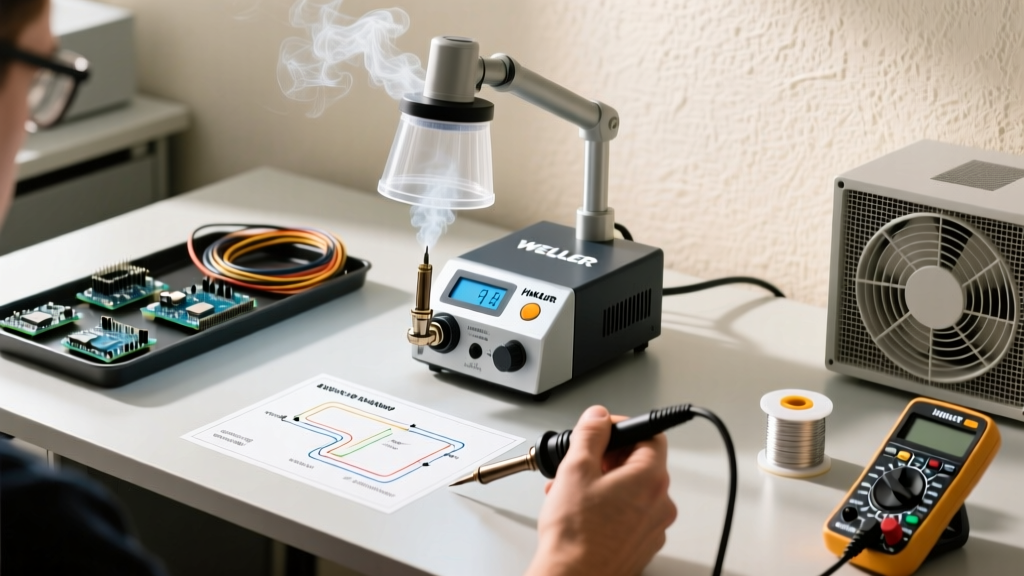
For technicians repairing consumer electronics or running small-batch assembly, transformer-based or mid-range digital stations are the standard. The Hakko FX-888D ($115) and the Weller WE1010NA ($140) dominate this space.
- Initial Hardware: $115 - $140
- Consumables: Chip Quik SMD430AX10 solder paste ($42) and Hakko T18-B conical tips ($7.50 each).
- Hidden Failure Modes: The FX-888D outputs 70W, but its thermal recovery time on large joints is roughly 8 to 12 seconds. If a technician attempts to use lead-free
SAC305alloy (which has a higher liquidus temperature of 217°C compared to 183°C for eutectic leaded solder), the station will struggle to maintain thermal equilibrium, accelerating tip oxidation and requiring frequent $7.50 tip replacements.
Tier 3: High-Volume Production and Micro-BGA ($800+)
At the enterprise level, time is money, and thermal recovery is measured in milliseconds. The JBC CD-2BQE station ($550) paired with C245 cartridge handles ($105) represents the pinnacle of soldering economics. The heating element is integrated directly into the tip cartridge, reducing the distance between the heat source and the joint to mere millimeters.
- Initial Hardware: $655 (Station + Handle)
- Consumables: JBC C245-764 tips ($48 each). While expensive, they last 5x longer under heavy use due to JBC's intelligent sleep/standby modes that drop the tip to 150°C when holstered, virtually halting iron plating dissolution.
- ROI Justification: A 2-second recovery time means a technician can complete a 14-pin SOIC soldering task in 40% less time than with a Tier 2 station, paying for the system upgrade within six months of billable labor.
5-Year Total Cost of Ownership (TCO) Comparison
To properly define soldering costs, we must project a 5-year horizon assuming 20 hours of active use per week. This matrix factors in power draw, tip degradation rates, and initial capital expenditure.
| Cost Metric (5-Year) | Pinecil V2 (Hobby) | Hakko FX-888D (Prosumer) | JBC CD-2BQE (Pro) |
|---|---|---|---|
| Initial Hardware Cost | $41 | $115 | $655 |
| Estimated Tip Replacements | $45 (9 tips) | $112 (15 tips) | $240 (5 tips) |
| Power Consumption Cost* | $35 | $85 | $60 |
| Maintenance / Calibration | $0 | $0 | $150 |
| Total 5-Year TCO | $121 | $312 | $1,105 |
*Power costs calculated at $0.16/kWh, factoring in the JBC's aggressive eco-sleep mode versus the Hakko's continuous 70W draw.
Hidden Variables in Your Soldering Budget
A common mistake when calculating the cost of a soldering lab is ignoring the peripheral ecosystem required to meet modern safety and quality standards.
Fume Extraction and Health Compliance
Soldering flux—particularly rosin-based (RO) fluxes—releases colophony fumes when heated, which is a known respiratory sensitizer. According to the Occupational Safety and Health Administration (OSHA), employers must mitigate exposure to hazardous airborne particulates and gases. A basic desk fan blowing fumes across the room is a compliance violation in commercial spaces.
- Budget Solution: Hakko FA-400 benchtop fan with carbon filter ($65). Requires $25 filter replacements every 3 months.
- Professional Solution: BOFA AD Oracle 300 extraction system ($1,200+). Features HEPA and deep-bed carbon filtration, requiring $150 annual filter swaps but ensuring absolute compliance with indoor air quality regulations.
Magnification and Inspection Hardware
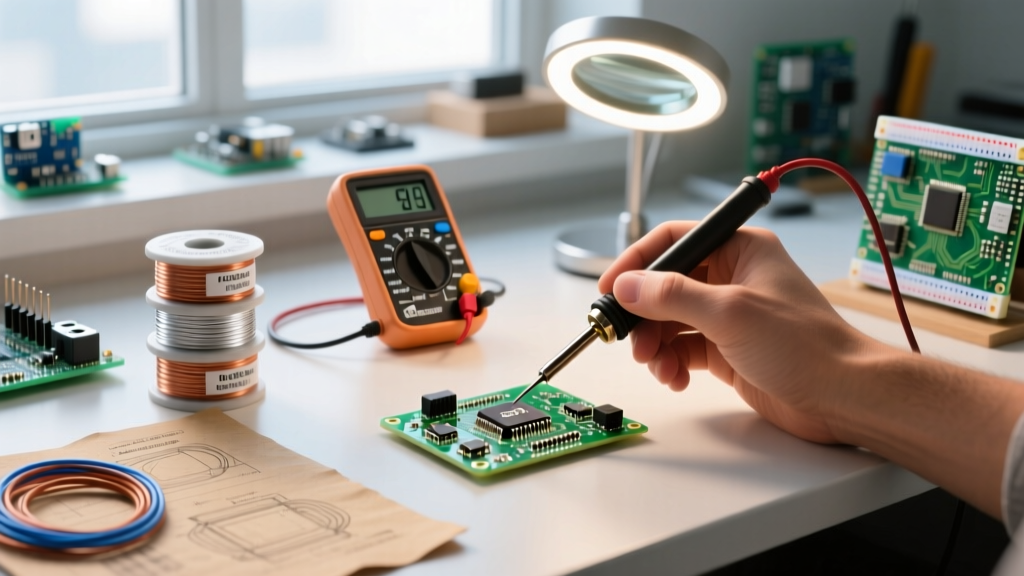
As component sizes shrink to 0201 and 01005 imperial footprints, the naked eye is no longer sufficient. The Association Connecting Electronics Industries (IPC) sets stringent acceptance criteria for solder fillets and wetting angles in standards like IPC-A-610. To verify these joints, optical assistance is mandatory.
- AmScope 144X Stereo Zoom Microscope: ~$280. Essential for inspecting micro-soldering joints and avoiding accidental bridging on 0.4mm pitch QFP chips.
- Digital HDMI Microscopes: ~$150. Good for documentation and rework tutorials, but the inherent latency of digital sensors makes real-time hand-eye coordination frustrating for precision drag soldering.
The True Cost of Rework and Pad Lift
The most expensive aspect of soldering is not the gear; it is the cost of failure. When an underpowered Tier 1 iron is used on a multilayer PCB with internal ground planes, the technician is forced to hold the iron on the pad for 8 to 10 seconds to achieve flow. This excessive dwell time causes the epoxy resin in the FR4 substrate to exceed its glass transition temperature (Tg), leading to pad lift or delamination.
If a technician lifts a pad on a $300 proprietary control board, the board is effectively scrapped. The financial loss includes the $300 material cost, plus 45 minutes of diagnostic and rework time at a standard $65/hour labor rate, resulting in a single error costing nearly $350. Investing in a high-thermal-mass JBC or Metcal system that achieves flow in 1.5 seconds is an insurance policy against catastrophic substrate damage.
Expert Takeaway: To accurately define soldering for your specific use case, stop looking at the wattage printed on the box. Calculate the thermal recovery time, the cost of the sleep-mode ecosystem, and the financial risk of the PCBs you are working on. A $600 station is remarkably cheap when it prevents a single $500 board from being destroyed by a cold joint.