
The Metallurgy of Plumbing: Why Material Compatibility Matters
When soldering a water pipe, you are not simply melting metal to glue two pieces together; you are facilitating a complex metallurgical bonding process driven by capillary action. For a joint to withstand the 60 to 80 PSI of standard municipal water pressure—and the thermal expansion cycles of hot water lines—the base metals, filler alloys, and chemical fluxes must be perfectly compatible. A mismatch in material compatibility doesn't just result in a weak joint; it can lead to galvanic corrosion, toxic leaching, or catastrophic pinhole failures within months of installation.
As of 2026, modern plumbing codes strictly regulate the materials used in potable water systems. This guide breaks down the exact metallurgical requirements, alloy compositions, and thermal dynamics required to execute a flawless, code-compliant solder joint on copper water lines.
Copper Pipe Grades: Type K, L, and M Compatibility
Not all copper tubing is created equal. The compatibility of your soldering technique must adapt to the wall thickness and thermal mass of the specific copper grade you are working with. Capillary action requires a precise gap between the pipe and the fitting—ideally between 0.002 and 0.005 inches. If the pipe is out-of-round or the wrong grade is forced into a mismatched fitting, capillary draw fails.
| Copper Type | Wall Thickness (1/2 in.) | Primary Use Case | Soldering Challenge & Thermal Mass |
|---|---|---|---|
| Type K | 0.049 inches | Underground mains, well pumps | Highest thermal mass. Requires sustained, high-BTU heat (MAP-Pro) to achieve capillary draw without localized overheating. |
| Type L | 0.040 inches | Interior potable water (Standard) | Ideal thermal balance. Standard propane or MAP-Pro torches easily achieve the 450°F required for lead-free solder flow. |
| Type M | 0.028 inches | Low-pressure drains, some residential | Extremely thin walls. High risk of burning through the pipe or melting the fitting shoulder if heat is not constantly moved. |
Thermal Dynamics and Torch Selection
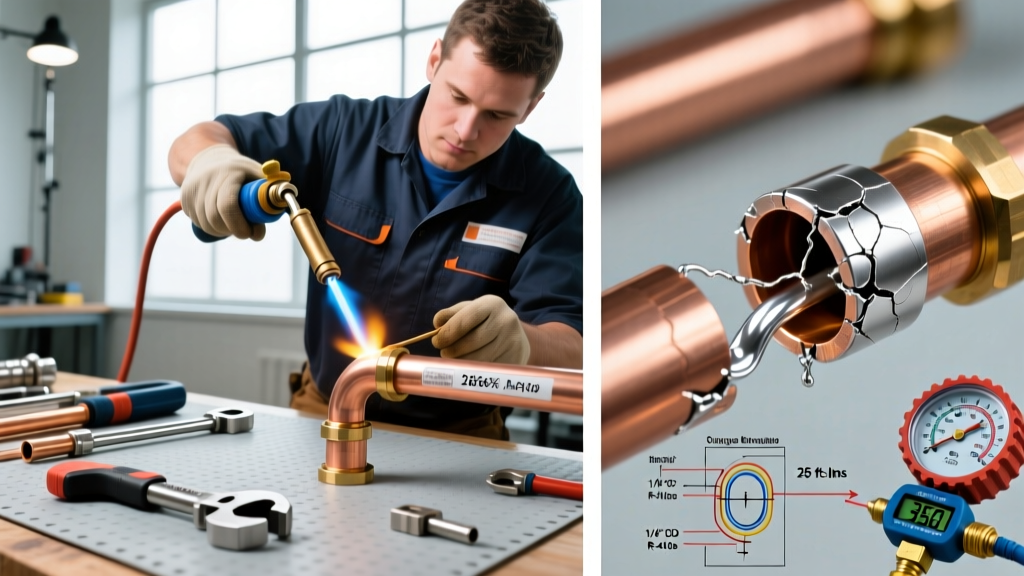
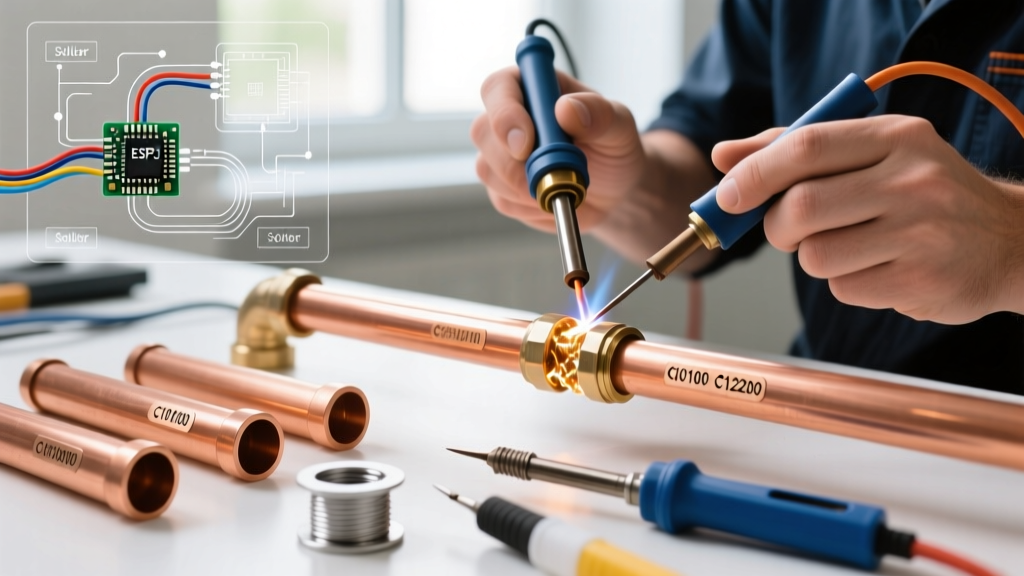
When soldering a water pipe made of Type L or M copper in residential settings, a standard propane torch (like the Bernzomatic TS3500) burning at roughly 3,600°F is sufficient for 1/2-inch and 3/4-inch lines. However, if you are soldering 1-inch Type K copper or working on a manifold with high thermal dissipation, you must upgrade to MAP-Pro gas (such as the Bernzomatic TS4000). MAP-Pro burns hotter (3,730°F) and transfers BTUs into the heavy copper mass significantly faster, preventing the flux from burning off before the solder melts.
Solder Alloy Selection: Navigating the Lead-Free Mandate
Historically, plumbers relied on 50/50 lead-tin solder for its low melting point and excellent flow characteristics. Today, using leaded solder on any potable water line is a severe violation of the Lead and Copper Rule enforced under the Safe Drinking Water Act. The Environmental Protection Agency (EPA) mandates that all solders and fluxes used in potable water systems must contain no more than 0.2% lead.
For modern plumbing, you must select from the following lead-free alloys, each with distinct metallurgical properties:
- 95/5 Tin/Antimony (e.g., Oatey Safe Flo): Melts at 452°F (233°C). This is the standard residential choice. The antimony adds structural rigidity, preventing joint creep under continuous pressure. Tensile strength is approximately 6,000 PSI.
- 97/3 Tin/Copper (e.g., Oatey Lead-Free): Melts at 440°F (227°C). Slightly lower melting point than 95/5, making it easier to work with on thin-walled Type M copper where burn-through is a risk.
- Silver-Bearing (e.g., Harris Stay-Brite 8): Composed of 96.25% Tin, 3.25% Silver, and 0.5% Copper. Melts at 420°F. The addition of silver drastically increases the tensile strength to over 12,000 PSI and improves vibration resistance. This is the mandatory choice for commercial lines, recirculating hot water loops, and lines subject to mechanical vibration.
Critical Warning: Never use acid-core electrical solder (like rosin-core or standard 60/40 tin/lead) on plumbing. Electrical solder lacks the necessary tensile strength for pressurized water, and the lead content poses severe neurological hazards, as documented by the Centers for Disease Control and Prevention (CDC).
Flux Chemistry: Matching the Paste to the Metal
Flux is the unsung hero of capillary soldering. Its primary job is to dissolve copper oxide at high temperatures and prevent new oxides from forming, allowing the molten solder to 'wet' the base metal. However, flux chemistry must be matched to the environment and the alloy.
Petroleum-Based vs. Water-Soluble Flux
For standard copper-to-copper water pipe soldering, a petroleum-based paste flux (such as Oatey #95 or La-Co Regular) is the industry standard. It remains active up to 700°F, giving you a wide working window. However, petroleum flux is highly corrosive if left on the exterior of the pipe and must be wiped clean with a rag while still warm.
If you are working in tight, enclosed joist bays where wiping the joint is impossible, or if you are soldering near sensitive finishes, a water-soluble flux (like Oatey #50) is required. Water-soluble fluxes are self-cleaning; the first time water flows through the newly soldered pipe, the residual flux dissolves and flushes out of the system, eliminating the risk of long-term pinhole corrosion caused by trapped acidic flux.
Incompatible Materials: What NOT to Solder
A major failure point for DIYers and apprentice plumbers is attempting to solder incompatible materials. Soldering relies on metallic bonding; if the base metal cannot alloy with tin, the joint will fail immediately or leak under pressure.
Galvanized Steel and Iron
You cannot solder a water pipe made of galvanized steel or black iron. The zinc coating on galvanized pipe vaporizes at soldering temperatures, releasing highly toxic fumes and leaving a porous, non-wettable surface. Furthermore, the iron itself does not readily accept standard plumbing solder without specialized, high-temperature silver brazing techniques. Solution: Use a dielectric union or a threaded transition fitting with Teflon tape and pipe dope to connect copper to galvanized steel. This also prevents galvanic corrosion, which occurs when dissimilar metals touch in the presence of an electrolyte (water).
PEX and CPVC Plastics
Soldering near Cross-Linked Polyethylene (PEX) or Chlorinated Polyvinyl Chloride (CPVC) requires extreme caution. The radiant heat from a propane torch will easily melt PEX (which deforms around 200°F) and ignite or warp CPVC. Solution: Solder all copper joints on a workbench before integrating them into a system containing plastics. If you must solder near existing PEX, use a wet rag as a heat sink wrapped tightly around the plastic pipe, or utilize push-to-connect fittings (like SharkBite) for the transition.
Troubleshooting Common Soldering Failures
Even with perfect material compatibility, technique errors will compromise the joint. Here is how to diagnose and fix the three most common failure modes when soldering a water pipe:
- Cold Joints (Capillary Starvation): Symptom: Solder forms a bead on the outside of the fitting but does not draw into the joint. Cause: The pipe was not heated sufficiently. The flux cooled and solidified before the solder melted, blocking capillary action. Fix: Heat the fitting, not the pipe. Apply the flame to the thickest part of the fitting until the flux bubbles and turns clear, then touch the solder to the opposite side of the joint.
- Burnt Flux (Corrosion Pinholes): Symptom: The joint looks black and crusty, and develops a pinhole leak 3 to 6 months after installation. Cause: Overheating the copper. When copper exceeds 800°F, petroleum flux burns into a hard carbon residue. This residue prevents solder wetting and becomes highly acidic when exposed to water, eating through the thin wall of Type M or L copper. Fix: Keep the torch moving. Remove the flame the exact second the solder flashes into the joint.
- Gravity Sagging (Joint Voids): Symptom: The bottom of a horizontal joint is bulging with solder, while the top is starved. Cause: Applying too much solder and relying on gravity rather than capillary action. Fix: For a 1/2-inch joint, exactly 3/4 inch of solder wire is sufficient. Feed the solder into the top of the joint and let capillary action pull it downward and around the fitting.
Frequently Asked Questions
Can I use Teflon tape on a soldered water pipe joint?
No. Teflon tape is strictly for threaded NPT (National Pipe Taper) connections. Soldered joints rely on a metallurgical seal via capillary action. Introducing any foreign material, including tape or pipe dope, into the slip-fit gap will completely block the solder from drawing into the joint.
Do I need to sand the inside of the copper fitting?
Yes. Material compatibility requires bare, bright copper on both the male and female surfaces. Use a specialized fitting wire brush to clean the inside of the fitting cup until it shines, followed by a light, even coat of paste flux. Do not over-apply flux, as excess will boil inside the joint and create voids.