
The Metallurgical Milestones That Shaped Modern Connectivity
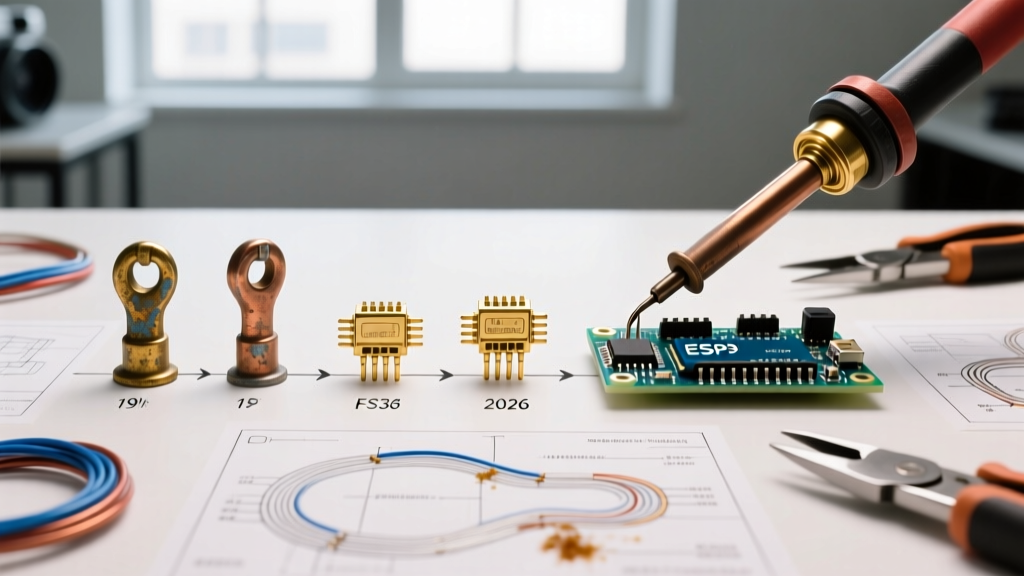
When sourcing components for a 2026 electronics build, it is easy to view soldering connectors as mere commodities. However, understanding the historical evolution of these components is not just an academic exercise; it is a critical buyer's framework. The transition from bulky telegraph lugs to microscopic surface-mount RF pads dictates everything from your choice of soldering iron tip to your reflow profile. By tracing the lineage of connector technology, engineers and DIYers can avoid catastrophic failure modes, select the right mating housings, and understand why certain legacy alloys remain specified in modern aerospace applications.
Era 1: The Telegraph, the Lug, and the Mechanical Wrap (1850s–1940s)
Before the printed circuit board, electrical connections were entirely point-to-point. The earliest soldering connectors were heavy brass lugs and cup terminals designed for telegraph lines and early power distribution. Solder was not used to hold the wires together; it was used to seal a mechanically robust joint.
Historical Insight: The 'Western Union splice' was a mandatory mechanical wrap before solder was ever applied. Early rosin-core solders were highly acidic and required aggressive external fluxes, often leaving corrosive residues that degraded early copper wiring.
Buyer's Takeaway for Vintage & Heavy-Duty Restorations
If you are restoring vintage audio equipment or building heavy-duty point-to-point tube amplifiers, modern stamped connectors will fail under high thermal cycling. You must source machined brass turret terminals and heavy-wall copper lugs. Expect to pay a premium—often $0.50 to $1.20 per lug—compared to fractions of a cent for modern stamped equivalents. Always pair these with a high-wattage iron (like the 80W Weller W100PG) to overcome the massive thermal mass of vintage chassis grounds.
Era 2: The PCB Revolution and Through-Hole Dominance (1950s–1980s)
The invention of the printed circuit board fundamentally changed connector design. As documented by the Engineering and Technology History Wiki, the shift from point-to-point wiring to etched copper traces required connectors that could be wave-soldered directly to the board. This era birthed the iconic through-hole connector families we still use today.
- Molex KK 254 (0.100-inch pitch): The undisputed king of 1970s and 1980s consumer electronics. Its friction ramp design prevented vibration-induced backing out.
- TE Connectivity (formerly Amp) MATE-N-LOK: Introduced robust nylon housings capable of handling higher currents (up to 13A) for appliance wiring.
The Eutectic Standard: Sn63/Pb37
During this era, the 63% Tin / 37% Lead alloy became the global standard. With a precise eutectic melting point of 183°C (361°F), it transitioned instantly from liquid to solid without a plastic (pasty) phase. This eliminated 'cold joints' caused by micro-movements during cooling. For modern buyers working on legacy industrial equipment or non-RoHS aerospace projects, Sn63/Pb37 remains the gold standard for hand-soldering through-hole connectors.
Era 3: Surface Mount, Miniaturization, and the Lead-Free Shift (1990s–2010s)
As consumer electronics shrank, through-hole connectors became a bottleneck. The industry pivoted to Surface Mount Technology (SMT), requiring connectors with flat, coplanar pins that could withstand automated reflow ovens. Simultaneously, environmental regulations forced a metallurgical revolution.
The RoHS Mandate and SAC305
The Restriction of Hazardous Substances (RoHS) directive effectively banned lead in consumer electronics. The industry settled on SAC305 (96.5% Sn, 3.0% Ag, 0.5% Cu). While environmentally superior, SAC305 melts at a higher 217°C–220°C and exhibits a plastic phase during cooling. This increased the risk of thermal fatigue and tombstoning in micro-connectors.
Miniature Connector Families to Know
| Connector Family | Pitch | Typical Application | Avg Cost per Pin (2026) | Soldering Challenge |
|---|---|---|---|---|
| JST PH 2.0 | 2.0mm | Drones, 3D Printers, Battery BMS | $0.02 - $0.04 | Plastic housing melts if iron dwell time exceeds 2 seconds. |
| Hirose U.FL | 1.2mm (SMT) | Wi-Fi/Bluetooth Antennas, IoT | $0.15 - $0.30 | Requires hot-air rework station; hand soldering risks pad lift. |
| Molex Pico-EZmate | 1.2mm | Wearables, Medical Devices | $0.08 - $0.12 | Extremely tight pitch requires 0.3mm chisel tips and flux gel. |
Era 4: The 2026 Landscape — High-Speed RF and Extreme Power
Today, the evolution of soldering connectors has bifurcated into two extremes: microscopic high-frequency data links and massive high-current electric vehicle (EV) interconnects.
High-Speed and RF Connectors
With 5G, Wi-Fi 7, and 112Gbps Ethernet dominating 2026 hardware, connectors like the Amphenol SMP and Southwest Microwave 2.92mm are critical. These are not hand-soldered with a standard iron. They require precision edge-mount soldering or specialized reflow profiles to maintain a 50-ohm impedance. A solder fillet that is 0.5mm too thick can introduce signal reflection and ruin a high-speed data link.
High-Current EV and Solar Connectors
On the opposite end of the spectrum, the EV boom has popularized heavy-duty soldering connectors like the Amphenol SurLok Plus and TE Connectivity DEUTSCH DT series. These connectors handle 150A to 300A at up to 1000V DC. While many use crimping, high-reliability aerospace and motorsport applications still specify solder-crimp hybrid contacts. The solder cup ensures zero contact resistance, while the crimp provides the necessary strain relief.
Critical Failure Modes: What History Taught Us
Understanding historical failures is the best way to inform your 2026 purchasing and assembly decisions. Here are the primary failure modes associated with modern soldering connectors:
- Tin Whiskers: The move to pure tin and lead-free finishes in the 2000s resulted in microscopic, conductive crystalline structures growing from connector pins. As extensively documented by NASA's NEPP Tin Whisker database, these whiskers can bridge adjacent pins, causing catastrophic short circuits in satellites and medical devices. Buyer Action: For mission-critical builds, specify connectors with matte-tin over a nickel barrier, or seek out RoHS-exempt SnPb finished components.
- Thermal Cycling Fatigue: SAC305 lead-free solder joints on large, high-pin-count connectors (like 100-pin board-to-board mezzanine connectors) are highly susceptible to cracking under repeated thermal expansion and contraction. Buyer Action: Specify connectors with integrated mechanical mounting tabs (board locks) to absorb physical stress before it reaches the solder joints.
- Flux Entrapment: Modern no-clean fluxes are designed to be left on the board, but if trapped under tight-pitch SMT connectors, they can absorb moisture and cause electrochemical migration. Buyer Action: Always choose connectors with 'vacuum pick-up' caps and open-frame designs that allow for post-soldering cleaning and inspection.
The Buyer's Decision Framework for 2026
Do not default to the newest or smallest connector. Use this historical framework to match the connector to your environment:
- High-Vibration / Automotive: Skip the friction-lock JST connectors. Buy TE Connectivity DEUTSCH or Molex MX150 series with primary locking mechanisms and secondary TPA (Terminal Position Assurance) wedges.
- Prototyping / Breadboarding: Stick to the 1970s workhorse: Molex KK 254 (0.1-inch). The ecosystem of housings, pre-crimped wires, and compatible headers is unmatched, and replacement parts cost pennies.
- Compact IoT / Wearables: Utilize JST SH (1.0mm pitch) or Molex Pico-EZmate. Ensure your assembly house is equipped with automated optical inspection (AOI) to verify the microscopic solder fillets.
Conclusion
The evolution of soldering connectors is a masterclass in engineering trade-offs. We traded the mechanical invincibility of 1920s lugs for the density of 1980s through-hole, and later sacrificed the forgiving eutectic properties of lead for the environmental compliance and miniaturization of modern SMT. As a buyer and builder in 2026, your success depends on respecting these metallurgical and mechanical histories. Whether you are sourcing a $15 Amphenol RF connector for a radar array or a $0.03 JST housing for a drone ESC, aligning your component choice with the physical realities of your soldering process is the ultimate key to long-term reliability.
For further reading on modern assembly standards, refer to the IPC Standards directory, which governs the acceptability of these soldered connections across all global industries.