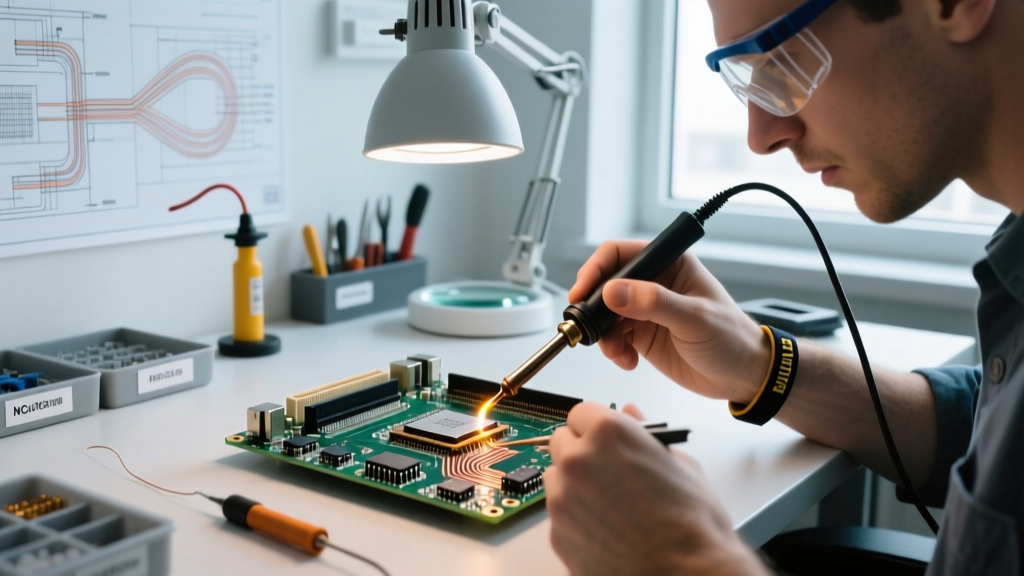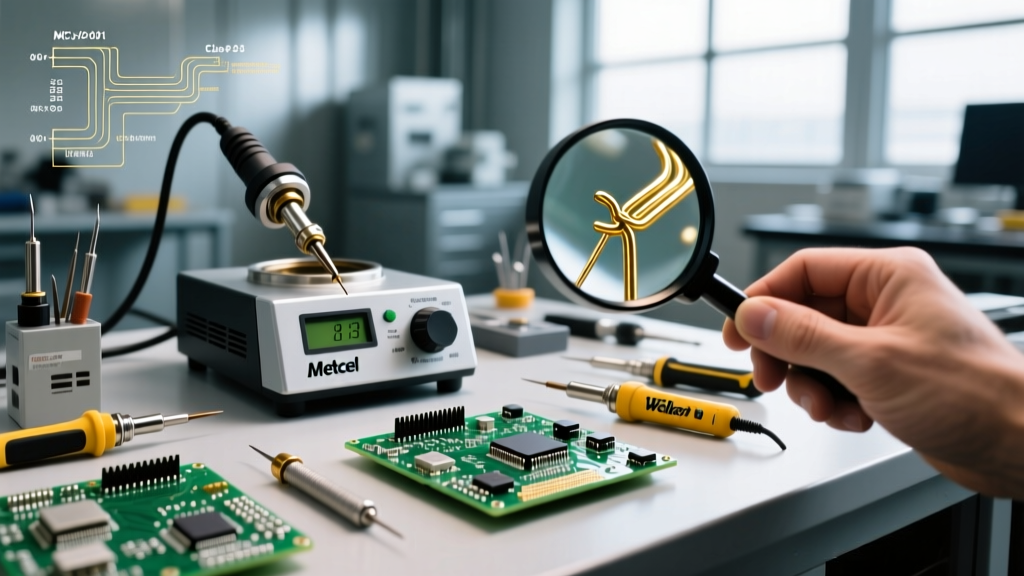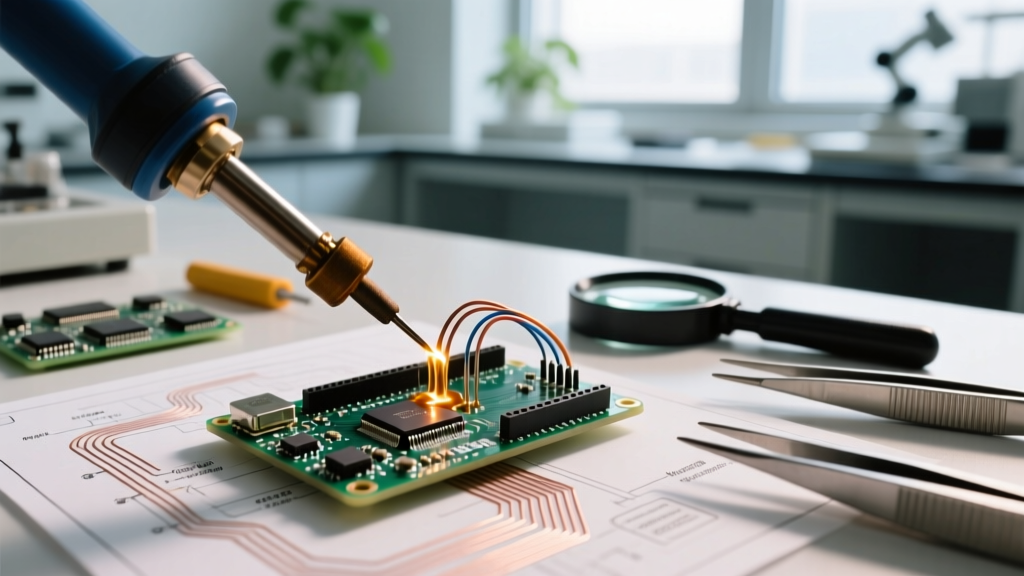

The Economics of Electronics: Hand Soldering vs. PCBA Services
When designing custom electronics, engineers and hobbyists eventually face a critical financial crossroads: should you hand-solder the prototype, or outsource the assembly to a turnkey Printed Circuit Board Assembly (PCBA) service? As surface-mount components shrink to 0201 and 01005 imperial sizes, the barrier to entry for manual assembly has risen significantly. In 2026, the true cost of soldering circuit boards extends far beyond the price of a soldering iron. It encompasses capital equipment depreciation, consumable attrition, rework labor, and yield loss.
This comprehensive cost analysis breaks down the exact financial realities of building a DIY soldering circuit lab versus outsourcing to a factory, providing a data-driven framework to help you decide where to allocate your hardware budget.
Capital Expenditure (CapEx): Building the DIY Soldering Circuit Lab
To reliably solder modern circuit boards featuring high-density QFN packages and fine-pitch TQFPs, a basic $15 mains-powered iron is no longer sufficient. You must invest in temperature-controlled stations with high thermal recovery rates and proper magnification. Here is the realistic 2026 pricing breakdown for a capable home or small-engineering lab setup.
1. The Soldering Station Tier List
- Entry-Level (Hobbyist): The Pinecil V2 ($26 bare unit) powered by a 65W USB-C laptop brick. Excellent for basic through-hole and 0805 SMD work, but struggles with heavy ground planes due to its 65W ceiling.
- Mid-Range (Prosumer): The Hakko FX-888D ($110). An industry staple for years, but its 70W ceramic heater exhibits noticeable thermal lag when soldering circuit boards with large copper pours.
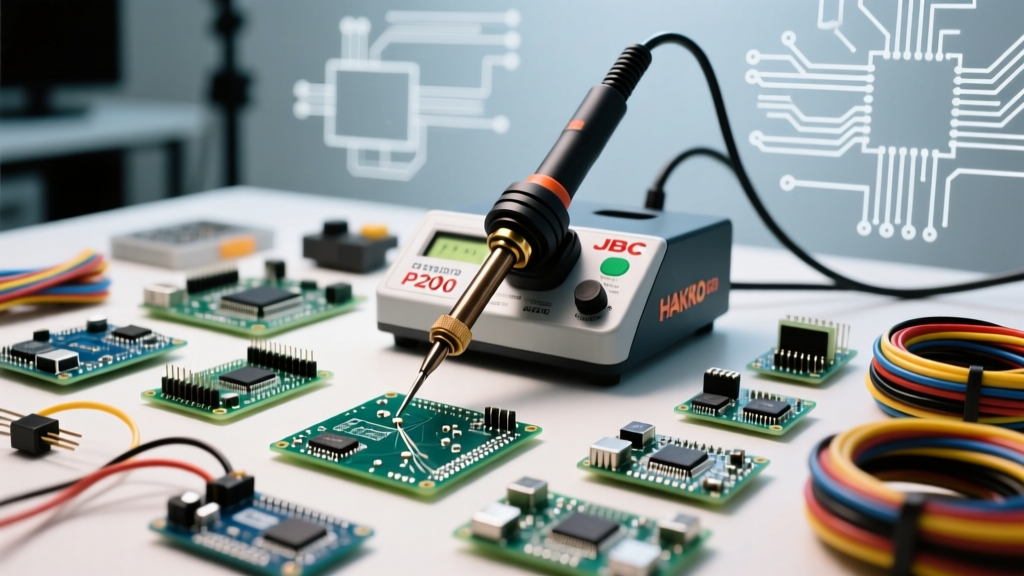
- High-End (Professional): The JBC CD-2BQF station paired with a C210-008 nano handle ($485). This is the gold standard for micro-soldering. The cartridge-integrated heater tip reaches 350°C in 2 seconds, eliminating cold joints on high-thermal-mass vias.
2. Optics and Inspection
Attempting to solder a circuit with 0.4mm pitch components using the naked eye guarantees bridging defects. A reliable boom-stand stereo microscope, such as the AmScope SE400-Z (7X-45X magnification, $180), is a mandatory CapEx investment for any serious SMD work.
Operational Expenditure (OpEx): Consumables and Component Attrition
Once the CapEx is secured, the ongoing costs of soldering circuit assemblies begin. Flux, solder paste, and cleaning solvents represent a recurring operational expense that many DIYers fail to track.
Expert Insight: Never compromise on flux. A $5 no-clean flux pen will leave corrosive residues that cause electrochemical migration over time. Invest in high-quality RMA (Rosin Mildly Activated) flux gels like Amtech NC-559-V2-TF ($35 per 10cc syringe) to ensure proper wetting and prevent tombstoning on passive components.
Consumable Cost Breakdown (Per 100 Boards)
- Solder Wire (Kester 245 Leaded 63/37): $45 per 1lb spool. Yields approximately $0.15 per board in wire consumption.
- Solder Paste (Chip Quik SMD4300AX10): $32 per 35g jar. Essential for hot-plate or hot-air reflow. Yields roughly $0.30 per board.
- Isopropyl Alcohol (99%) & Kimwipes: $18 for a gallon. Yields $0.05 per board for post-solder flux removal.
- Tip Degradation: High-quality JBC C210 tips cost $42 each. With proper care (never leaving the station idle at 400°C), a tip lasts roughly 2,000 joints, adding $0.02 per joint to your OpEx.
The Outsourcing Alternative: Turnkey PCBA Pricing Models
If hand soldering a circuit sounds financially and temporally draining, turnkey PCBA services (like JLCPCB or PCBWay) offer an alternative. However, their pricing models are optimized for volume, not single prototypes.
When you order an assembled circuit board from a factory, you are paying for:
- Stencil Fabrication: Custom laser-cut stainless steel stencils cost $15 to $30.
- Setup & Engineering Fees: Machine programming and pick-and-place setup usually incur a flat $8 to $20 fee.
- Component Sourcing: Turnkey services charge a premium on basic passives (e.g., $0.01 per 0402 resistor instead of the DigiKey reel price of $0.002).
- Extended Parts Fee: If your specific microcontroller (e.g., an STM32G4 series) is not in their basic library, they charge a $3 to $5 'extended part' handling fee per unique component line.
For a single prototype with 50 unique parts, outsourced assembly can easily cost $60 to $90. However, at 100 boards, the per-unit cost plummets to roughly $2.50 per board.
Break-Even Matrix: DIY vs. Factory Assembly
The following matrix illustrates the financial break-even points for a moderately complex 4-layer board featuring an ARM Cortex-M4 MCU, two QFN-32 power ICs, and forty 0402 passives.
| Metric | DIY Hand Soldering (Home Lab) | Outsourced PCBA (Turnkey) |
|---|---|---|
| Initial Setup Cost | $600 (CapEx amortization) | $25 (Stencil + Setup Fee) |
| Cost for 1 Board | $12 (Materials + 2 hrs Labor) | $75 (High setup + extended parts) |
| Cost for 10 Boards | $35 (Materials + 15 hrs Labor) | $140 ($14 per board average) |
| Cost for 50 Boards | $110 (Materials + 75 hrs Labor) | $225 ($4.50 per board average) |
| Defect / Rework Rate | 15% (High on 0.4mm pitch QFNs) | < 1% (Automated Optical Inspection) |
Note: DIY labor is calculated at an internal engineering rate of $0/hr for hobbyists, but at $50/hr for professional engineering teams, the DIY cost for 50 boards skyrockets to $3,860 in lost engineering time.
Hidden Costs: Rework, Yield Loss, and IPC Standards
The most frequently overlooked expense in soldering circuit boards is rework. When a 0.4mm pitch QFP microcontroller develops a solder bridge on pin 14, the board is not necessarily ruined, but salvaging it requires time, specialized tools, and carries the risk of pad delamination.
The Cost of Rework Tools
- Desoldering Braid: Goot Wick CP-2020 ($6 per 1.5m spool). Essential for cleaning up bridged pads.
- Hot Air Station: Quick 861DW ($230). Required for safely lifting multi-ground-pad QFNs without applying excessive mechanical stress.
- Pad Repair Kits: Weller PTHK1 ($120). Used when aggressive desoldering lifts the FR-4 copper trace, requiring epoxy and replacement eyelets.
Yield Loss and IPC-A-610 Compliance
According to the IPC-A-610 standard for acceptability of electronic assemblies, solder joints must meet specific wetting and fillet criteria. In a DIY environment, achieving IPC Class 3 (high-reliability) standards on BGA or bottom-terminated components (BTCs) is nearly impossible without X-ray inspection equipment. If your circuit is destined for medical or aerospace applications, the cost of X-ray inspection outsourcing ($150+ per hour) must be factored into your DIY assembly costs.
Furthermore, improper thermal profiling during hot-air reflow often leads to 'tombstoning' (where a passive component stands on one end due to uneven surface tension) or 'wicking' (where solder crawls up the lead instead of forming a fillet). A 10% yield loss on a board populated with $40 FPGAs is a devastating financial blow compared to factory AOI (Automated Optical Inspection) guarantees.
Design for Manufacturing (DFM) Implications
As highlighted in technical guides by All About Circuits, designing a board with DIY assembly in mind fundamentally changes your layout choices. To make hand soldering a circuit financially viable, engineers often:
- Upscale 0402 components to 0805 to reduce magnification requirements and rework time.
- Avoid 4-sided QFNs in favor of SOIC packages, sacrificing PCB real estate for solderability.
- Add excessive thermal reliefs to ground vias, which can compromise high-frequency RF performance but allows a 70W iron to achieve reflow temperatures.
- These compromises can degrade the final product's performance, representing a hidden 'opportunity cost' of choosing DIY assembly over factory-grade SMT processes.
The Verdict: When to Solder a Circuit Yourself
Deciding between the soldering iron and the pick-and-place machine requires a pragmatic look at your project's lifecycle stage. Follow this decision framework to protect your budget and your sanity:
- Proof of Concept (1-3 Boards): Hand solder the circuit. The $75+ setup fees and 7-day lead times of PCBA services are not justified for a single breadboard-tested prototype. Use a Pinecil or Hakko, apply generous flux, and accept minor aesthetic imperfections.
- Alpha Testing (5-20 Boards): This is the 'danger zone.' Hand soldering 20 complex boards will consume 40+ hours of engineering time. If your hourly rate exceeds $25, outsource to a domestic or rapid-turn prototype house, even if the per-board cost seems high.
- Beta & Production (50+ Boards): Always outsource. The economies of scale in SMT assembly mean your per-unit cost will drop below $5. More importantly, factory AOI ensures that you are debugging firmware, not hunting for a microscopic cold joint on a decoupling capacitor.
Ultimately, the true cost of soldering circuit boards is measured not just in dollars spent on solder paste and copper, but in the value of your engineering time. Build your CapEx toolkit for prototyping, but leverage global supply chains when it is time to scale.