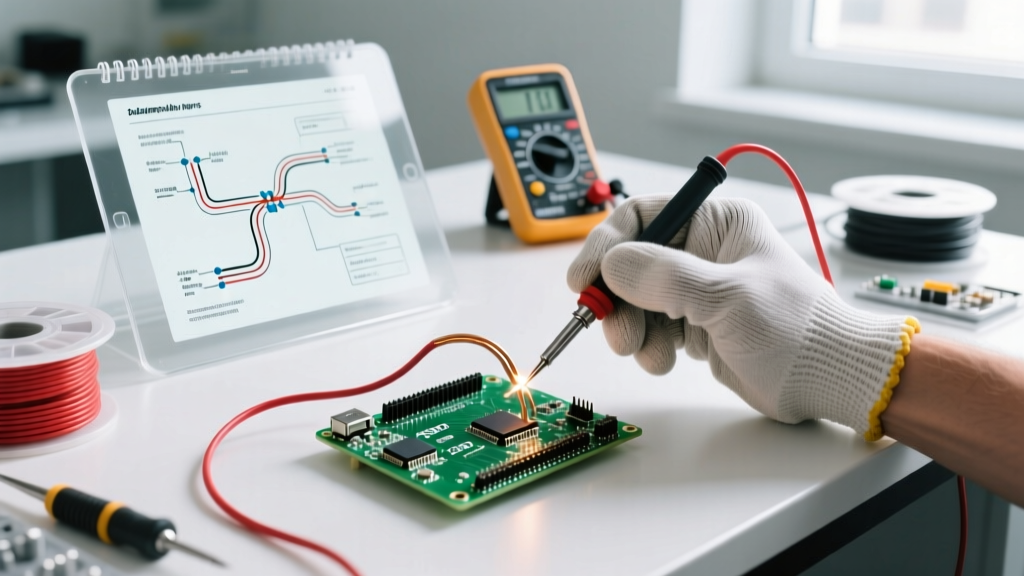

The Financial Reality of Solderability Testing in 2026
For electronics manufacturers and PCB assemblers, verifying component and board solderability is not merely a quality assurance checkbox; it is a critical financial shield. As the industry continues to navigate the tight process windows of lead-free alloys like SAC305 and SAC405, the IPC solderability test standard framework has become the definitive benchmark for incoming inspection. However, implementing these standards involves significant capital expenditure, ongoing operational costs, and complex logistical decisions.
Whether you are evaluating the purchase of a wetting balance tester, setting up a manual dip-and-look station, or outsourcing to an ISO 17025 accredited laboratory, understanding the true cost of compliance is essential for protecting your profit margins. This analysis breaks down the exact financial requirements of meeting modern solderability standards, providing a decision matrix for engineering managers and procurement teams.
Defining the Solderability Test Standard Framework
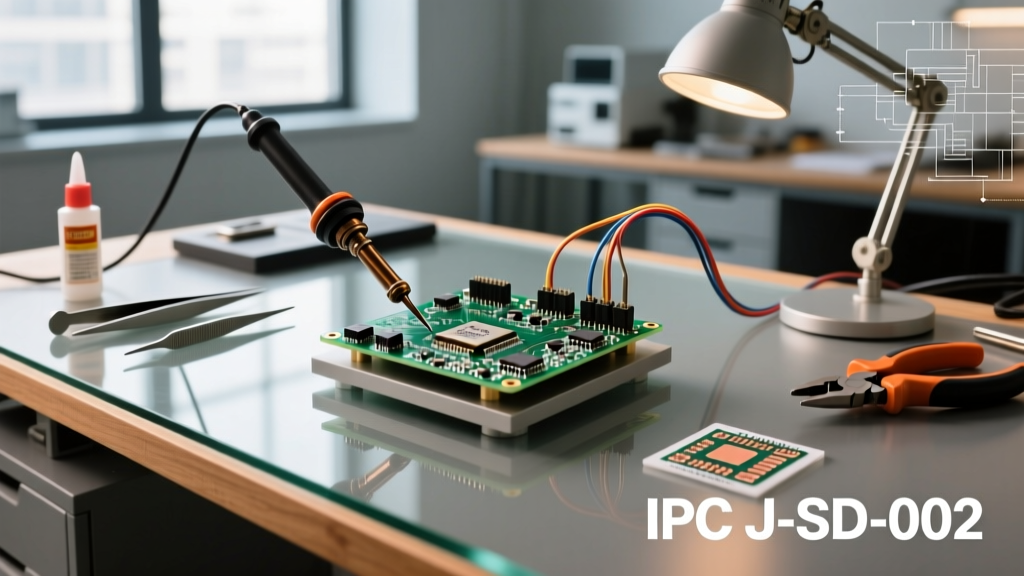
Before calculating costs, we must define the testing methodologies mandated by the primary standards. The two most dominant frameworks are IPC J-STD-003 (for printed boards) and IPC J-STD-002 (for component leads and terminations). Internationally, IEC 60068-2-69 governs the wetting balance method. These standards generally split testing into two distinct categories, each with different equipment and cost requirements:
- Dip and Look (Qualitative/Semi-Quantitative): The sample is fluxed, dipped into a static solder pot, and inspected under a microscope for coverage percentage (usually requiring >95% coverage for Class 3 products). This relies on visual inspection criteria outlined in NASA workmanship standards and IPC visual aids.
- Wetting Balance Testing (Quantitative): Measures the exact force and time it takes for molten solder to wet a component lead. It generates a precise meniscus force curve, providing hard data on wetting time (T0) and maximum wetting force (Fmax).
Furthermore, IPC standards require specific preconditioning, such as Test B (Steam Aging), which simulates prolonged warehouse storage by exposing components to steam for 8 hours prior to dipping. This requirement drastically alters the equipment footprint and cost.
Capital Expenditure: In-House Testing Equipment
Establishing an in-house solderability lab requires navigating a wide spectrum of equipment tiers. The choice between automated quantitative systems and manual qualitative setups dictates your initial CapEx.
Equipment Cost Matrix (2026 Estimates)
| Equipment Category | Model / Brand Example | Primary Standard Met | Approx. Cost (USD) | Best Application |
|---|---|---|---|---|
| Automated Wetting Balance | Rhesca SAT-5100 / Malcom ST-60 | IEC 60068-2-69, IPC J-STD-002 | $28,000 - $45,000 | High-reliability aerospace, medical, R&D |
| Automated Dip & Look Tester | Metcal STS-450 / PACE | IPC J-STD-003, J-STD-002 | $6,500 - $12,000 | Mid-to-high volume PCBA incoming inspection |
| Manual Solder Pot & Scope | Hakko FX-305 + AmScope Trinocular | Basic IPC visual criteria | $2,500 - $4,500 | Low-volume, consumer electronics, quick checks |
| Steam Aging Chamber | Alpha Metals / PACE Steam Ager | IPC Test B preconditioning | $3,500 - $6,000 | Required for simulating shelf-life degradation |
Note: For facilities targeting IPC Class 3 (high-reliability) compliance, the steam ager is not optional if you are performing Test B preconditioning. Failing to budget for this $5,000 peripheral is a common oversight that renders a basic dip-and-look station non-compliant for shelf-life verification.
Operational Expenses: Consumables, Dross, and Labor
The hidden costs of in-house solderability testing lie in the daily operational expenses. Molten solder degrades, fluxes expire, and technician time is expensive.
Consumable Costs
- Solder Alloys: A standard static solder pot holds 5 to 15 kg of solder. In 2026, SAC305 bar solder costs approximately $85 to $110 per kilogram. Initial pot fill for a 10kg bath costs roughly $1,000.
- Dross Management: Molten solder oxidizes rapidly. Without nitrogen blanketing, a standard pot can generate 1-2 kg of dross per week. While dross can be recycled, the net loss in usable alloy and the labor required for skimming adds $150 to $300 monthly in wasted material.
- Fluxes and Solvents: Testing requires specific non-activated rosin fluxes (e.g., Kester 331 or Alpha 859-D) to prevent the flux from masking poor solderability. These cost $80 to $150 per liter and have strict shelf lives.
Labor and Calibration
Running a compliant test is labor-intensive. A standard IPC J-STD-003 Test A and Test B sequence for a batch of PCBs requires preparation, steam aging (8 hours), dipping, cooling, cleaning, and microscopic evaluation. Expect to allocate 3 to 4 technician hours per batch. At a burdened labor rate of $45/hour, the labor cost per test cycle is $135 to $180. Additionally, wetting balance testers require bi-annual calibration by accredited metrology labs, costing $1,200 to $1,800 annually.
The Outsourcing Alternative: Third-Party Lab Costs
For low-to-medium volume manufacturers, outsourcing to an ISO/IEC 17025 accredited materials testing laboratory (such as EAG Laboratories or regional equivalents) often makes financial sense. Outsourcing eliminates CapEx, calibration overhead, and dross management.
Outsourcing Pricing Structure (2026):
- Standard Dip & Look (Test A): $150 - $250 per sample lot (up to 5 coupons).
- Steam Aged Dip & Look (Test B): $300 - $450 per sample lot.
- Wetting Balance Analysis: $400 - $600 per component type.
- Expedited Turnaround (48 hours): +50% surcharge.
While outsourcing protects capital, it introduces a logistical vulnerability. The standard turnaround time for third-party IEC and IPC standard testing is 7 to 14 days. If your incoming inspection relies on external labs, you must hold raw components in quarantine for two weeks before releasing them to the SMT line, tying up working capital and delaying time-to-market.
The Financial Impact of Non-Compliance and Failure
To justify the cost of a solderability testing program, one must quantify the cost of skipping it. The electronics manufacturing industry relies on the Rule of 10 to calculate defect costs. If a component with poor solderability (e.g., oxidized MLCC terminations) slips past incoming inspection, the cost to rectify the defect multiplies by a factor of 10 at each subsequent assembly stage.
- Component Level ($0.05): The cost of the defective capacitor itself.
- Board Level ($5.00): Cost to diagnose the tombstoning or non-wetting defect after reflow, plus the labor to desolder, clean the pad, and rework the component.
- System Level ($50.00): The board is integrated into a chassis. Rework now requires disassembly of the enclosure, risking damage to adjacent connectors and voiding thermal interface materials.
- Field Failure ($500.00+): The solder joint fractures under thermal cycling in the field. Costs now include RMA processing, return shipping, forensic failure analysis, and severe brand damage.
When a single reel of 3,000 microcontrollers with degraded lead finishes enters your SMT line, the resulting rework bottleneck can cost a mid-sized PCBA facility upwards of $25,000 in delayed shipments and scrapped stenciled paste. A $30,000 wetting balance tester pays for itself by intercepting just one such catastrophic batch.
ROI Framework: When to Build vs. Buy
Deciding between in-house testing and outsourcing requires a volume-based ROI calculation. Use the following framework to guide your capital allocation:
Scenario A: High-Mix, Low-Volume (HMLV) / Prototyping
Recommendation: Outsource or use a basic Manual Dip & Look setup.
Rationale: The frequency of testing does not justify a $40,000 wetting balance. Rely on supplier certificates of compliance (CoC) and perform random manual dip tests using a $3,000 Hakko solder pot and microscope for visual verification. Send critical aerospace components to a third-party lab.
Scenario B: High-Volume, Standard Commercial PCBA
Recommendation: In-house Automated Dip & Look + Steam Ager.
Rationale: At $12,000 to $18,000 total CapEx, an automated dip-and-look system allows technicians to rapidly process incoming PCB batches. The ROI is achieved within 8 months by eliminating third-party lab fees and reducing quarantine holding times from 14 days to 24 hours.
Scenario C: High-Reliability (Aerospace, Medical, Automotive)
Recommendation: In-house Wetting Balance + Full Preconditioning Lab.
Rationale: Visual inspection is insufficient for Class 3 mandates where quantitative wetting force data is required for lot traceability. The $45,000 investment is mandatory for compliance and provides the empirical data required for AS9100 and IATF 16949 audits.
Expert Strategies for Cost Optimization
If you are bringing solderability testing in-house, implement these specific strategies to minimize ongoing operational costs:
- Implement Nitrogen Blanketing: Installing a localized nitrogen shroud over your static solder pot reduces dross generation by up to 80%. The $1,500 cost of the shroud and nitrogen generator is recovered in less than six months through saved SAC305 bar solder.
- Standardize Test Coupons: For PCB testing, do not sacrifice entire production boards. Work with your bare-board fabricator to include standardized 1x2 inch breakaway test coupons on the panel rails. This allows you to perform destructive solderability testing without scrapping valuable populated PCBs.
- Batch Steam Aging: Steam aging requires 8 hours of continuous operation. Schedule steam ager runs overnight or over the weekend to ensure the 8-hour preconditioning is complete by the start of the Monday shift, eliminating daytime equipment bottlenecks.
Conclusion
Compliance with the IPC solderability test standard is a non-negotiable aspect of modern electronics manufacturing, but it does not have to be a financial black hole. By accurately forecasting the CapEx of quantitative versus qualitative equipment, managing dross and consumable OpEx, and understanding the exponential cost of field failures, engineering managers can build an incoming inspection strategy that guarantees reliability while protecting the bottom line.