
The Reality of Automotive Wiring: Material Compatibility
When soldering car wires, the harsh under-hood environment demands strict attention to material compatibility. Unlike static indoor electronics, automotive harnesses endure extreme thermal cycling (-40°C to 150°C), constant high-frequency vibration, and exposure to corrosive fluids. A solder joint that holds perfectly on a workbench can fracture within weeks inside an engine bay if the wrong alloy, flux, or insulation type is used.
This guide breaks down the metallurgical and chemical realities of automotive soldering, helping you select the exact wire insulations, solder alloys, and flux chemistries required for reliable 12V, 48V, and high-voltage EV repairs in 2026.
Wire Insulation Compatibility: TXL, GXL, and SXL
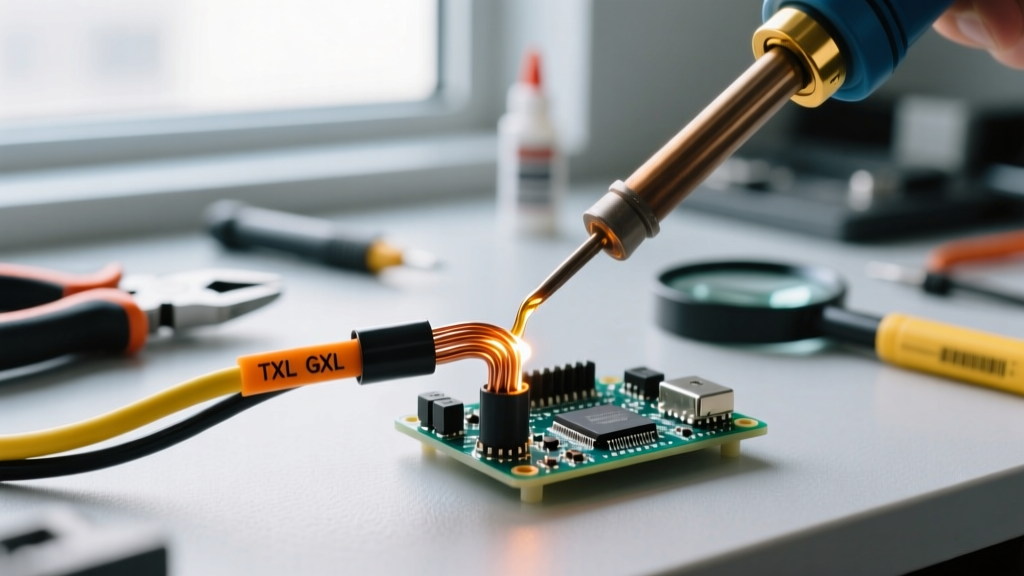
Modern vehicles rarely use standard PVC-insulated wire. Instead, OEMs specify Cross-Linked Polyethylene (XLPE) wires, designated as TXL, GXL, or SXL under the SAE J1128 standard. Understanding the thermal limits of these insulations is critical when applying a 350°C soldering iron.
| Wire Type | Insulation Material | Wall Thickness | Max Continuous Temp | Soldering Iron Contact Limit |
|---|---|---|---|---|
| TXL | XLPE | 0.41 mm (Thin) | 125°C | 2-3 seconds max |
| GXL | XLPE | 0.58 mm (General) | 125°C | 3-4 seconds max |
| SXL | XLPE | 0.79 mm (Special) | 125°C | 4-5 seconds max |
| Standard PVC | Polyvinyl Chloride | 0.80 mm | 105°C | Melts/shrinks rapidly |
The PVC Shrink-Back Problem
If you are repairing an older vehicle or an aftermarket accessory using PVC wire, be aware that PVC begins to soften at 85°C and melts around 105°C. When a soldering iron touches the copper strands, heat transfers rapidly down the wire, causing PVC insulation to melt and shrink back, exposing bare copper. XLPE (TXL/GXL) is chemically cross-linked, meaning it will char before it melts, making it vastly superior for soldering car wires. Always strip exactly 6mm to 8mm of insulation using a precision tool like the Knipex MultiStrip 10 to avoid nicking the copper strands, which creates stress risers.
Selecting the Right Solder Alloy for Automotive Systems
The vibration profile of a combustion engine or the thermal cycling of a 48V mild-hybrid system will quickly destroy the wrong solder alloy. You must choose between eutectic, non-eutectic, and lead-free alloys based on the specific application.
Alloy Comparison Matrix
| Alloy Designation | Composition | Melting Point | Plastic Phase? | Best Automotive Use Case |
|---|---|---|---|---|
| Sn63/Pb37 | 63% Tin / 37% Lead | 183°C (361°F) | No (Eutectic) | Engine bay sensors, high-vibration 12V harnesses |
| Sn60/Pb40 | 60% Tin / 40% Lead | 183°C - 190°C | Yes | Cabin electronics, low-vibration zones |
| SAC305 | 96.5% Sn / 3% Ag / 0.5% Cu | 217°C - 220°C | Yes | RoHS-compliant infotainment, EV battery management |
For soldering car wires in high-vibration areas, Sn63/Pb37 (Eutectic) is the undisputed champion. Because it is eutectic, it transitions instantly from liquid to solid at exactly 183°C. It has no "plastic phase" (a semi-solid state). If engine vibration shakes the wire while a non-eutectic alloy like Sn60/Pb40 or SAC305 is cooling through its plastic phase, the internal crystalline structure fractures, resulting in a cold joint that will eventually cause high resistance and voltage drop.
Recommended Product: Kester 24-6337-00273 (Sn63/Pb37, 3.3% No-Clean Flux Core, 0.031" diameter). Expect to pay around $38-$45 for a 1lb spool in 2026.
Flux Chemistry: Why Acid-Core Destroys Harnesses
A catastrophic mistake made by DIYers is using plumbing solder or acid-core flux on automotive wiring. Acid fluxes (typically zinc chloride or hydrochloric acid-based) are designed to etch copper pipes. When trapped inside stranded automotive wire, the acid wicks down the capillaries of the copper strands via capillary action.
Expert Warning: Acid flux causes rapid galvanic corrosion. Within months, the copper will turn into a brittle, green copper oxide powder, leading to an open circuit. Always use Rosin-Based (RA or RMA) or high-reliability No-Clean fluxes specifically formulated for electronics and automotive wiring.
The OEM Debate: Soldering vs. Open-Barrel Crimping
While soldering provides excellent electrical conductivity, it fundamentally alters the mechanical properties of stranded wire. Solder wicks into the strands, turning a flexible wire into a rigid, solid rod. The boundary where the flexible wire meets the rigid solder blob creates a severe stress concentration point. In high-vibration environments, the wire will fatigue and snap exactly at this junction.
This is why the IPC/WHMA-A-620 standard and major OEMs (Toyota, Ford, GM) heavily favor open-barrel crimping for primary harness connections. Crimping creates a cold-weld that maintains wire flexibility and withstands vibration far better than solder alone.
When is Soldering Acceptable in Vehicles?
- Low-Vibration Zones: Inside the cabin, under dashboards, or in trunk-mounted audio amplifiers.
- High-Current, Static Connections: Alternator output posts or heavy-gauge battery lugs (where mechanical strain is relieved by zip-ties or loom clamps).
- Emergency Field Repairs: When proper crimping tools (like a TE Connectivity CERTI-CRIMP) are unavailable, a soldered joint protected by adhesive-lined heat shrink is a viable temporary fix.
Step-by-Step: Soldering and Sealing High-Current Cables
If your material compatibility checks pass and you proceed to solder, follow this high-reliability workflow to ensure moisture ingress and vibration do not compromise the joint.
- Pre-Slide Heat Shrink: Always slide dual-wall, adhesive-lined heat shrink (e.g., 3M MFP-301 or SCL) onto the wire before stripping. Standard thin-wall PVC shrink will not seal against moisture.
- Strip and Interleave: Strip 8mm of insulation. For a lap joint, interleave the strands of both wires so they lay flat against each other, minimizing the bulk of the joint.
- Tin the Iron Tip: Clean your iron tip on brass wool and apply a fresh coat of Sn63/Pb37 solder. Set the station to 340°C (644°F) for 18-20 AWG wire, or 380°C (716°F) for 12-14 AWG wire to ensure rapid heat transfer.
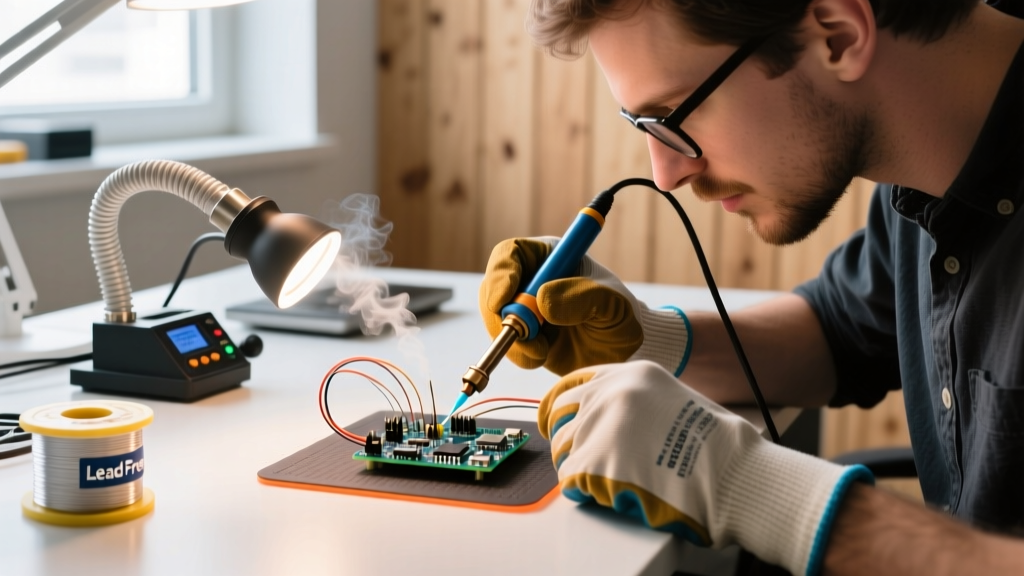
- Apply Heat, Then Solder: Touch the iron to the copper wire, not the solder. Heat the wire for 2 seconds, then feed the flux-core solder into the wire strands (away from the iron tip) until it wicks fully through the strands. The joint should look shiny and concave.
- Seal with Adhesive Shrink: Slide the dual-wall heat shrink over the joint. Use a hot air gun (set to 250°C) starting from the center and moving outward. The inner polyamide adhesive layer must melt and squeeze out slightly at the edges, creating a waterproof IP67-rated seal.
High-Voltage EV Warning: 400V and 800V Architectures
As of 2026, the proliferation of 800V EV architectures (found in modern Porsche, Hyundai, and Lucid platforms) has introduced thick, orange-shielded high-voltage cables. Never solder high-voltage EV traction cables. The thermal mass of these 2/0 AWG or larger cables requires massive heat, which will destroy the specialized silicone and cross-linked insulation. Furthermore, solder joints cannot handle the extreme thermal expansion cycles of battery inverters. These cables must be terminated using specialized hex-crimp dies and torqued to exact OEM specifications using insulated, VDE-certified torque wrenches. For high-voltage systems, refer to NASA-STD-8739.4 crimping guidelines adapted for aerospace and heavy-duty EV applications.
Summary: The Compatibility Checklist
Before applying heat to any automotive harness, verify the following:
- Insulation: Is it XLPE (TXL/GXL) or PVC? Adjust iron dwell time accordingly.
- Alloy: Are you using Sn63/Pb37 for high-vibration areas to avoid plastic-phase cold joints?
- Flux: Is it strictly Rosin or No-Clean? (Zero acid allowed).
- Mechanical Relief: Will the joint be subjected to bending? If yes, abandon soldering and use an open-barrel crimp.
- Sealing: Are you using adhesive-lined, dual-wall heat shrink to prevent capillary water ingress?
By respecting the metallurgical limits of your solder and the thermal thresholds of your wire insulation, you can execute automotive wiring repairs that rival factory OEM durability.