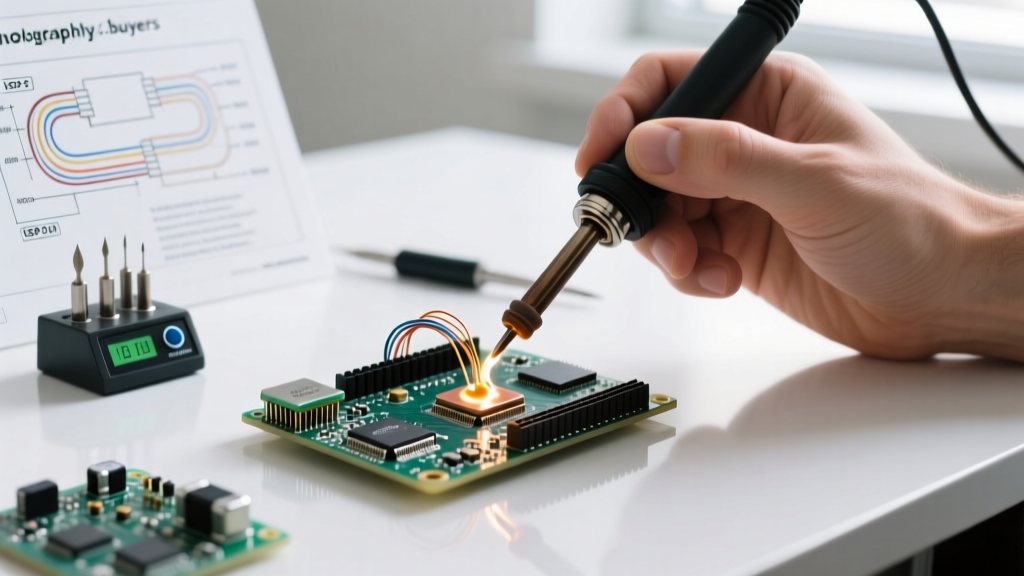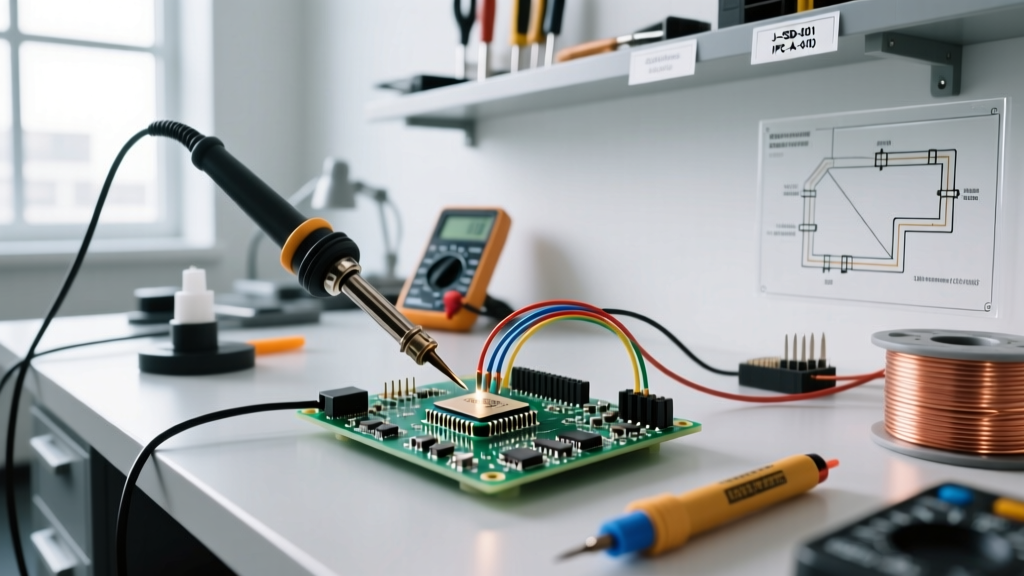

The Great Divide in Electronics Manufacturing Credentials
Navigating the professional electronics manufacturing sector requires more than just a steady hand and a high-end Weller WX2021 soldering station. For technicians, inspectors, and engineers, obtaining a formal soldering certification is the definitive dividing line between hobbyist assembly and aerospace-grade reliability. However, when employers or defense contractors request 'IPC certification,' they are rarely referring to a single monolithic test. Instead, they are pointing toward one of two distinct, highly specialized tracks governed by the Association Connecting Electronics Industries (IPC).
The two dominant pillars of the IPC ecosystem are IPC J-STD-001 (Requirements for Soldered Electrical and Electronic Assemblies) and IPC-A-610 (Acceptability of Electronic Assemblies). Choosing the wrong path can result in wasted training budgets and delayed project clearances. In this comprehensive comparison, we break down the exact methodologies, testing formats, and 2026 career applications for both certifications to help you make an informed decision.
The Core Philosophical Difference: Process vs. Inspection
The easiest way to understand the divide is to look at the fundamental purpose of each standard. J-STD-001 is a process standard. It dictates how to prepare, flux, and solder components to achieve a reliable metallurgical bond. IPC-A-610 is a visual inspection standard. It dictates what the final product should look like and provides the photographic criteria to accept or reject a joint after the fact.
Industry Rule of Thumb: If your daily job involves holding the iron, stripping wires, and applying SAC305 solder paste, you need J-STD-001. If your job involves looking through a 10x-30x stereo microscope to sign off on a completed PCB before it goes to conformal coating, you need IPC-A-610.
Deep Dive: IPC J-STD-001 (The Builder's Standard)
The J-STD-001 Certified IPC Specialist (CIS) credential is the gold standard for hands-on soldering operators. The curriculum is heavily focused on the metallurgy of soldering, flux chemistry, and the physical mechanics of creating intermetallic compounds (IMC).
Curriculum and Modules
The standard 4-day (32-hour) CIS course is broken down into mandatory and elective modules. As of the current Revision H guidelines, the structure includes:
- Module 1 (Mandatory): General requirements, soldering materials, and ESD (Electrostatic Discharge) safety protocols.
- Module 2 (Elective): Wire preparation, including stripping, tinning, and handling of shielded cables.
- Module 3 (Elective): Soldering to terminals (turret, bifurcated, and pierce terminals).
- Module 4 (Elective): Plated Through Hole (PTH) technology, focusing on barrel fill requirements and wetting angles.
- Module 6 (Elective): Surface Mount Technology (SMT), covering 0805 down to 0201 metric chip components and fine-pitch QFPs.
The Practical Examination
The J-STD-001 practical exam is notoriously rigorous. Candidates are given a blank 'test vehicle' PCB and a kit of components. You must physically build the assembly within a strict 4-to-6-hour window using provided equipment (typically Hakko FX-951 or Metcal MX-5200 stations). Instructors grade your board on barrel fill percentages (e.g., 75% minimum for Class 3), wetting angles (must be less than 90 degrees), and the absence of flux residue violations. According to IPC's official standards documentation, failure to meet the strict Class 3 criteria on even a single critical PTH joint results in a failed practical.
Deep Dive: IPC-A-610 (The Inspector's Standard)
IPC-A-610 is the most widely used electronic assembly inspection standard in the world. The CIS training for this standard does not teach you how to solder; it teaches you how to judge the work of others using a highly specific visual vocabulary.
Target, Acceptable, Process Indicator, Defect
The A-610 curriculum trains inspectors to categorize every solder joint and component placement into one of four distinct conditions:
- Target: The ideal, perfect joint (rarely required, but always the goal).
- Acceptable: The joint meets the minimum requirements for reliability and will pass inspection.
- Process Indicator: An anomaly that does not affect form, fit, or function (e.g., slight discoloration on a lead). It passes, but triggers a process review.
- Defect: A condition that compromises the reliability of the assembly and mandates rework or scrap.
The Practical Examination
Unlike the J-STD-001 physical build, the A-610 practical is a visual gauntlet. Candidates are handed a 'golden/silver' board pre-loaded with 50 to 100 intentional defects and process indicators. Using magnification tools and the IPC-A-610 manual, you must identify, categorize, and document every anomaly within a 2-hour time limit. Missing a hidden cold solder joint on the underside of a QFP package or misclassifying a tombstoned capacitor will cost you critical points.
Head-to-Head Comparison Matrix
| Feature | IPC J-STD-001 CIS | IPC-A-610 CIS |
|---|---|---|
| Primary Focus | Soldering process, materials, and physical assembly | Visual inspection, defect identification, and acceptance criteria |
| Ideal Role | Soldering Technician, Rework Operator, Assembler | Quality Assurance Inspector, Test Engineer, QC Manager |
| Practical Exam | Physical soldering of a test vehicle PCB (4-6 hours) | Visual inspection of a pre-defected board (2 hours) |
| Tools Used in Test | Soldering iron, flux, tweezers, wire strippers | Stereo microscope, magnification lamp, inspection mirror |
| Course Duration | 4 Days (32 Hours) | 4 Days (32 Hours) |
| 2026 Avg. Cost | $950 - $1,400 USD | $950 - $1,400 USD |
Understanding the Product Classes (1, 2, and 3)
Both certifications require you to declare a 'Product Class' during your training and examination. This dictates the strictness of the criteria you will be tested against. High-reliability sectors, such as those governed by NASA's Electronic Parts and Packaging (NEPP) Program, strictly mandate Class 3 compliance.
- Class 1 (General Electronic Products): Items where the primary requirement is function. Examples include consumer toys, basic LED flashlights, and disposable electronics. Solder joints must be functional, but cosmetic perfection is not required.
- Class 2 (Dedicated Service Electronic Products): Products where extended life and uninterrupted performance are required, but not life-critical. Examples include laptops, telecommunications routers, and automotive infotainment systems.
- Class 3 (High-Performance Electronic Products): Equipment where failure cannot be tolerated. Examples include medical life-support systems, aerospace flight computers, and military radar. Class 3 requires 75% to 100% barrel fill on PTH joints and zero tolerance for solder splashes or wetting angle violations.
2026 Logistics: Costs, Validity, and Recertification
As of 2026, the financial and temporal investment for a Certified IPC Specialist (CIS) credential remains significant. A standard 4-day public enrollment course through an Authorized Training Center (ATC) typically ranges from $950 to $1,400 USD, which includes the mandatory IPC manual (priced around $150 on its own), materials, and testing fees.
Crucially, both certifications expire after 24 months. To maintain your active status without retaking the full 4-day course, you must complete a 1-day (8-hour) recertification class and pass a shortened written and practical exam before your expiration date. If you let your certification lapse by even one day, you are forced to retake the entire 32-hour initial course from scratch—a costly mistake that many technicians make due to poor calendar management.
Advanced Add-Ons: The Space Addendum
For those working in satellite manufacturing or deep-space probes, standard Class 3 is often insufficient. Both J-STD-001 and IPC-A-610 offer a 'Space Applications Addendum' (often denoted with an 'S', such as J-STD-001S). This addendum incorporates NASA-STD-8739.3 requirements, introducing extreme criteria for wire wrapping, specific solder alloy restrictions (like banning pure tin to prevent tin whiskers), and rigorous cleanliness testing for ionic contamination.
The Decision Framework: Which Path Should You Take?
Do not rely on guesswork when requesting training budget approval from your employer. Use this framework to determine the correct soldering certification path:
Choose IPC J-STD-001 If:
- You are the person physically holding the soldering iron or managing the reflow oven profile.
- You are transitioning from prototype bench work to high-volume or high-reliability production floor assembly.
- Your company's quality manual explicitly references 'process compliance' rather than just 'end-stage inspection'.
Choose IPC-A-610 If:
- You work in Quality Assurance (QA), Quality Control (QC), or as a Final Test Inspector.
- Your primary tools are magnification loupes, microscopes, and automated optical inspection (AOI) validation.
- You are responsible for signing the traveler documents that release a PCB assembly to the customer or the next manufacturing stage.
Final Thoughts on Career Progression
While J-STD-001 and IPC-A-610 are distinct, they are highly complementary. The most valuable technicians in the aerospace and medical device sectors often hold both credentials. Understanding how to build a joint to J-STD-001 specifications makes you a vastly superior inspector when using IPC-A-610 criteria, as you understand the root cause of the defects you are finding. Conversely, inspectors who understand A-610 visual targets make better soldering operators because they can self-correct their technique in real-time before a joint cools and solidifies into a defect.