
The Science of Desoldering: Why Material Compatibility Matters
In the intricate world of PCB rework and repair, a soldering braid (often called desoldering wick) is not merely a consumable; it is a precision metallurgical tool. As we navigate the electronics manufacturing landscape in 2026, the shift toward complex lead-free alloys, ultra-fine-pitch components, and fragile surface finishes demands a rigorous understanding of material compatibility. Using the wrong braid chemistry or weave geometry can result in catastrophic pad lifting, nickel barrier destruction, or hidden flux-induced corrosion.
This comprehensive guide breaks down the material science of soldering braids, matching copper metallurgy, flux chemistries, and physical dimensions to specific PCB pad finishes and solder alloys. Whether you are reworking a legacy through-hole board or performing micro-BGA salvage on a modern HDI smartphone motherboard, mastering these compatibilities is non-negotiable for IPC-compliant results.
The Golden Rule of Desoldering: A soldering braid does not 'suck' solder via vacuum. It relies on capillary action driven by surface tension and flux chemistry. If the braid's flux is incompatible with the pad's oxidation layer, or if the copper weave's thermal mass exceeds your iron's recovery rate, capillary action fails, leading to mechanical pad damage.
Copper Weave Metallurgy: Bare vs. Pre-Fluxed Braid
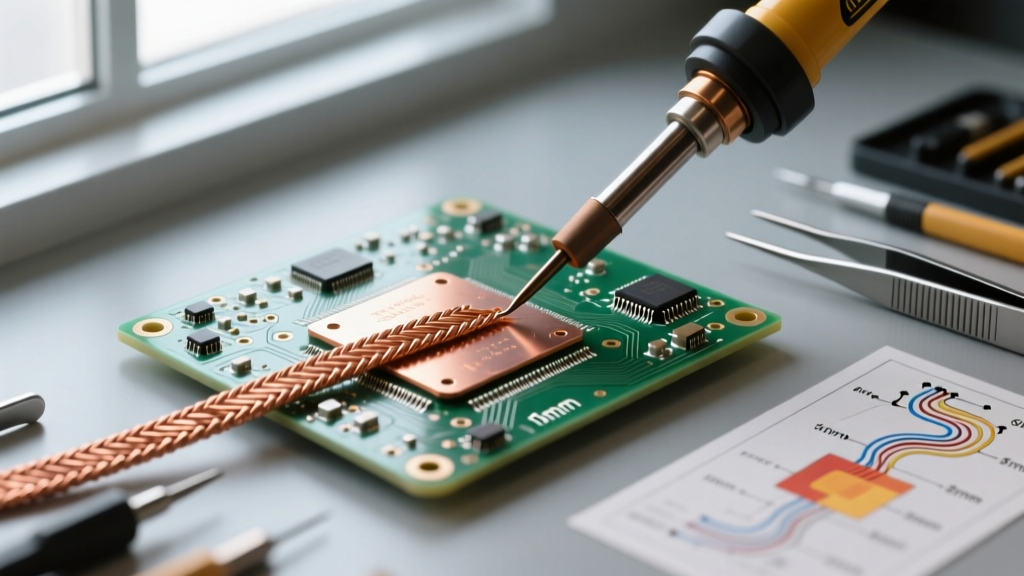
The base material of almost all high-quality soldering braids is Oxygen-Free High Conductivity (OFHC) copper. The geometric weaving of this copper creates the microscopic capillaries required to draw molten solder. However, the surface treatment of this copper dictates its application.
Bare (Unfluxed) Copper Braid
- Composition: Pure OFHC copper with no chemical coatings.
- Best Use Case: Environments where outgassing or flux residue is strictly prohibited, such as aerospace vacuum chambers or high-voltage RF cavities.
- Compatibility: Requires the manual application of liquid or paste flux to the PCB pad before use. Never use bare braid directly on a dry pad; the copper will oxidize instantly upon contact with the iron, fusing to the pad and tearing it off the FR4 substrate.
Pre-Fluxed Copper Braid
- Composition: OFHC copper pre-impregnated with a specific flux chemistry (Rosin, RMA, or No-Clean).
- Best Use Case: 95% of commercial, industrial, and consumer electronics rework.
- Compatibility: The flux lowers the surface tension of the molten solder and dissolves metal oxides, allowing the copper weave to absorb the alloy seamlessly. The specific flux type must match the board's cleaning protocol and environmental requirements.
Flux Chemistry Compatibility Matrix
Selecting the correct flux core within your soldering braid is critical for maintaining the integrity of the PCB and ensuring compliance with standards like IPC J-STD-001. Below is a compatibility matrix for the three primary flux types used in modern braids.
| Flux Type | Chemical Base | Activity Level | Residue Profile | Ideal PCB Application | Cleaning Required? |
|---|---|---|---|---|---|
| Rosin (R) | Pure pine rosin | Low | Hard, non-conductive, non-corrosive | Bare copper, high-impedance analog circuits, legacy boards | No (but often cleaned for aesthetics) |
| RMA (Rosin Mildly Activated) | Rosin + mild organic acids (e.g., adipic acid) | Medium | Tacky, slightly corrosive if left in high humidity | Slightly oxidized HASL pads, through-hole rework, military/aerospace | Yes (Mandatory for high-reliability) |
| No-Clean (NC) | Synthetic resins + halogen-free activators | Low-Medium | Minimal, clear, benign, non-conductive | Dense SMT, BGA rework, HDI boards, modern consumer electronics | No (Designed to remain on board) |
Solder Alloy Matching: Leaded vs. Lead-Free vs. Low-Temp
The thermal mass and wetting characteristics of your soldering braid must align with the liquidus temperature of the solder alloy you are removing. In 2026, technicians routinely encounter three distinct alloy families.
1. Standard Leaded (Sn63/Pb37 or Sn60/Pb40)
Melting at a eutectic 183°C, leaded solder wets easily and flows rapidly. Standard RMA or No-Clean braids with a medium weave density work perfectly here. A standard 60W-80W temperature-controlled iron set to 320°C provides optimal heat transfer without scorching the flux.
2. Lead-Free (SAC305 / SAC405)
SAC305 (Sn96.5/Ag3.0/Cu0.5) melts between 217°C and 220°C. It exhibits poor wetting compared to leaded solder and forms stubborn tin-oxide layers. Compatibility Rule: You must use a braid with a highly activated No-Clean or RMA flux to break the tin oxides. Furthermore, because SAC alloys require higher iron temperatures (350°C-380°C), use a braid with a slightly looser weave to prevent rapid flux burnout before the solder reaches liquidus.
3. Low-Temperature Bismuth-Tin (Sn42/Bi57)
Increasingly popular in 2026 for eco-friendly consumer devices and server modules, BiSn melts at just 138°C. Compatibility Rule: Standard braids often fail here because the iron temperature required to activate standard RMA fluxes (usually >150°C) vastly exceeds the alloy's melting point, causing thermal shock to delicate components. Use specialized low-temperature synthetic flux braids and keep your iron dialed down to 180°C.
Pad Finish Vulnerabilities and Braid Selection
The surface finish of the PCB pad dictates how aggressively you can apply a soldering braid. Different finishes have vastly different mechanical and thermal tolerances.
ENIG (Electroless Nickel Immersion Gold)
ENIG features a microscopically thin gold flash (2-4 microinches) over a nickel barrier. The gold dissolves into the solder joint during initial assembly. When desoldering, the braid is actually interacting with the nickel layer. Risk: If you use a highly activated RMA braid and press down hard with a 380°C iron, you can scrub through the nickel barrier, exposing the raw copper beneath. This ruins the pad's solderability. Solution: Use a soft, low-activation No-Clean braid and rely on capillary action rather than mechanical pressure.
OSP (Organic Solderability Preservative)
OSP is an ultra-thin organic layer (0.2-0.5 microns) that protects bare copper. It is incredibly fragile. Risk: Any soldering braid will instantly strip the OSP coating. Once stripped, the bare copper will oxidize within seconds under the heat of the iron. Solution: Pre-tin the pad with fresh leaded or SAC solder and liquid flux before applying the braid. This 'sacrificial' solder layer protects the copper while the braid absorbs the bulk of the joint.
HASL (Hot Air Solder Leveling)
HASL pads are coated with a thick layer of solder (either leaded or lead-free). They are robust and forgiving. Solution: You can use aggressive RMA braids and apply moderate mechanical pressure without fear of destroying the underlying pad structure.
Width and Thickness Sizing Guide
Using a braid that is too wide acts as a massive heat sink, pulling thermal energy away from the joint and causing 'thermal shadowing.' Using a braid that is too narrow requires multiple passes, increasing the total thermal dwell time on the pad. Match the braid width to the pad geometry:
- #1 (White / 0.6mm / 0.025 inch): Essential for 0402 and 0603 SMD components, 0.5mm pitch QFPs, and micro-BGA pad clearing. Requires a micro-pencil iron tip.
- #2 (Yellow / 1.5mm / 0.060 inch): The universal workhorse. Ideal for 0805, 1206, SOICs, and standard 1.0mm pitch through-hole vias.
- #3 (Green / 2.5mm / 0.098 inch): Used for DPAK/D2PAK components, large DIP IC pins, and moderate ground plane connections.
- #4 (Blue / 3.3mm / 0.130 inch): Reserved for heavy power lugs, thick multilayer ground planes, and large RF shielding cans. Requires a high-wattage (100W+) iron with a chisel tip to maintain thermal equilibrium.
Real-World Failure Modes and Edge Cases
Even with the right materials, improper technique leads to specific failure modes. Understanding these edge cases separates novices from master technicians.
Failure Mode 1: Wick Starvation and Pad Lift
The Scenario: You place the braid over the joint, apply the iron, and press down. The braid turns black, sticks to the pad, and rips the copper trace off the board when pulled away.
The Cause: 'Wick starvation.' The flux in the braid burned off or was insufficient to cover the entire contact area. The bare, oxidized copper of the braid fused to the oxidized copper of the pad via solid-state diffusion.
The Fix: Never press down hard. Let the weight of the iron do the work. If the braid turns black or fails to absorb solder within 3 seconds, remove it, cut off the spent section, and apply fresh liquid flux to the pad.
Failure Mode 2: Flux Boil-Over and Solder Splatter
The Scenario: Upon heating, the flux violently boils, spitting microscopic spheres of solder across the PCB, potentially shorting adjacent fine-pitch components.
The Cause: Using a braid with a high-solvent liquid flux on a board that has trapped moisture, or applying an iron that is vastly overheated (>400°C) causing instantaneous vaporization of the flux activators.
The Fix: Pre-heat the board to 80°C-100°C using a bottom-side preheater to drive off ambient moisture. Lower the iron temperature to the 320°C-350°C range and use a No-Clean braid with a slower-activating synthetic resin profile.
Top 2026 Braid Recommendations by Application
Based on current market availability and consistent metallurgical quality, here are the industry-standard soldering braids for specific rework scenarios:
- Chemtronics Soder-Wick (No-Clean #2 & #3): The undisputed industry standard for general SMT and through-hole rework. Their proprietary synthetic flux leaves a virtually invisible residue that passes standard SIR (Surface Insulation Resistance) testing without cleaning. Expect to pay around $7 to $9 per 5-foot spool. For deep technical specifications, refer to the Chemtronics technical documentation.
- MG Chemicals No-Clean Desoldering Wicks: An excellent, cost-effective alternative that features a highly consistent copper weave density. Particularly effective on SAC305 lead-free joints due to their aggressive wetting agents. Typically priced between $6 and $8 per spool. View their full desoldering wick lineup for specific flux variants.
- Hakko CP Series (Bare & RMA): Hakko's CP braids feature a unique 'corrugated' copper weave that increases surface area, improving capillary action on massive ground planes. Their RMA variant is highly recommended for military and aerospace rework where IPC J-STD-001 Class 3 compliance is mandatory.
Conclusion: Precision is in the Details
Treating a soldering braid as a generic commodity is a fast track to ruined PCBs and scrapped components. By carefully matching the copper weave geometry, flux chemistry, and thermal profile of your braid to the specific solder alloy and pad finish of your board, you transform desoldering from a destructive necessity into a precise, controlled science. Stock your lab with a variety of widths and flux types, respect the thermal limits of modern ENIG and OSP finishes, and always prioritize capillary action over mechanical force.