
The Metallurgy of a Reliable Soldered Wire Joint
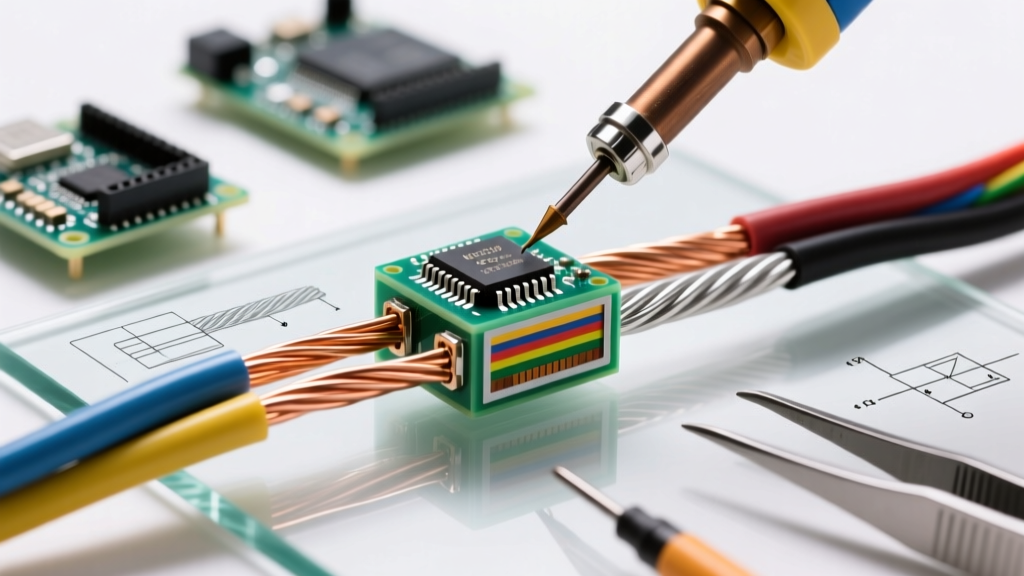
Creating a robust soldered wire connection is not merely about melting alloy onto a conductor; it is a complex metallurgical process governed by material compatibility, surface oxidation, and intermetallic compound (IMC) formation. When evaluating a soldered wire joint, the fundamental requirement is that the base metal must be capable of forming a stable IMC layer with the solder alloy. In 2026, as lead-free assemblies continue to dominate high-reliability sectors, understanding the exact chemical and thermal compatibility between your wire metal and your chosen flux/alloy pairing is critical for preventing field failures.
This material compatibility guide breaks down which wire metals readily accept solder, which require specialized chemical activation, and which should never be soldered under standard IPC guidelines.
Tier 1: Highly Compatible Wire Metals
These metals readily form intermetallic bonds with standard tin-based alloys using mildly activated rosin (RMA) or modern no-clean (NC) fluxes. They are the standard for 95% of all electrical and electronic wiring applications.
Copper (Bare and Tinned)
Bare copper is the universal baseline for soldered wire terminations. When heated with Sn63/Pb37 or SAC305 (Tin/Silver/Copper) alloys, copper rapidly forms a Cu6Sn5 intermetallic layer, followed by a slower-growing Cu3Sn layer. For optimal joint reliability, the total IMC thickness should remain between 1 and 3 microns; exceeding this via excessive dwell time makes the joint brittle.
- Recommended Flux: Kester 44 (RMA) or Alpha Metals NC-500 (No-Clean).
- Thermal Profile: 350°C for leaded, 380°C for SAC305. Dwell time strictly under 3 seconds for 22 AWG to prevent insulation melt-back.
- 2026 Market Note: SAC305 wire solder has stabilized at approximately $55 to $75 per pound due to fluctuating silver spot prices, while Sn63/Pb37 remains around $35 to $45 per pound.
Silver-Plated Copper
Often used in aerospace and high-temperature environments, silver-plated wire prevents the underlying copper from oxidizing. Silver dissolves into the tin matrix rather than forming a traditional IMC, which can lead to 'silver leaching' if the dwell time is too long or if the solder alloy lacks its own silver content. Always use a silver-bearing alloy like SAC305 or Sn62/Pb36/Ag2 to saturate the molten pool and protect the wire's plating.
Tier 2: Moderate Compatibility (Requires Specific Prep)
These metals can be soldered, but their native oxide layers or slow IMC formation rates require aggressive flux chemistry or specialized thermal profiling.
Nickel and Constantan
Nickel is frequently used in thermocouple wires and battery tab interconnects. Unlike copper, nickel forms a Ni3Sn4 intermetallic layer, which grows significantly slower and requires higher activation energy to initiate wetting. Standard no-clean fluxes often fail to break through nickel's passivation layer.
- Required Chemistry: You must use a fully activated rosin flux (RA) or a specialized water-soluble organic acid (OA) flux to achieve initial wetting.
- Failure Mode: If the flux is insufficient, the solder will 'ball up' on the nickel surface (non-wetting), resulting in a zero-strength mechanical wrap rather than a metallurgical bond.
Phosphor Bronze and Beryllium Copper
Common in spring contacts and flexible wire braids, these alloys contain elements that rapidly oxidize when heated. They require pre-tinning with a high-activity flux before the final soldered wire joint is made. Attempting to solder them directly to a terminal in a single step usually results in a cold, granular joint.
Tier 3: Incompatible Metals (Without Specialized Chemistry)
Standard electronics soldering processes are entirely ineffective on these metals. Attempting to create a soldered wire joint with these materials using standard rosin flux will result in immediate mechanical failure.
Aluminum
Aluminum wire is notoriously hostile to standard soldering. The moment bare aluminum is exposed to air, it forms a layer of aluminum oxide (alumina). While aluminum melts at 660°C, alumina melts at over 2,072°C. Standard fluxes cannot dissolve this ceramic-like shell.
To solder aluminum wire, you must use a specialized fluoroaluminate-based flux (such as Superior Flux #30261) and mechanically abrade the wire surface through the flux pool using a soldering iron tip or fiberglass pen. Even then, the resulting joint is highly susceptible to galvanic corrosion if exposed to moisture, making crimping the vastly superior termination method for aluminum conductors.
Nichrome (Nickel-Chromium)
Used in heating elements and high-resistance wire, the chromium in Nichrome forms an incredibly stable, impenetrable oxide layer. Standard soldering is impossible. Creating a soldered wire joint on Nichrome requires specialized active solders containing trace amounts of titanium or indium, combined with ultrasonic soldering irons that use cavitation to shatter the oxide layer in real-time.
Wire Material Compatibility Matrix
| Wire Base Metal | Oxidation Rate | Recommended Flux Type | Optimal Solder Alloy | Joint Reliability |
|---|---|---|---|---|
| Bare Copper | Moderate | RMA or No-Clean | Sn63/Pb37 or SAC305 | Excellent |
| Tinned Copper | Very Low | No-Clean (Low-Solids) | Sn63/Pb37 or SAC305 | Excellent |
| Silver-Plated | Low | RMA or No-Clean | SAC305 (Ag-bearing) | Excellent |
| Nickel | High (Passivates) | RA or Water-Soluble (OA) | SAC305 or Sn96.5/Ag3.5 | Good (with proper prep) |
| Aluminum | Instant (Ceramic) | Fluoroaluminate (Specialty) | Sn60/Pb40 or Zn-based | Poor (Crimp preferred) |
| Nichrome | Extreme | Ultrasonic / Active Flux | Indium-Tin active alloys | Unreliable (Spot-weld preferred) |
Flux Selection and Thermal Profiling for Wire Joints
The compatibility between your wire metal and your solder is entirely mediated by your flux. In modern electronics manufacturing, the shift toward no-clean fluxes has introduced new challenges for wire terminations. No-clean fluxes possess lower solid content and lower activation temperatures than traditional water-soluble acids. When working with heavily oxidized copper wire or Tier 2 metals, a no-clean flux may exhaust its activators before the wire reaches the liquidus temperature of the solder, resulting in a dewetted joint.
Expert Tip: When hand-soldering a soldered wire joint to a heavy ground plane or large terminal lug, the thermal mass of the terminal will act as a heat sink. Apply the iron to the terminal first, feed a small amount of flux-core solder to the terminal to create a thermal bridge, and then introduce the wire. This prevents the flux inside the wire's solder core from burning off before the wire itself reaches wetting temperature.
Common Failure Modes in Material-Mismatched Joints
Understanding how incompatible materials fail is crucial for quality control and troubleshooting in the field.
- Non-Wetting: The solder refuses to spread over the wire, forming distinct beads with a high contact angle (>90°). This occurs when the flux fails to remove the base metal oxide, commonly seen when attempting to solder aluminum or heavily tarnished nickel with standard rosin.
- Dewetting: The solder initially wets the wire but then retracts into islands, exposing the underlying metal. This is a classic symptom of silver leaching on silver-plated wire when using a tin-lead alloy lacking silver content, or when the iron temperature exceeds 420°C, destroying the flux chemistry.
- Brittle IMC Fracture: The joint looks visually perfect but snaps under minor mechanical vibration. This occurs when excessive heat (dwell time >5 seconds) causes the Cu6Sn5 intermetallic layer on a copper wire to grow beyond 4 microns, transforming the joint from a ductile bond into a brittle, glass-like ceramic interface.
Industry Standards for Wire Terminations
For high-reliability applications, material compatibility is strictly governed by industry workmanship standards. According to IPC J-STD-001 (Requirements for Soldered Electrical and Electronic Assemblies), a soldered wire joint must exhibit complete wetting, a smooth continuous fillet, and no evidence of disturbed or cold grain structures. For Class 3 products (life-support, aerospace), the wire must be securely wrapped or seated in a terminal before soldering; the solder itself cannot be relied upon to provide mechanical strain relief.
Similarly, NASA-STD-8739.3 explicitly forbids the soldering of incompatible metals like aluminum in spaceflight hardware, mandating crimping or ultrasonic welding instead. Furthermore, the NASA standard dictates that stranded wire must never be 'pre-tinned' (dipped in a solder pot) prior to being inserted into a crimp barrel or terminal screw, as the cold flow of the solder alloy under mechanical pressure will lead to a loose, high-resistance connection over time.
Ultimately, the success of a soldered wire joint relies on matching the correct metallurgy with the appropriate chemical activators and thermal limits. By respecting the oxide layers and IMC growth rates of your specific wire material, you ensure long-term electrical conductivity and mechanical resilience.