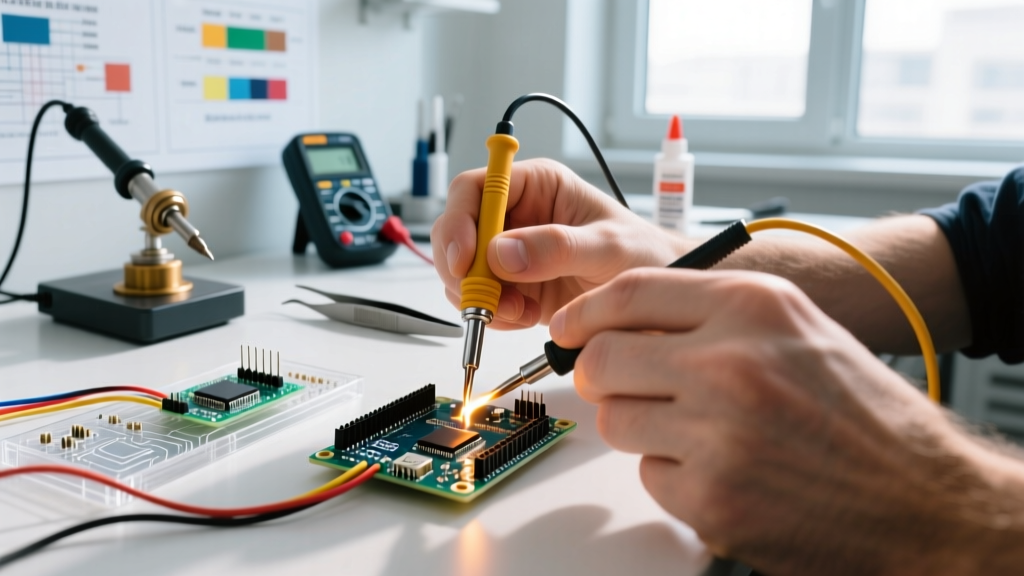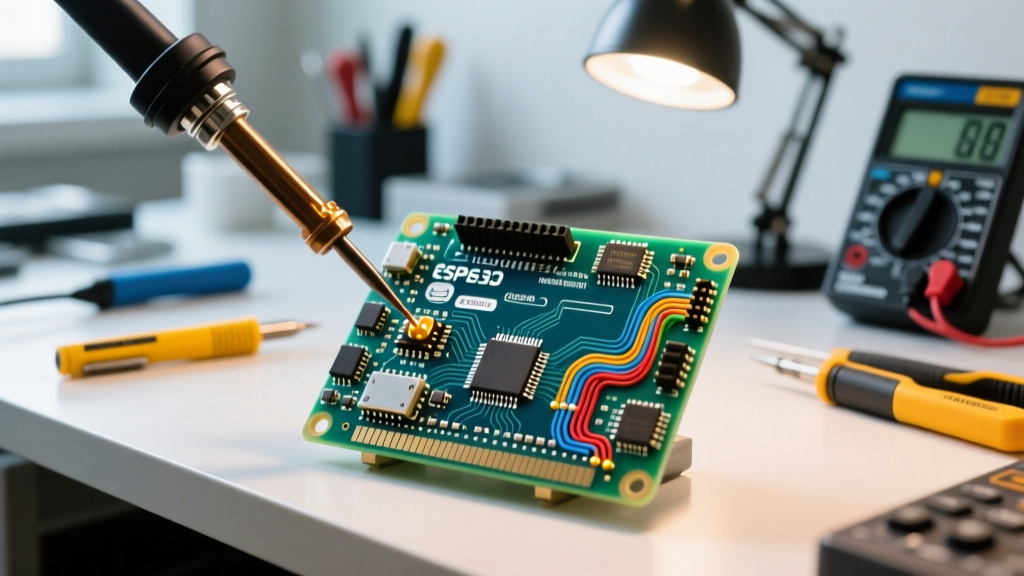

The Problem with 'Soldered' in Technical Documentation
When writing technical documentation, patent applications, or international Bills of Materials (BOMs) in 2026, the word 'soldered' is often too broad. In the electronics manufacturing and metallurgical industries, precision in language prevents costly assembly errors. If a schematic calls for a 'soldered' connection, does that mean a reflowed surface-mount joint, a hand-soldered through-hole lead, or a high-temperature brazed RF shield? To answer this, we conducted an expert roundup, consulting IPC-certified trainers, metallurgical engineers, and PCB fabrication specialists to compile the definitive guide on every 'soldered synonym' used in modern engineering.
Using the correct terminology is not just about semantics; it dictates the thermal profile, flux chemistry, and inspection criteria required for the joint. Below, our panel of experts breaks down the precise synonyms for soldering based on industry context, metallurgical reality, and quality assurance standards.
Expert Roundup: Context-Driven Synonyms for Soldering
1. PCB Assembly & Microelectronics (The 'Reflow' Experts)
In modern PCBA (Printed Circuit Board Assembly), the term 'soldered' is rarely used on the manufacturing floor. Instead, process engineers use synonyms that describe the specific thermal mechanism used to achieve the joint.
- Reflowed: The definitive synonym for Surface Mount Technology (SMT). Components are placed on solder paste (typically SAC305 or Sn63/Pb37) and passed through a convection or vapor-phase oven. The paste 'reflows' into a liquid state and solidifies. Expert Insight: 'Never write "solder the SMD pads" in an assembly guide. Write "reflow to a peak temperature of 245°C,"' advises a senior SMT process engineer.
- Wave-Soldered: Used exclusively for Through-Hole Technology (THT) or bottom-side SMT. The board passes over a standing wave of molten solder alloy.
- Selective-Soldered: A targeted synonym for automated THT soldering where a mini-wave nozzle solders specific pins without a pallet, avoiding thermal damage to nearby SMT components.
- Tinned: Often used interchangeably with 'pre-soldered.' When a wire or component lead is coated with solder prior to the final mechanical connection, it is 'tinned.' This is critical for preventing copper oxidation before the final joint is made.
2. Heavy Electrical, RF, & Plumbing (The 'Sweated & Brazed' Experts)
When moving from microelectronics to heavy-gauge wiring, RF shielding, or thermal management, the terminology shifts dramatically. Our heavy-electrical experts emphasize that temperature thresholds define the vocabulary.
- Sweated: A traditional and highly specific synonym for soldering large copper lugs, braided grounding straps, or plumbing. 'Sweating' a joint involves heating the massive copper base metal until it is hot enough to melt the solder wire upon contact, drawing the alloy into the joint via capillary action without melting the base metal itself.
- Brazed (or Silver-Soldered):strong> A critical distinction. According to the American Welding Society (AWS), any process using a filler metal with a liquidus temperature above 450°C (842°F) is brazing, not soldering. In RF engineering and aerospace, 'silver soldering' is technically brazing. Using the synonym 'soldered' for a 600°C silver-copper-phosphorus joint will result in rejected IPC-A-610 inspections.
- Hot-Bar Bonded (Pulse Heat): Used in flex-PCB and micro-coaxial RF assemblies. A thermode applies precise, localized heat and pressure to melt pre-tinned pads. Experts prefer 'pulse-heat bonded' over 'soldered' to specify the lack of liquid flux and the reliance on pre-existing tinning.
3. Quality Assurance & IPC Inspection (The 'Wetting' Experts)
For Quality Assurance (QA) engineers and Automated Optical Inspection (AOI) programmers, the physical geometry and metallurgical bond of the joint require specific synonyms outlined in the IPC-A-610 Acceptability of Electronic Assemblies standard.
- Wetted: The most accurate metallurgical synonym for a successful solder joint. 'Wetting' describes the phenomenon where molten solder displaces flux and forms an intermetallic bond with the base metal. An IPC inspector will note, 'The lead is fully wetted to the barrel,' rather than 'soldered.'
- Filleted: Refers to the concave meniscus shape of the solder between a lead and a pad. A 'Class 3 fillet' implies a specific geometric profile that guarantees mechanical strength and thermal fatigue resistance.
- Coalesced: Used when describing BGA (Ball Grid Array) or QFN (Quad Flat No-lead) solder spheres melting and merging with the PCB pad. The spheres 'coalesce' into a unified joint.
The Intermetallic Distinction: Why 'Fused' or 'Melted' are Incorrect
A common mistake in amateur technical writing and patent drafting is using 'fused,' 'melted,' or 'welded' as a soldered synonym. Our metallurgical consultants stress that these terms describe fundamentally different physical processes.
'Soldering does not melt the base metal. If the copper pad melts, you have catastrophically failed the thermal profile. Soldering is the creation of an Intermetallic Compound (IMC) layer—typically Cu6Sn5—between the liquid filler and the solid substrate. It is a chemical diffusion process, not a fusion process.'
— Senior Metallurgical Engineer, Electronic Packaging Division
Data from NASA's Electronic Parts and Packaging (NEPP) program consistently highlights that the reliability of a solder joint depends entirely on the controlled growth of this IMC layer. Too thin, and the joint is mechanically weak (a 'cold' or 'disturbed' joint); too thick, and the joint becomes brittle and prone to thermal cracking. Therefore, 'bonded' or 'alloyed' are vastly superior synonyms to 'fused' when describing the microscopic reality of the connection.
Master Terminology Matrix for BOMs and Schematics
To streamline your technical documentation in 2026, use this expert-approved matrix to select the correct 'soldered synonym' based on your specific engineering discipline.
| Industry Context | Preferred Synonym | Definition & Application | Typical Alloy / Temp |
|---|---|---|---|
| SMT PCBA | Reflowed | Oven-melted paste forming a joint on surface pads. | SAC305 (217°C - 245°C) |
| THT / Mass PCBA | Wave-Soldered | Board passed over a molten solder wave. | Sn63/Pb37 or Lead-Free Bar |
| Heavy Lugs / RF | Sweated | Base metal heated to melt solid wire via capillary action. | Sn96.5/Ag3.5 (High temp) |
| Aerospace / HVAC | Brazed (Silver-Soldered) | Filler metal melts above 450°C; base metal remains solid. | BCuP-5 (Silver-Phosphorus) |
| Flex / Micro-Coax | Pulse-Heat Bonded | Thermode applies localized heat/pressure to pre-tinned pads. | Pre-tinned Sn/Bi or SAC |
| QA / Inspection | Wetted / Filleted | Describes the successful metallurgical bond and geometry. | N/A (Descriptive state) |
| Wire Prep | Tinned | Pre-coating a stripped wire to prevent oxidation. | Any standard rosin-core |
FAQ: Translating Soldering Terms Across Disciplines
Is 'brazing' a valid synonym for 'soldering'?
No. While both are capillary-action joining processes where the base metal remains solid, the American Welding Society strictly defines soldering as using filler metals below 450°C (842°F), and brazing as using filler metals above 450°C. Using them interchangeably in a BOM will result in the procurement of incorrect, potentially dangerous alloys.
What does 'tack soldered' mean in a schematic?
'Tack soldered' is a temporary synonym. It refers to using a minimal amount of solder to hold a component in place mechanically before the final, full-volume soldering (or brazing/welding) operation is performed. It is not considered a final electrical connection.
How should I translate 'soldered' for international PCB fabrication files?
In Gerber files and ODB++ manufacturing notes, avoid the word 'soldered' entirely. Instead, specify the exact process: 'HASL (Hot Air Solder Leveling) finish,' 'ENIG (Electroless Nickel Immersion Gold) finish,' or 'Selective Wave Solder per IPC-A-610 Class 3.' Ambiguous terms lead to fabricated panels being rejected by automated assembly lines.
Conclusion: Precision in Language Yields Precision in Hardware
As electronics push into higher frequencies, tighter tolerances, and more extreme thermal environments in 2026, the language we use to describe assembly must evolve. Whether you are specifying a 'reflowed' BGA for a server motherboard, a 'sweated' copper lug for a 400A EV battery busbar, or inspecting a 'wetted' meniscus on a Class 3 aerospace PCB, choosing the correct 'soldered synonym' bridges the gap between design intent and manufacturing reality. Update your technical glossaries, align your BOMs with IPC standards, and ensure your engineering team speaks the precise language of modern metallurgy.