
The 2026 Landscape of SMT Soldering Automation
Selecting the right SMT soldering machine is no longer just about melting solder; it is an exercise in thermal fluid dynamics, metallurgical phase control, and yield optimization. As component geometries shrink to 01005 passives and micro-BGAs with 0.25mm pitch, the thermal tolerances required to meet IPC-A-610 Class 3 standards have become unforgiving. A deviation of just 5°C in the soak zone or a 10-second variance in time-above-liquidus (TAL) can mean the difference between a reliable aerospace assembly and a catastrophic field failure.
This decision framework is engineered for process engineers, lab managers, and electronics manufacturing services (EMS) owners evaluating capital expenditures in 2026. We will dissect batch reflow, inline conveyor, and vapor phase technologies, providing exact pricing, failure mode mitigations, and hidden operational costs.
Core SMT Soldering Machine Categories
1. Batch and Drawer Reflow Ovens
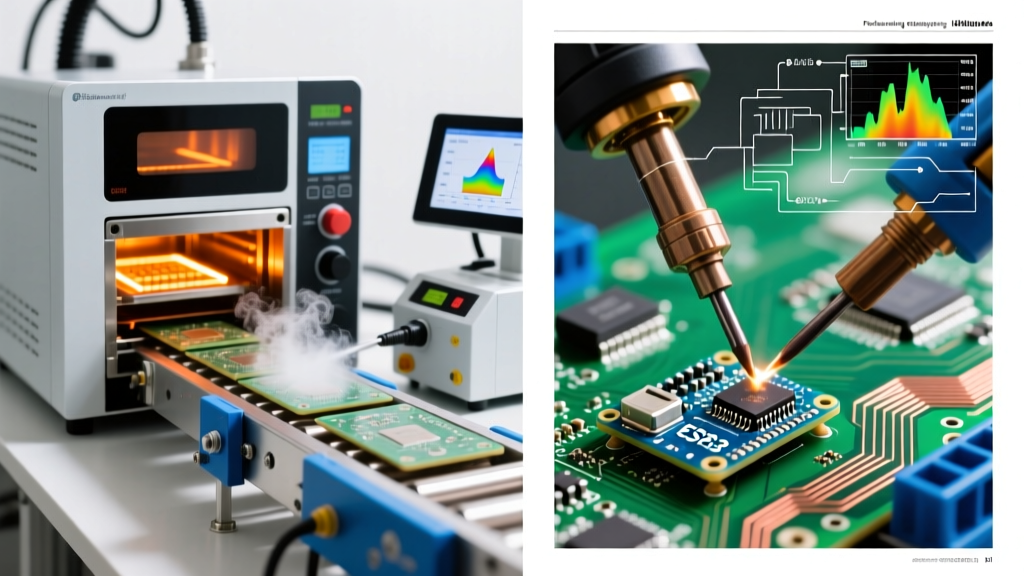
Batch ovens process multiple boards simultaneously in a single enclosed chamber. They rely on forced convection to circulate heated air. Modern 2026 models, such as the LPKF ProtoFlow S4 or Manncorp IR3000, feature integrated nitrogen purging and advanced thermocouple feedback loops.
- CapEx Range: $4,500 (Basic IR) to $14,000 (Convection + N2).
- Throughput: 10 to 50 boards per day.
- Best Application: R&D labs, university engineering departments, and low-volume/high-mix prototype runs.
- Edge Case Weakness: High thermal mass variations between boards in the same batch can lead to uneven heating, requiring conservative, extended thermal profiles that risk degrading moisture-sensitive components.
2. Inline Conveyor Reflow Systems
Inline systems move boards continuously through distinct thermal zones (preheat, soak, reflow, cooling). The industry workhorses—such as the Heller 1809 EXL (9-zone) or BTU Pyramax 150N—utilize high-velocity forced convection and precise edge-rail control.
- CapEx Range: $28,000 (Entry-level 5-zone) to $110,000+ (12-zone with vacuum and N2).
- Throughput: 500 to 5,000+ boards per day.
- Best Application: Mid-to-high volume production, automotive electronics, and continuous SMT lines.
- Edge Case Weakness: Requires strict conveyor speed synchronization with the pick-and-place machine. Chain lubrication maintenance is critical to prevent contamination.
3. Vapor Phase Soldering (VPS)
Vapor phase technology uses an inert heat transfer fluid (like Galden) heated to its exact boiling point (typically 230°C for SAC305 solder). The board is lowered into the vapor blanket, ensuring perfectly uniform heating regardless of component mass or color.
- CapEx Range: $18,000 (Batch VPS) to $45,000 (Inline VPS).
- Throughput: 20 to 200 boards per day.
- Best Application: High-reliability sectors (medical, aerospace), heavy copper PCBs, and complex 3D assemblies with severe thermal shadowing.
- Edge Case Weakness: Risk of 'solder balling' if moisture is trapped under components; requires strict adherence to NASA NEPP guidelines for moisture sensitivity level (MSL) baking prior to assembly.
Thermal Profiling Warning: No SMT soldering machine can compensate for a poorly designed thermal profile. In 2026, investing in a multi-channel wireless profiler (e.g., KIC X5 or Datapaq Q18) is mandatory. According to research published by the Surface Mount Technology Association (SMTA), over 68% of reflow defects are traced back to unoptimized soak zones rather than hardware failure.
The Decision Matrix: Matching Machine to Production
Use the following matrix to align your operational requirements with the correct SMT soldering machine architecture.
| Technology | Estimated CapEx | N2 Inerting Required? | Ideal Volume (Monthly) | Primary Failure Mode Mitigated |
|---|---|---|---|---|
| Batch Convection | $8k - $14k | Optional (but recommended) | < 1,000 boards | General cold joints via extended soak |
| Inline Convection (5-7 Zone) | $28k - $45k | Yes (for 0201/BGA) | 1,000 - 10,000 boards | Tombstoning via balanced preheat |
| Inline Convection (9+ Zone) | $65k - $110k | Yes (Mandatory) | 10,000+ boards | Head-in-Pillow (HiP) via precise TAL |
| Vapor Phase (Batch/Inline) | $18k - $45k | No (Inherently inert) | 500 - 5,000 boards | Thermal shadowing & voiding in BTCs |
Critical Failure Modes & Machine Mitigation Strategies
Understanding how specific machine architectures address metallurgical defects is crucial for your buying decision.
Head-in-Pillow (HiP) on Micro-BGAs
HiP occurs when the solder paste on the PCB pad and the BGA sphere melt but fail to coalesce, often due to oxide formation or warpage. Mitigation: A 9-zone inline conveyor oven with integrated nitrogen inerting (maintaining O2 levels below 500 ppm) prevents oxidation during the critical 60-second soak phase, allowing flux activators to clean the metallurgy before the peak reflow at 245°C.
Tombstoning on 01005 Passives
Tombstoning happens when one pad of a small passive reaches liquidus before the other, causing surface tension to pull the component upright. Mitigation: Machines with highly uniform lateral temperature distribution (±1.5°C across the conveyor width) and programmable multi-stage preheat zones ensure the entire board crosses the 183°C threshold simultaneously.
Voids in Bottom Terminated Components (BTCs)
QFNs and LGAs trap flux volatiles, creating voids that degrade thermal and electrical conductivity. Mitigation: Advanced 2026 inline systems now feature vacuum reflow chambers (e.g., Heller 1809V). By pulling a vacuum immediately after the solder reaches liquidus, trapped gases are extracted, reducing voiding from 25% to under 2%.
Hidden Costs of Ownership (Total Cost of Ownership)
The sticker price of an SMT soldering machine is only the beginning. Process engineers must budget for the following operational expenditures:
- Nitrogen Generation: If your facility lacks a bulk liquid N2 supply, an on-site PSA nitrogen generator will cost between $9,000 and $16,000, plus $2,500 for installation and air compressor upgrades.
- Vapor Phase Fluid: Galden HT240 fluid costs approximately $180 per liter. While modern condensation coils recover most vapor, drag-out on PCBs and periodic maintenance will cost roughly $1,200 annually in fluid replacement.
- Flux Management (Inline): Volatile flux residues coat convection blowers and exhaust ducts. High-end machines require automated flux management systems (FMS) and water-cooled traps, which add $4,000 to the initial BOM and require quarterly maintenance.
- Power Consumption: A 9-zone convection oven running at 250°C with N2 and blowers draws roughly 18-25 kW. At industrial electricity rates, expect $600–$900 per month in continuous energy costs.
Final Verdict: Which SMT Soldering Machine Fits Your Line?
If you are an R&D facility iterating on IoT prototypes with mixed component masses, a Vapor Phase system offers the most forgiving thermal envelope without requiring complex profiling. For high-mix, medium-volume EMS providers, a 7-zone inline convection oven with nitrogen strikes the optimal balance between CapEx and throughput. However, if you are manufacturing high-density computing modules, automotive radar, or Class 3 medical devices with heavy ground planes and micro-BGAs, the investment in a 9-to-12-zone vacuum-capable inline convection system is non-negotiable to ensure long-term field reliability and IPC compliance.